

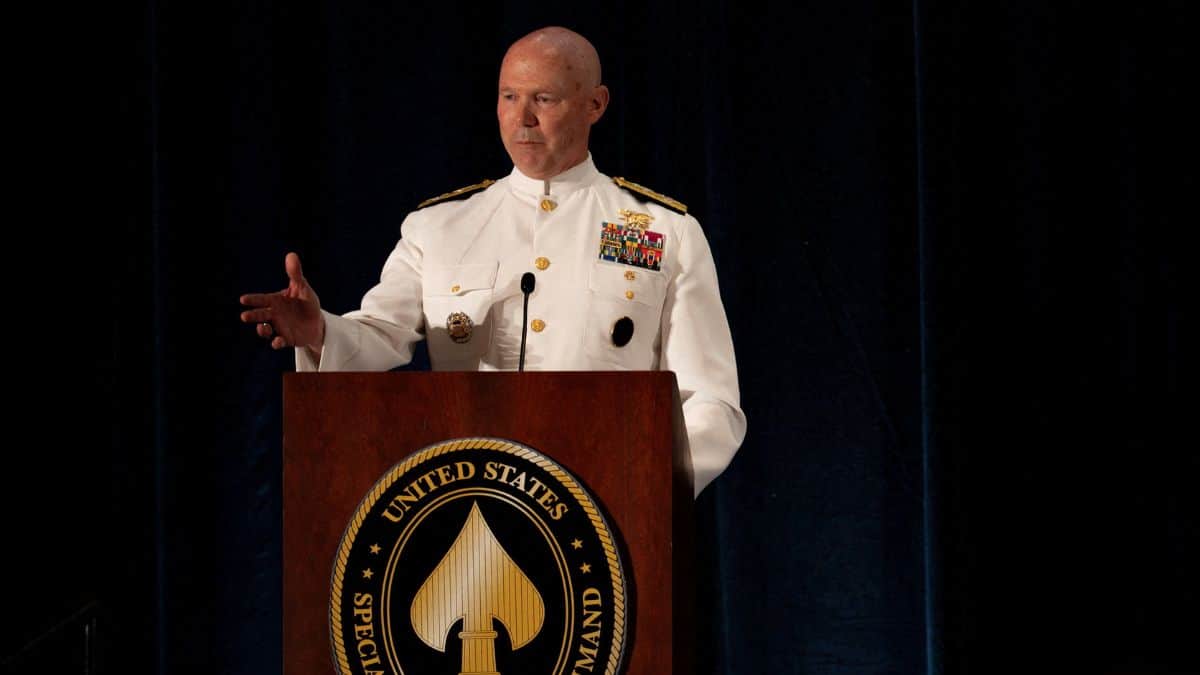
United States Navy Admiral Frank M Bradley, the senior special operations officer who directed the second strike on a burning vessel off the coast of Trinidad and Tobago on September 2 finds himself in the middle of a firestorm in Washington.
The operation — part of the Trump administration’s push to dismantle drug-smuggling networks linked to Venezuela — resulted in the deaths of two survivors who were clinging to the wreckage after the initial missile strike.
STORY CONTINUES BELOW THIS AD
Since the Washington Post disclosed that US Defence Secretary Pete Hegseth had verbally
instructed the military to “kill everybody,” Bradley’s decision-making has been under bipartisan examination.
More from Explainers
Meanwhile, senior officials in the White House and Pentagon insist the admiral acted within established military authorities.
What happened in the September 2 op?
The events of 2 September were part of a wider series of US missions targeting suspected narcotics-carrying boats transiting Caribbean waters.
These operations are designed to halt drug flows the Trump administration argues are directly tied to violent criminal networks and to
the government of Venezuelan President Nicolás Maduro.
According to multiple official accounts, the first missile launched that day struck the vessel and immediately engulfed it in flames.
Hegseth said he personally watched this initial attack unfold. “I watched that first strike live,” he said during a Cabinet meeting, seated beside US President Donald Trump.
He explained that after observing the first engagement, he left for another scheduled meeting, noting, “At the Department of War we’ve got a lot of things to do, so I didn’t stick around…I moved on to my next meeting.”
It was only later that day that Hegseth was updated that Bradley — then the head of Joint Special Operations Command (JSOC) — had authorised a second strike intended to finish the destruction of the vessel.
STORY CONTINUES BELOW THIS AD
Hegseth later affirmed his support for Bradley’s call, stating, “Admiral Bradley made the correct decision to ultimately sink the boat and eliminate the threat.”
Witnesses monitoring the operation via drone feed spotted two individuals alive on the remnants of the vessel after the initial explosion and fire.
As reported by the Washington Post, the second missile was fired after Bradley, using a secure communications link, ordered the follow-up strike.
This decision, according to sources cited by the news outlet, was premised on fulfilling what they described as Hegseth’s earlier verbal directive “to kill everybody.”
The administration has since emphasised that Bradley was authorised to proceed. White House press secretary
Karoline Leavitt told reporters, “Adm. Bradley worked well within his authority and the law to ensure the boat was destroyed and the threat to the United States of America was eliminated.”
How have Pentagon & White House responded?
As questions grew louder about who was responsible for the second strike, administration officials shifted attention toward Bradley’s command role while defending his conduct.
Kingsley Wilson, the Pentagon’s press secretary, placed the responsibility solely with the admiral, saying the strike was a product of Bradley’s operational authorities and was executed “to ensure the boat was destroyed and the threat to the United States was eliminated.”
STORY CONTINUES BELOW THIS AD
He also stated that Hegseth “stands behind Admiral Bradley, 100%.”
The comments reflected a coordinated message from senior officials, even as they attempted to distance Hegseth from the more controversial aspects of the decision-making.
Leavitt repeated that Hegseth authorised Bradley to conduct the kinetic strikes, but stressed Bradley “directed the engagement” itself.
Hegseth, for his part, insisted publicly that he did not personally see survivors at the time he was watching the first strike. “I did not personally see survivors,” he said. “That thing was on fire…This is called the fog of war.”
He later defended the overall operation, saying, “We’ve only just begun striking narco boats and putting narco terrorists at the bottom of the ocean.”
In a social-media post late Monday, he offered an emphatic endorsement of Bradley, writing, “Let’s make one thing crystal clear: Admiral Mitch Bradley is an American hero, a true professional, and has my 100% support. I stand by him and the combat decisions he has made — on the September 2 mission and all others since. America is fortunate to have such men protecting us. When this [Department of War] says we have the back of our warriors — we mean it.”
STORY CONTINUES BELOW THIS AD
Despite these repeated assurances, the narrative has been complicated by Trump’s own comments. Speaking to reporters aboard Air Force One two days before Hegseth’s public remarks, Trump said he did not know whether the second strike had actually occurred and suggested he would not have wanted it.
“No. 1, I don’t know that that happened,” he said. When asked whether a second strike would be unlawful, he answered, “The first strike was very lethal, it was fine, and if there were two people around. But [Hegseth] said that didn’t happen. I have great confidence in him.”
Trump added that Hegseth denied ordering the deaths of the survivors, “Pete said he did not order the death of those two men.”
How has US Congress reacted?
The second strike has triggered substantial bipartisan concern on Capitol Hill, prompting several committees — including both the House and Senate Armed Services Committees — to launch formal investigations.
These inquiries aim to determine whether the administration’s counter-narcotics campaign and its use of lethal force comply with US law, military rules of engagement, and international humanitarian norms.
Lawmakers also want to establish whether Hegseth’s really did issue a “kill everybody” directive, how it was interpreted by commanders, and whether it framed Bradley’s choice to target the two survivors.
STORY CONTINUES BELOW THIS AD
US Senator Mark Warner, a senior member of the Senate Intelligence Committee said the committee will hear directly from Bradley in a classified briefing and is already working with Republican Senator Tom Cotton on preliminary discussions.
Warner stated the need for clarity, “We’ve got to get to the bottom of this,” he said, adding that an unedited video recording of the strike would help determine “whether these individuals were in the water, on the boat, still combatants or not.”
Warner also raised concerns about the risks posed to American military personnel deployed in the region, saying he needed to ensure none of his constituents from Norfolk, Virginia, were being placed in “unsafe or illegal positions.”
US Senator Chris Murphy sharply criticised the administration’s efforts to pin responsibility on Bradley.
“He is selling out Admiral Bradley and sending chills down the spines of his chain of command, who now know their boss will sell them out if he is taking heat,” he said. “A case study in how not to lead.”
STORY CONTINUES BELOW THIS AD
A classified opinion from the Justice Department’s Office of Legal Counsel reportedly frames the operations as targeting cocaine — not individuals — meaning fatalities are viewed as the destruction of enemy materiel rather than unlawful killings.
This rationale diverges significantly from Trump’s public argument that the strikes are intended to prevent overdoses by halting drug shipments.
The concerns in Congress have been partly triggered by the scale of the campaign. The Pentagon has acknowledged that since the start of this new