

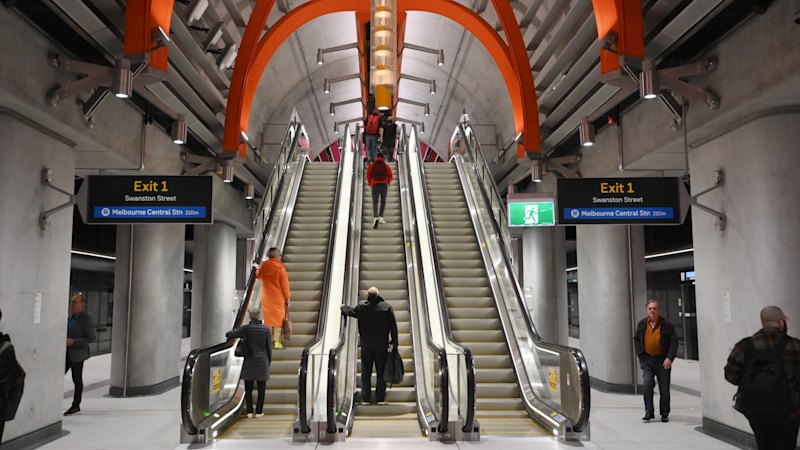
Each station also has accessible toilets, parents’ rooms and adult changing place facilities. A Travellers Aid hub at Parkville will open soon and help passengers get between the station and nearby hospitals. Stations could do with more seating, though.
Good: Architecture and design The Arden station entrance features massive concrete arches lined with more than 100,000 hand-laid bricks, reflecting North Melbourne’s rich industrial history. Credit: Justin McManus
It’s hard not to be impressed walking through the five new underground stations.
High ceilings and wide platforms create a sense of space and openness that is a world away from their grubby City Loop counterparts.
Arden station’s redbrick arches will surely become one of the city’s architectural landmarks.
The coupling of raw concrete – most impressively in State Library station’s arched entrance – with Art Deco-inspired lighting and fixtures reflects the city above it. It feels undeniably Melbourne.
Signage is clear, and the connections between CBD interchange stations are intuitive to follow.
There are escalators galore – including a wall of five at the State Library entrance – to avoid the passenger congestion experienced at other CBD stations, and provide redundancy during breakdowns (looking at you, Southern Cross).
Bad: Deja vu The quiet State Library station on Monday morning. Credit: Justin McManus
The platforms at Town Hall and State Library look nearly identical – especially on board an arriving train.
And because not every concrete column on the platform is signed, it might not be obvious which station you are arriving at.
Making the two stations distinct was a missed opportunity to explore different design ideas while making life easier for commuters.
Good and bad: Anzac tram interchange The canopy at Anzac isn’t up to the job. Credit: Wayne Taylor
Anzac station’s integrated tram stop w
Read More