

When Prime Minister Narendra Modi and Russian President Vladimir Putin met at Hyderabad House, Modi opened the dialogue by articulating, once again, India’s clearly defined position on the Ukraine conflict.
“India is not neutral — India has a position, and that position is for peace,” he
told Putin as summit talks began on Friday.
Modi also stated “We support every effort for peace, and we stand shoulder to shoulder with every initiative taken for peace.”
STORY CONTINUES BELOW THIS AD
Putin arriving in New Delhi for the 23rd India-Russia Annual Summit has highlighted India’s approach to the biggest war in Europe since World War II.
New Delhi’s simultaneous engagement with Moscow, Kyiv, and Washington has positioned it as one of the only global actors capable of sustaining dialogue with all parties involved in the war.
More from Explainers
Putin’s visit is his
first to India since February 2022 while bring under tightened Western sanctions and US tariff pressure.
With red carpets rolled out and military honours accorded, India signalled that its relationship with Moscow remains essential, even as Western pressure intensifies.
Responding to Modi’s remarks, Putin acknowledged India’s role and his discussions with New Delhi over the conflict.
“We had the opportunity – and you gave me that opportunity – to speak in detail about what is happening on the Ukrainian track and about the steps we are taking jointly with some other partners, including the United States, toward a possible peaceful settlement of this crisis.”
He added that Russia intends to expand cooperation with India across advanced technologies, saying, “New areas are emerging – high technologies, joint work in aviation, space, and artificial intelligence. We have a very trusting relationship in the field of military-technical cooperation, and we intend to move forward in all these areas.”
STORY CONTINUES BELOW THIS AD
How India played the peace card
Since the war began in 2022, India’s stance has shifted from guarded neutrality to vocal advocacy for a diplomatic settlement.
Modi reiterated, during the joint appearance with Putin, that “war cannot solve problems” repeating the substance of statements he has made consistently since the outbreak of hostilities — often framed around his remark to Putin at Samarkand in 2022
that “this is not an era of war.”
India’s diplomatic engagement came the the fore in 2024 when Modi became one of the few leaders to engage at the highest levels with both Moscow and Kyiv within weeks.
When Modi visited Moscow in July 2024
In July 2024, Modi travelled to Moscow for the 22nd India-Russia Annual Summit — his first trip to the country since the conflict began. Far from symbolic, the visit focused on energy security and defence preparedness, areas that remain central to India’s national interests.
However, the optics triggered immediate criticism from Western governments and Kyiv.
The backlash also increased because the meeting coincided with a deadly missile strike on a children’s hospital in the Ukrainian capital.
Ukrainian President Volodymyr Zelenskyy described the Moscow visit as a “devastating blow to peace efforts.”
Yet New Delhi maintained that the meeting was essential for safeguarding India’s longstanding military ties and ensuring stable energy supplies in an unpredictable global market.
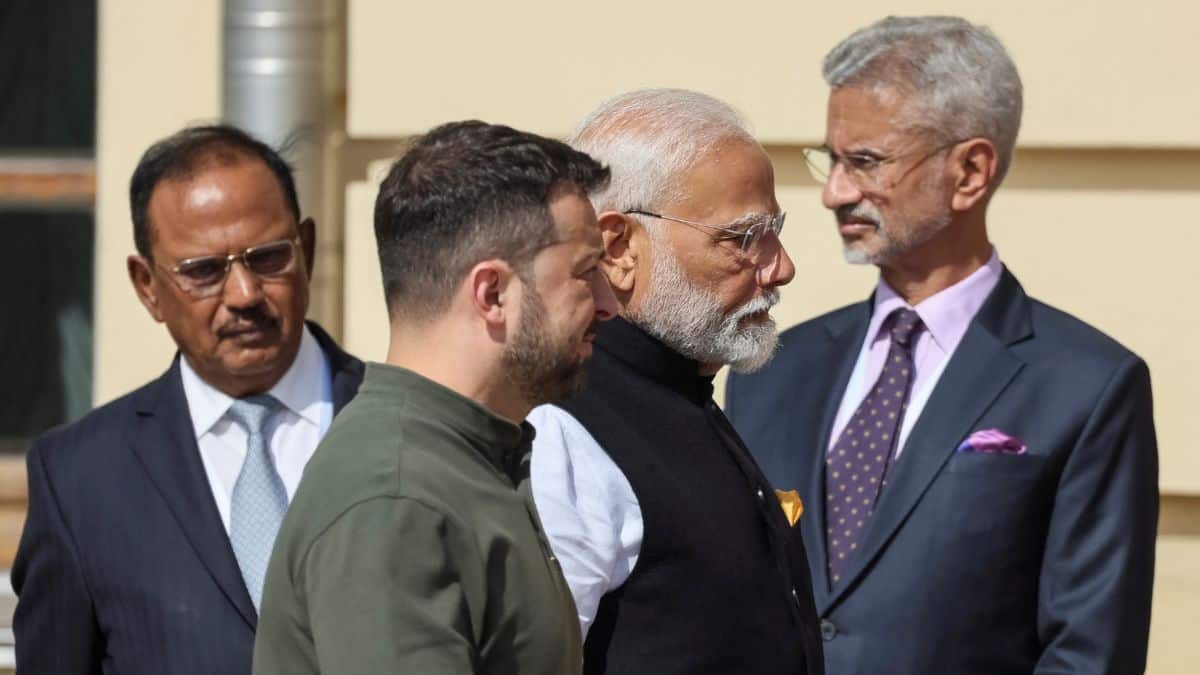
When Modi visited Kyiv in August 2024
Six weeks after Moscow, Modi took an unprecedented step
by visiting Kyiv on August 23, 2024 — making him the first Indian Prime Minister ever to set foot in Ukraine.
Travelling via the special “Rail Force One” service, he joined Ukrainian leaders at the Martyrologist Exposition to honour children killed in the conflict.
STORY CONTINUES BELOW THIS AD
During the visit, he made one of the clearest articulations of India’s diplomatic identity, stating, “We were not neutral from day one; we have taken a side, and we stand firmly for peace.”
This visit delivered measurable commitments. India
handed over BHISHM (Bharat Health Initiative for Sahyog Hita and Maitri) trauma-care medical units designed for battlefield casualties, strengthening humanitarian assistance efforts.
Four agreements were signed covering cooperation in agriculture, healthcare, and culture, making the trip a substantial step in broadening India-Ukraine ties.
Modi’s presence in Kyiv so soon after meeting Putin signalled that India intended to position itself as an honest broker capable of engaging both sides.
During the visit, Modi also told Zelenskyy, “If I can personally contribute to this [peace process], I would like to do so.”
Indian National Security Advisor Ajit Doval even visited Moscow in September carrying a message from Zelenskyy for Putin, while also telling the latter about Modi’s visit to Ukraine.
STORY CONTINUES BELOW THIS AD
How India drew the ire of Trump-led US
As Europe drastically reduced its dependence on Russian oil, India stepped in to buy seaborne Russian crude at discounted prices.
These purchases surged after 2022, making India one of Russia’s largest energy customers.
External Affairs Minister S Jaishankar defended India’s imports by explaining that ensuring affordable energy was a responsibility to Indian consumers.
However, this surge came with repercussions as India-Russia trade reached a record $68.7 billion in the previous fiscal year, but the imbalance grew significantly due to India’s heavy oil imports and limited Indian exports to Russia.
Moscow has publicly stated its intention to import more Indian goods and raise bilateral trade to $100 billion by 2030.
Earlier this year, United States President Donald Trump
introduced new tariffs on nations accused of “abusing” trade relationships or aiding Russia’s efforts to bypass sanctions. These tariff hikes compelled India to reduce its imports of Russian crude.
Why India won’t sever ties with Moscow
India’s refusal to condemn Russia at international forums has frequently been interpreted by Western governments as a sign of passive alignment with Moscow.
However, Indian officials have repeatedly clarified that Delhi’s calculations stem from security, geography, and strategic necessity.
Russia has been India’