

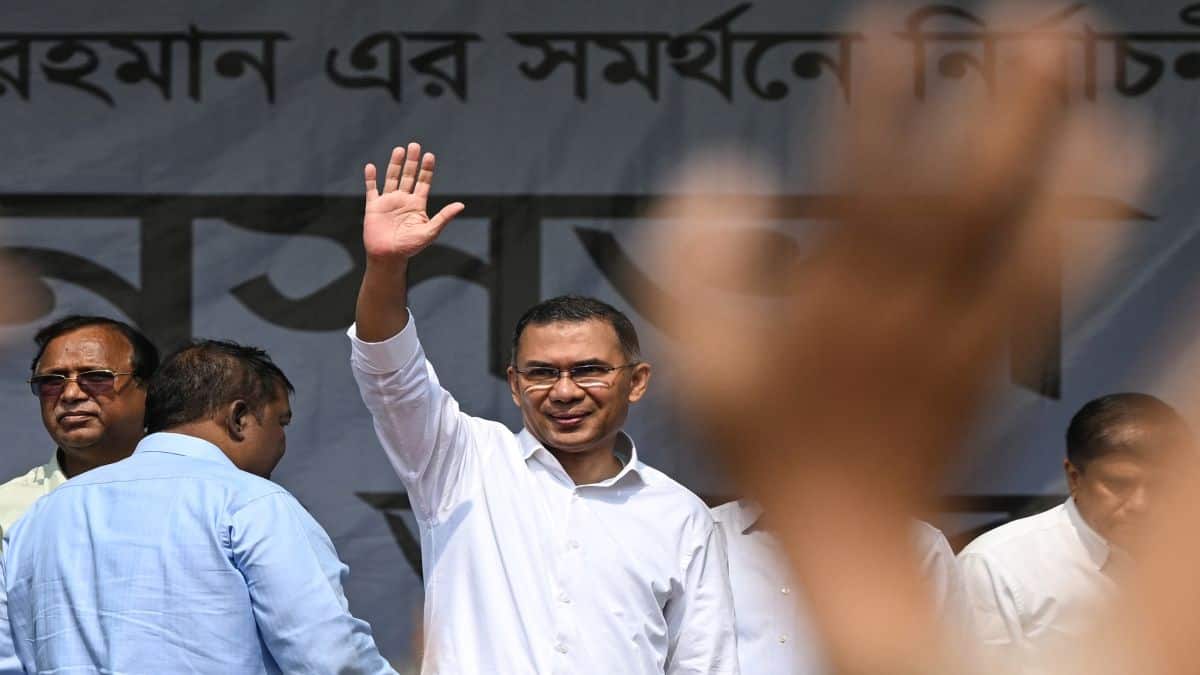
It’s a momentous day in Bangladesh. Eighteen months after a Gen-Z revolt ousted Sheikh Hasina from power — she fled the country and has been in India ever since — the South Asian nation is going to the polls in what is being dubbed as the first properly free and fair election in more than a decade.
About
127 million registered voters are eligible to cast votes to elect 350 members of the Jatiya Sangsad, the country’s parliament. This time around, the two main blocs competing in the polls are the Bangladesh Nationalist Party (BNP), led by Tarique Rahman, and the Jamaat-e-Islami (JIB), which heads an 11-party alliance, including the National Citizen Party, a group formed by students who led the anti-Hasina movement in 2024.
STORY CONTINUES BELOW THIS AD
Meanwhile, Sheikh Hasina’s Awami League, which dominated Bangladeshi politics for decades, has been barred from fielding candidates.
Previous opinion polls and surveys have suggested that the BNP is set for a victory in today’s election. If that’s the case, it would mark a stunning reversal of fortune for Rahman, the soft‑spoken 60‑year‑old who left the country in 2008.
- Catch live updates from
Bangladesh election voting here
The rise of Tarique Rahman
Tarique Rahman is the eldest son of former Bangladesh President Ziaur Rahman and three-time
Prime Minister Khaleda Zia. His father, General Ziaur Rahman, founded the BNP on September 1, 1978. He also played a major role in Bangladesh’s liberation and set up the first civil administration in Roumari, a region that was reclaimed from Pakistani forces.
Rahman studied international relations at the University of Dhaka, dropped out, and later started businesses in textiles and agro‑products.
In his mother’s third term as prime minister, between 2001 and 2006, Rahman was often referred to as ‘dark prince’. Moreover, he was believed to be the de facto boss, with many even noting that he ran a ‘shadow PMO’ out of Hawa Bhaban.
In 2007, Rahman was arrested by the caretaker government and held for 17 months on various charges. He was convicted in absentia on multiple charges, including money laundering, as well as a case linked to the alleged plot to assassinate Hasina.
The following year, he fled Bangladesh and moved to the United Kingdom, stating that he needed medical treatment. He was in the UK until December 2025.
The prodigal son returns
When
Rahman returned to Bangladesh last December, along with his wife, Zubaida, and daughter, Zaima, he received a hero’s welcome. For Rahman, the return was laden with emotions. As he told The Times, “It’s emotional that I could — and I have — come back to my people.”
However, just five days later, his mother, Bangladesh’s first female Prime Minister Khaleda Zia, passed away following a long illness. “It’s very heavy in my heart,” said Rahman, eyes welling. “But the lesson I learned from her is that when you have a responsibility, you must perform it.”
STORY CONTINUES BELOW THIS AD
Following Zia’s funeral, Rahman formally assumed office as the chairman of the BNP. Previously, he served as the acting chairman of the BNP.
Since then, Rahman has been rallying far and wide for the BNP. “We will build a Bangladesh that a mother dreams of,” he said, calling on citizens from the hills and plains – Muslims, Hindus, Buddhists, and Christians – to join him in creating a secure and inclusive nation.
In election rallies, he has pledged to improve the country’s infrastructure, among other promises. “If elected, the healthcare system will be improved, a flyover will be constructed in Sherpur, permanent embankments will be built in the river erosion areas of Dhunat, and the youth will be made self-reliant through the establishment of IT education institutions,” he noted.
Moreover, he promises a transformed economy valued at $1 trillion by 2034 and jobs for 10 million in five years. His foreign policy also focuses on strategic autonomy.
STORY CONTINUES BELOW THIS AD
Many analysts note that since his return to Bangladesh, Rahman has utilised his mother’s name and played to the personality cult surrounding her legacy as the first female prime minister, as well as that of his father.
But Rahman refutes that claim, saying that he’s the right person to rule the country. “It’s not because I’m the son of my father and mother,” he was quoted as telling TIME magazine. “My party supporters are the reason why I’m here today.”
Political watchers have also observed that during the campaigning, the 60-year-old BNP chief has tried to project himself as a statesman. No longer is the brash man of 2001-2006 visible. And to further this softening of image, there is the family cat —
Jebu.
But Rahman’s road to power is rocky
Despite all his efforts, Rahman faces several challenges and the baggage of the past to contend with. While he has tried to move past his previous image of being brash, many still refer to him as Khamba Tarique, referring to an alleged corruption scandal whereby thousands of electricity poles, or khamba, were reportedly bought from an associate at inflated prices but never connected to the grid.
There’s also the matter of being away from Bangladesh so lo