

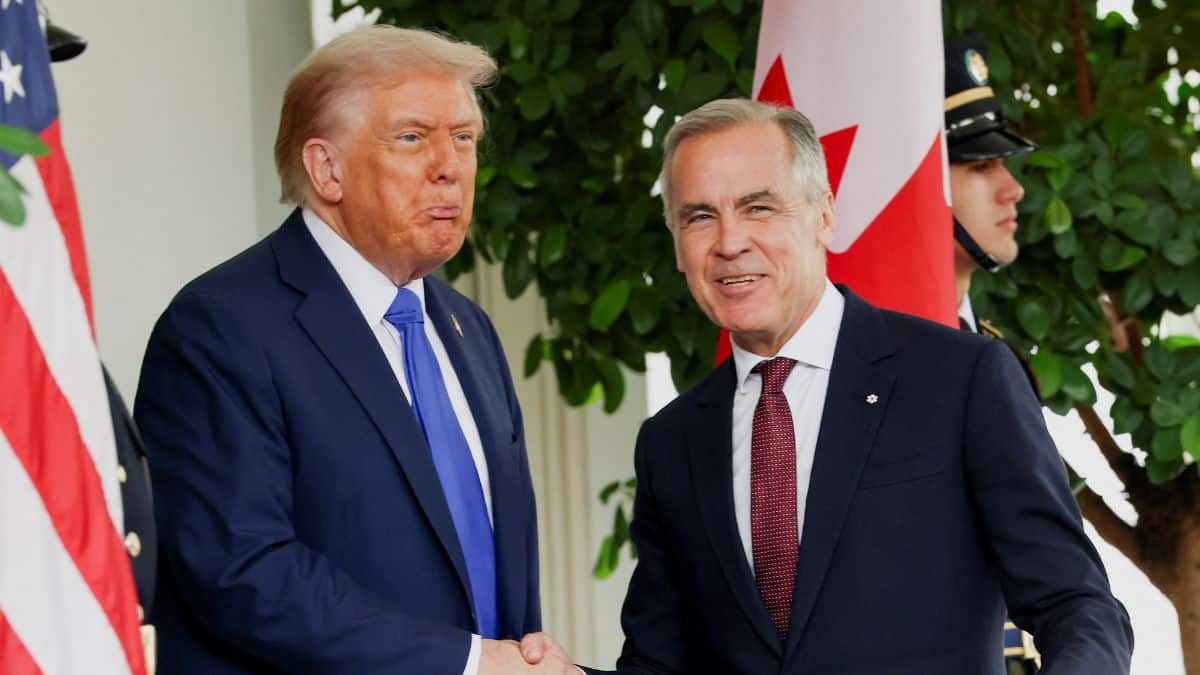
Canada, just like many other nations, breathed a sigh of relief after the US Supreme Court struck down the reciprocal tariffs proposed by US President Donald Trump last year.
Canada, just like many other nations, breathed a sigh of relief after the
US Supreme Court struck down the reciprocal tariffs proposed by US President Donald Trump last year. The apex court tossed the tariffs proposed under the International Emergency Economic Powers Act, or
IEEPA, which also included the
“fentanyl” tariffs Trump imposed on Canada, China and Mexico.
The decision reinforced Canada’s position that the levies were “unjustified”,
US-Canada Trade Minister Dominic LeBlanc said on X, formerly known as Twitter. However, LeBlanc also pointed to the challenges ahead in Ottawa. There is the “critical work” to do in dealing with impacts from levies on steel, aluminium and automobiles, which Trump said will remain.
STORY CONTINUES BELOW THIS AD
The ruling also came at a time when the upcoming review of the Canada-US-Mexico trade deal, the
USMCA, is on the cards. The deal covers a market of more than 500 million people. However, it is pertinent to note that the actual impact of the Supreme Court decision on Canadian tariffs is limited.
The trade tussle between Canada and the US
Last year, the Trump administration imposed 25 per cent tariffs on Canada and later raised them to 35 per cent. At that time, Trump argued that both Canada and Mexico must do more to stop migrants and the illegal drug fentanyl from reaching the US.
The vast majority of trade, some 85 per cent, under these “fentanyl” tariffs was already levy-free under a USMCA exemption. Meanwhile, LeBlanc’s office declined to comment on the Trump administration’s latest decision to impose a 15 per cent global tariff to replace the duties imposed under the International Emergency Economic Powers Act, or IEEPA, which the Supreme Court struck down.
The
White House official clarified that the USMCA exemption will continue under the new 15 per cent tariff, BBC reported. In his post on TruthSocial, Trump increased the tariff from 10 to 15 per cent. Beyond the remaining US tariffs on sectors like steel and automobiles, the biggest issue for Canada on its US trade agenda is the
USMCA review.
This summer, all three parties are expected to sit together and decide whether to extend the deal, which was negotiated during Trump’s first term. It is significant because a North American free trade deal has been in place in some form since the early 1990s, and has led to deeply integrated economies.
STORY CONTINUES BELOW THIS AD
During his visit to Mexico this week,
LeBlanc told reporters that both countries “remain absolutely committe