

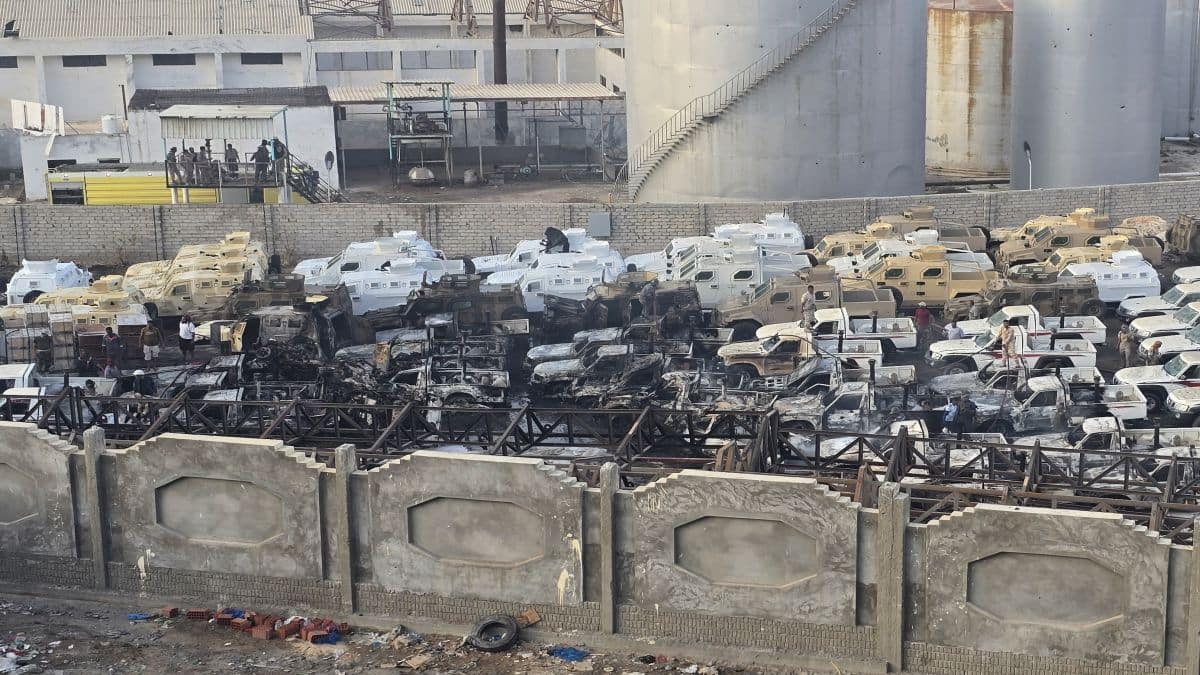
They used to be considered the twin pillars of regional security in the Gulf region. Now, both United Arab Emirates (UAE) and Saudi Arabia are facing off against one another in Yemen.
On Tuesday (December 30), the
UAE said it was pulling out its forces from Yemen after Saudi bombed the country’s port city of Mukalla following accusations that two ships from UAE had delivered weapons and combat forces to separatist forces.
STORY CONTINUES BELOW THIS AD
This was considered by many as shocking as the UAE was part of a Saudi-led coalition fighting the Iran-backed Houthis, who govern most of Yemen.
So, what exactly is going on? And what could happen next? We get you all the answers.
Air strikes in Yemen’s Mukalla
It all began on Tuesday morning when
Saudi forces launched an airstrike on what it said was an arms shipment bound for a group of Yemeni separatists — known as the Southern Transitional Council (STC) — who are backed by the UAE and control parts of southern Yemen.
According to Brigadier General Turki al-Malki, a Saudi military official, the ships were carrying arms were intended for the STC. According to a Saudi military statement, the ships had arrived from Fujairah in the UAE.
“The ships’ crew had disabled tracking devices aboard the vessels, and unloaded a large amount of weapons and combat vehicles in support of the STC’s forces,” the statement said.
“Considering that the aforementioned weapons constitute an imminent threat, and an escalation that threatens peace and stability, the Coalition Air Force has conducted this morning a limited airstrike that targeted weapons and military vehicles offloaded from the two vessels in Mukalla,” it added.
It wasn’t clear if there were any casualties in the strikes but residents around the Mukalla port reported damage to their houses.
Following the strikes, the UAE asserted that the shipment neither carried any weapons nor was it intended for any Yemeni group. It further stated that Saudi Arabia knew about the shipment ahead of time.
STORY CONTINUES BELOW THIS AD
Later, the Emirati Defence Ministry said it carried out a “comprehensive assessment” of its role in Yemen and decided to end its mission there.
“In light of recent developments and their potential implications for the safety and effectiveness of counterterrorism missions, the Ministry of Defence announces the termination of the remaining counterterrorism personnel in Yemen of its own volition, in a manner that ensures the safety of its personnel,” the UAE statement said.
Notably, the military action by Riyadh came after a speech by the head of Yemen’s Presidential Council Rashad Al Olimi, a body backed by Saudi Arabia, who accused the UAE of “directing” forces to “rebel against the state authority” and “escalating militarily” in the country.
“The Kingdom stresses that any threat to its national security is a red line, and the Kingdom will not hesitate to take all necessary steps and measures to confront and neutralise any such threat,” read a statement by the Saudi Foreign Ministry.
STORY CONTINUES BELOW THIS AD
The STC and UAE’s ‘support’ of it
At the heart of the tensions between the UAE and Saudi is the Southern Transitional Council (STC), the most powerful group in southern Yemen, which is also at odds with Yemen’s Presidential Council.
It was established in April 2017 as an umbrella organisation for groups that seek to restore
South Yemen as an independent state, as it was between 1967 and 1990. They now control almost all of South Yemen’s former territory, whereas the
Iran-backed Houthis control power in north Yemen.
As Gregory D Johnsen, a non-resident fellow at the Arab Gulf States Institute, wrote in a recent analysis, “The STC is betting that if the south can be united under a single leadership — its own, of course — it can cordon the south off from the Houthis in the north, utilise oil and gas revenue, and create a stable and functioning state.”
However, such a move “is a tall order, and it will likely be contested both internally and externally,” Johnsen added.
The STC, reportedly backed by the UAE, controls key territory in the south, including Aden, and commands armed forces known as the Southern Armed Forces. Recently, the STC forces marched to Hadramout and took control of the province’s major facilities, including PetroMasila, Yemen’s largest oil company, after brief clashes with government forces and their tribal allies.
STORY CONTINUES BELOW THIS AD
This took place after the Saudi-backed Hadramout Tribal Alliance seized the PetroMasila oil facility in late November to pressure the government to agree to its deman