

Special Operations Command pushed back on the contention that Adm. Frank Bradley ordered a double-tap attack when the U.S. military conducted a second strike killing survivors of the September 2 boat attack in the Caribbean, first reported by The Intercept.
“He does not see his actions on 2 SEP as a ‘double tap,’” Col. Allie Weiskopf, a Special Operations Command spokesperson told The Intercept on Tuesday in response to questions about the follow-up attack.
In military jargon, the term “double tap” — which has no legal or doctrinal meaning — typically refers to a follow-on strike to kill rescuers or first responders. Such attacks have been carried out by U.S. forces in conflicts including the drone wars in Pakistan, Somalia, and Yemen. Israel has carried out double-tap strikes in its most recent war on Gaza, targeting journalists and rescue efforts.
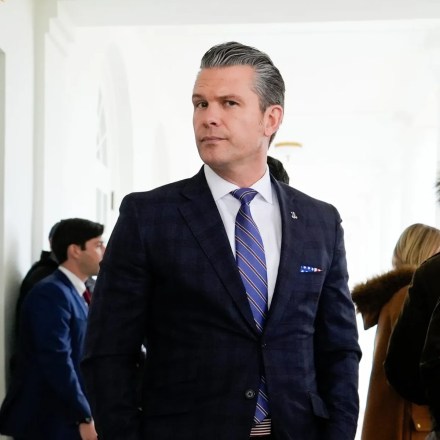
Secretary of War Pete Hegseth acknowledged U.S. forces conducted a follow-up strike on the alleged drug boat during a Cabinet meeting at the White House on Tuesday, but distanced himself from the killing of individuals clinging to the wreckage. “I didn’t personally see survivors,” Hegseth told reporters, noting that he watched live footage of the attack. “The thing was on fire. It was exploded in fire and smoke. You can’t see it.” He added, “This is called the fog of war.”
Hegseth said Bradley — then the commander of Joint Special Operations Command and now head of Special Operations Command — “made the right call” in ordering the second strike after Hegseth allegedly left the room.
The statements from Hegseth and Special Operations Command on Tuesday mark an evolution in the Pentagon’s response to the killings. But several government officials and experts on the laws of war said messaging focusing on technical definitions misses the reason this strike has drawn widespread condemnation.
“Quibbling over the semantics of ‘double-tap’ doesn’t change the reality that the strike was a summary execution of men clinging to the remains of a boat,” Sarah Harrison, who advised Pentagon policymakers on issues related to human rights and the law of war in her former role as associate general counsel at the Pentagon’s Office of General Counsel, International Affairs, told The Intercept.
The military has carried out 21 known attacks, destroying 22 boats in the Caribbean Sea and eastern Pacific Ocean since September, killing at least 83 civilians. Since the attacks began, experts in the laws of war and members of Congress, from both parties, say the strikes are illegal extrajudicial killings because the military is not permitted to deliberately target civilians — even suspected criminals — who do not pose an imminent threat. In the long-running U.S. war on drugs, suspected smugglers have been arrested by law enforcement rather than subjected to summary execution.
The multiple strikes on September 2 added a second layer of illegality to attacks that experts and lawmakers say are already tantamount to murder. “Persons who have been incapacitated by wounds, sickness, or shipwreck are in a helpless state, and it would be dishonorable and inhumane to make them the object of attack,” reads the Pentagon’s Law of War Manual.
Weiskopf did not respond to other questions by The Intercept. “ADM Bradley looks forward to briefing Congress on your questions. He will do this on Thursday,” she wrote in an email.
Capitol Hill staffers say that Bradley is currently slated to only meet with the House Armed Services Committee Chair Mike Rogers, R-Ala., and ranking member Adam Smith, D-Wash., and the Senate Armed Services Committee Chair Roger Wicker, R-Miss., and ranking member Sen. Jack Reed, D-R.I.