

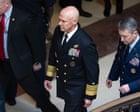
Top Navy admiral briefs lawmakers on ‘double-tap’ strike on suspected drug boats Adm Frank “Mitch” Bradley arrived on Capitol Hill earlier today to discuss the “double-tap” boat strike on suspected drug boats off the coast of Venezuela with the House and Sentate armed services committees. The top Navy official spoke to lawmakers alongside the chairman of the Joint Chiefs of Staff, Dan Cain.
Representative Jim Himes, the top Democrat on the House intelligence committee, gaggled with reporters after Bradley’s classified briefing.
“What I saw in that room was one of the most troubling things I’ve seen in my time in public service,” he said, according to CNN’s Manu Raju.
Himes added that Bradley did confirm “there had not been a ‘kill them all’ order, and that there was not an order to grant no quarter”.
Adm Frank Bradley, accompanied by general Dan Caine, walks to a meeting with lawmakers on Capitol Hill. Photograph: Mark Schiefelbein/AP Key events
Show key events only Please turn on JavaScript to use this feature
Suspect named in January 6 pipe bomb case – report A suspect has been named in the pipe bomb case that targeted the Republican and Democratic party headquarters in Washington DC, on the night before the January 6 insurrection.
The Associated Press is reporting, citing three unnamed sources familiar, that Brian Cole has been identified as the alleged perpetrator. Two of the AP’s sources said that Cole is from suburban Woodbridge, Virginia. No other details were immediately available, including the charges the suspect might face.
Signalgate report concludes Hegseth violated internal defense department instructions by using personal phone The inspector general concluded that Hegseth had sent “sensitive, nonpublic, operational information” to the Signal chat from his personal cell phone “that he determined did not require classification” before he sent it.
The report acknowledges that Hegseth “holds the authority to determine the required classification level of all DoD information he communicates”. But it does not say whether or not he did so in this instance.
It finds that his actions violated an internal defense department instruction that prohibits “using a personal device for official business and using a non-approved commercially available messaging application to send nonpublic DoD information”.
According to the report, in Hegseth’s statement he acknowledged the email briefing he had received about upcoming war plans on 14 March from the US Central Command.
He also stated that as defense secretary “he has authority to decide whether information should be classified and whether classified materials no longer require protection”.
Hegseth also said that he had taken “‘non-specific general details” that he determined “were either not classified or that he could safely declassify and use to create an ‘unclassified summary’ to provide to the Signal chat participants”.
Further, Hegseth refused to be interviewed in person, and instead provided a written statement on 25 July, more than four months after the incident.
According to the report, the Department of Defense provided only “a partial copy of messages from the Secretary’s personal cell phone, including some messages that The Atlantic previously reported, but other messages had auto-deleted because of chat settings”.
That meant the inspector general had to rely in part on a transcript of those messages published by The Atlantic for a full record.
The report finds that Hegseth “sent a message containing operational information to members of the ‘Houthi PC Small Group’ Signal chat” at 11.44pm on 15 March.
It finds that some of the information the secretary of defense sent from his personal cell phone on Signal matched the operation information in the aforementioned email (see my last post).
It also found that he did so from his residence at Fort McNair in Washington in the presence of “his junior military assistant and his personal communicator”.
DoD inspector general releases report into Hegseth Signalgate furor The Department of Defense’s inspector general has released the much-anticipated report this morning about Pete Hegseth’s disclosure of plans for military airstrikes in Yemen in a Signal group chat earlier this year. I’ll go through the findings in the next few posts.
It finds that the head of US Central Command sent a secure email to Hegseth and the acting chairman of the joint chiefs of staff on 14 March just before 9pm, approximately 17 hours before the beginning of the 15 March strikes. “This email provided operational details and updates to senior DoD leadership, including detailed information on the means and timing of the strikes,” it says.
That information about the planned attacks was classified as secret, and not to be disseminated to foreign nationals.
Here’s the outside of the freshly unveiled Donald J. Trump Institute of Peace in Washington DC, formerly known as the US Institute of Peace, the congressionally funded nonprofit his administration has been working to dismantle since February.
The state department said on Wednesday it renamed the organization to “reflect the greatest dealmaker in our nation’s history”.
The renaming comes despite an ongoing fight over the institute’s control. The Trump administration seized the independent entity and ousted its board before actually affixing his name to the building. A seesaw court battle is ongoing.
The rebranded Donald J. Trump Institute of Peace in Washington DC. Photograph: Brian Snyder/Reuters Melody Schreiber
Only testing mothers for hepatitis B can be problematic for several reasons.
Testing occurs in the first trimester, and infection could happen later in the pregnancy or after birth, and the tests have a 5% false negative rate, which means one in 20 people who have hepatitis B will still test negative. Because of unequal access to prenatal care, some 500,000 people are not tested during pregnancy each year.
In addition, mothers are not the only people who give birth, and they are not the only family members in close contact with babies – other parents, children, extended family members, and friends could also pass on the virus.
Some 50% of people who are infected with hepatitis B don’t know where they acquired the virus, according to the CDC. The Hepatitis B Foundation puts that figure higher, around 68%. Exposures can happen at daycare, while playing sports, even while sharing nail clippers.
Further, the ACIP meeting is today voting on whether to restrict access to the vaccine and make it “shared clinical decision-making” at the hospital.
Shared clinical decision-making is a process that has only been applied to five vaccines in the past – usually when vaccines don’t warrant full recommendation. When the recommendation for Covid vaccines switched to this framework, families and providers were confused and uncertain about the change. Insurers don’t always cover vaccines in this category.
Even short delays in giving children the hepatitis B vaccine have immense health and financial repercussions, according to a new model.
Delaying the shot from birth to two months would lead to at least 1,400 infections, 300 cases of liver cancer, and 480 deaths every year – all preventable by vaccination, the researchers wrote. It would also result in more than $222 million in additional health care costs every year.
A new review from the Vaccine Integrity Project of more than 400 studies over four decades found no evidence that delaying the vaccine would improve safety or effectiveness, and it found that vaccination at birth has no short- or long-term serious adverse events or deaths.
Melody Schreiber
The hepatitis B vaccine is extremely safe and offers for most people lifelong protection against the virus, which can cause liver cancer and other serious health outcomes.
Children who become infected within the first year of life are most at risk of developing severe illness.
Recommending hep B vaccination at birth has nearly eliminated transmission from birth parents and dramatically reduced cases of the illness in childhood. Infant immunization has been directly linked to a 99% decline in acute hepatitis B cases in children, adolescents and young adults since 1990 and 2019.
Kennedy advisers weigh dropping hepatitis B vaccine recommendation for most US children For more than 30 years it has been routine to give all newborn babies in the United States the hepatitis B vaccine within the first 24 hours of life, a practice which has resulted in a dramatic drop in hep B infections.
There has also long been a carefully constructed timetable used by pediatricians to administer more than 30 doses to protect against more than a dozen diseases in early childhood.
But that could be set for a major and controversial change. Robert F Kennedy Jr’s handpicked vaccine advisers are convening today and tomorrow to discuss whether to abandon the current recommendation for vaccinating babies against hepatitis B, and to rethink fundamental elements of the established childhood vaccination schedule that has protected children against dangerous diseases for decades.
A vote is planned for around 2.30pm ET.
Trump’s vaccine-sceptic health and human services secretary Robert F Kennedy Jr. Photograph: José Luis Magaña/AP Per my colleague Melody Schreiber:
The vote contains several parts. First, the advisers plan to vote on recommending the vaccine at birth if an infant’s mother tests positive for hepatitis B. For babies whose mothers test negative or whose mothers don’t know their status, the shot could become shared clinical decision-making – an opaque term not typically applied to routine vaccines. If the shot is not chosen at birth, advisers will consider limiting it to be offered at two months or later – which would mean parents who aren’t able or ready to get it at birth may have to wait eight weeks or more.
A second vote would recommend that providers draw blood from infants to check for hepatitis B before giving the vaccine, and would require insurance companies to cover the blood test. Both of these rules would exceed the authority of the committee, which makes recommendations on vaccines.
A review of more than 400 studies and reports by independent vaccine experts released on Tuesday found that the current US policy of giving the hepatitis B vaccine to newborns has cut infections in children by more than 95%.
The advisers are also set to discuss how pediatricians inoculate children against more than a dozen other infectious diseases, including measles, mumps, whooping cough and polio.
Should the changes get voted through, which is likely, it would be the most significant shift in US vaccination policy yet under Trump’s polarizing, vaccine-sceptic health secretary. Per NPR, for public health experts “the meeting underscores grave concerns … [that] it will further erode childhood vaccinations, leading to a resurgence of preventable infectious diseases”.
We’ll bring you all the key developments here.
Top Navy admiral briefs lawmakers on ‘double-tap’ strike on suspected drug boats Adm Frank “Mitch” Bradley arrived on Capitol Hill earlier today to discuss the “double-tap” boat strike on suspected drug boats off the coast of Venezuela with the House and Sentate armed services committees. The top Navy official spoke to lawmakers alongside the chairman of the Joint Chiefs of Staff, Dan Cain.
Representative Jim Himes, the top Democrat on the House intelligence committee, gaggled with reporters after Bradley’s classified briefing.
“What I saw in that room was one of the most troubling things I’ve seen in my time in public service,” he said, according to CNN’s Manu Raju.
Himes added that Bradley did confirm “there had not been a ‘kill them all’ order, and that there was not an order to grant no quarter”.
Adm Frank Bradley, accompanied by general Dan Caine, walks to a meeting with lawmakers on Capitol Hill. Photograph: Mark Schiefelbein/AP Slotkin says watchdog’s Signalgate report shows that Hegseth put ‘lives of our service members at risk’ Senator Elissa Slotkin said that after reading the Pentagon inspector general’s Signalgate report, it “reinforced what was already publicly known”.
Today, we can expect to see the unclassified version of the watchdog’s report to be released, which concludes that the defense secretary violated departmental policies when he shared sensitive strike information in a Signal messaging chat in March.
“That kind of sensitive information, on a hackable personal cell phone and DoD-prohibited app, put the lives of our service members at risk,” said Slotkin, a Michigan Democrat who serves on the both the armed services and homeland security committees in the Senate.
Senator Elissa Slotkin rehearses the Democratic response to President Donald Trump’s address to a joint session of congress, 4 March 2025. Photograph: Paul Sancya/Reuters
Read More