

Donald Trump has said he will look into reports that the US military conducted a follow-up strike on a boat in the Caribbean that it believed to be ferrying drugs, killing survivors of an initial missile attack.
The US president also said on Sunday he “wouldn’t have wanted” a second strike on the vessel during the incident on 2 September – the first publicised operation in a series of attacks in the Caribbean and eastern Pacific that Washington says are aimed at combatting the drug trade.
In that incident, the US military saw two survivors of an initial strike clinging to the burning vessel, and proceeded to strike the boat again, the Washington Post reported.
The UN human rights chief, Volker Türk, has urged Washington to investigate the strikes’ legality, saying there was “strong evidence” they constituted “extrajudicial” killings.
The top Republican and the top Democrat on the House armed services committee, Mike Rogers and Adam Smith, said in a statement on Saturday that they were “taking bipartisan action to gather a full accounting of the operation in question”.
Their Senate counterparts issued a similar statement late on Friday. Representative Mike Turner, a Republican, told CBS about an alleged second strike: “Obviously if that occurred, that would be very serious, and I agree that that would be an illegal act,” and Tim Kaine, a Democratic senator, said if accurate it “rises to the level of a war crime”.
Before the operation, the troops had been given a directive from the US defense secretary, Pete Hegseth, to kill everyone onboard, the Washington Post and CNN reported, citing unnamed sources familiar with the operation. “The order was to kill everybody,” one of the sources told the Post.
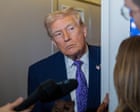
Trump defended Hegseth, telling reporters onboard Air Force One on Sunday: “I’m going to find out about it, but Pete said he did not order the death of those two men.”
When asked if he would have wanted a second attempt to kill the survivors, Trump said: “We’ll look into it, but no, I wouldn’t have wanted that – not a second strike. The first strike was very lethal.”
Hegseth has dismissed the reports as “fake news”.
Since September, US airstrikes have targeted alleged drug-trafficking boats in the Caribbean Sea and the eastern Pacific Ocean, killing at least 83 people.
Trump’s administration has offered no concrete evidence to back up the allegations behind its campaign, and numerous experts have questioned the legality of the operations.
Late on Sunday, Hegseth posted a mockup cover of a book featuring the children’s character Franklin the Turtle, entitled “Franklin Targets Narco Terrorists”. The turtle, wearing a US military vest, is shooting from a helicopter at boats crewed with armed men. “For your Christmas wish list,” he wrote on his personal account on X.
Trump also confirmed on Sunday that he had spoken with the Venezuelan president, Nicolás Maduro, but did not provide details on what the two leaders discussed.
skip past newsletter promotion after newsletter promotion
“I don’t want to comment on it. The answer is yes,” the US president said when asked if he had spoken with Maduro. He was speaking to reporters onboard Air Force One.
The New York Times first reported Trump had spoken with Maduro earlier this month and discussed a possible meeting between them in the US.
“I wouldn’t say it went well or badly. It was a phone call,” Trump said regarding the conversation.
The revelation of the phone call comes as Trump continues to use bellicose rhetoric regarding Venezuela, while also entertaining the possibility of diplomacy.
On Saturday, the US president said the airspace above and surrounding Venezuela should be considered “closed in its entirety” but gave no further details, stirring anxiety and confusion in Caracas as his administration ramps up pressure on Maduro’s government.
When asked whether his airspace comments meant strikes against Venezuela were imminent, Trump said: “Don’t read anything into it.”
The Trump administration has been weighing Venezuela-related options to combat what it has portrayed as Maduro’s role in supplying illegal drugs that have killed Americans. The socialist Venezuelan president has denied having any links to the illegal drug trade.
Reuters has reported the options under US consideration include an attempt to overthrow Maduro, and that the US military is poised for a new phase of operations after a massive military buildup in the Caribbean and nearly three months of strikes on suspected drug boats off Venezuela’s coast.
Human rights groups have condemned the strikes as illegal extrajudicial killings of civilians, and some US allies have expressed growing concerns that Washington may be violating international law.