

Australia is on the verge of one of the most significant digital shifts in its history: a nationwide ban on social media accounts for anyone under 16.
While the policy is aimed at protecting young people from online harm, its ripple effects extend beyond teenagers.
A new study shows more than two million Australians plan to reduce or quit social media rather than complete age-verification, with Gen Z leading the exodus from the platforms they grew up on over safety concerns.
Know the news with the 7NEWS app: Download today Arrow
The shift comes as major platforms — including Facebook, Instagram, TikTok, Snapchat, X, YouTube, and Reddit — face a December 10 deadline to implement strict age-verification measures for users under 16, with penalties of up to $50 million for non-compliance.
Experts say the change could reshape digital culture, advertising, and business models across the country.
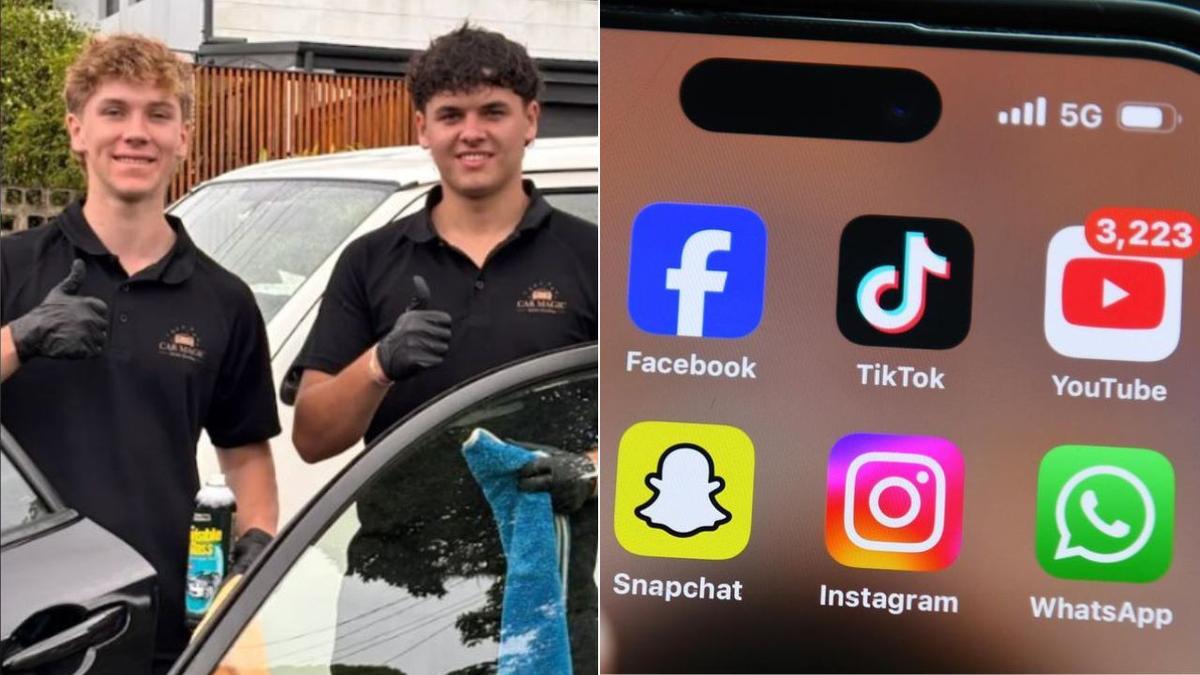
Gen Z leads the wave of Australians reconsidering social media use ahead of the new age-verification rules. Credit: 7NEWS A generation quietly leaving the platforms they grew up on Charlie Honour, 19, who runs the car detailing business Car Magic with his friend Joe Wright, 18, in Sydney’s Northern Beaches, said he personally doesn’t feel much attachment to social media anymore.
Charlie said they already avoid private social media “just for privacy,” and the new verification rules only reinforce that decision.
Professionally, however, it still matters.
While their car detailing business mainly serves adults, their video content is perfect for under-18s.
“Even though we don’t target under-16s, they’re often the ones sharing our videos,” Charlie told 7NEWS.com.au.
In a short series, they show how to scale a business to $30,000 a month, sharing the tips and tricks they wished they had when they started out.
Charlie Honour and Joe Wright run Car Magic, sharing business tips for young entrepreneurs while growing their car detailing service. Credit: Supplied Charlie and Joe demonstrating their car detailing skills as part of their growing Northern Beaches business. Credit: Instagram A drop in users, particularly younger ones who are known to amplify content organically more effectively, could mean slower growth for small businesses, Charlie explained.
“Our Instagram Reels go from one group of boys to the next. That’s how a lot of people see our work. If fewer young users are online, that will affect how far our content travels,” Charlie said.
The young men rely on Facebook and Instagram ads — both of which use data signals to push their services toward interested audiences.
“It definitely changes how businesses like ours reach people.” Joe said.
The study behind the trend: why Australians would rather quit than verify The survey from Airteam.com.au — involving national respondents aged 14 to 65 — revealed up to 2.1 million Australians said they will abandon social media rather than undergo strict age-verification measures.
Reasons include:
Privacy concerns: participants fear companies or governments storing their biometric or identification data. General distrust of verification systems, worsened by recent data breaches. A chance to break unhealthy social habits: many respondents described the ban as “a good excuse” to reduce screen time. Feeling “watched” or “tracked” is a major deterrent for users. Gen Z users are likely to be the largest group to walk away from social media for the above reasons, the study showed, with 45 per cent saying they would rather disconnect entirely than hand over personal details to prove their age.
Age verification methods may include biometric analysis, AI-based verification, or identity document requests, raising significant privacy concerns that appear to be driving the resistance.
This means the government’s attempt to create safer online environments could unintentionally accelerate a generational shift away from mainstream platforms.
“For tech companies and digital service providers, this is a wake-up call about privacy expectations,” said Rich Atkinson, founder of Airteam.
“If social media platforms can lose 2.1 million users over age verification, any business collecting sensitive data needs to ask whether their users trust them enough to stay.
“The cost of getting privacy wrong isn’t just regulatory, it’s existential when your customers would rather walk away than verify who they are.”
Millennials are rethinking their own social media use The decision is not just affecting teenagers.
Adults are reconsidering their own digital habits as the verification rollout approaches.
Alan, 33, says the ban has forced him to reflect on the role social media plays in his life.
“It’s no secret social media is terrible for your mental health,” he said.
“The constant comparison, the doom-scrolling — it’s draining. I’ve wanted to step back for a while, and with age verification coming, it feels like the right time to cut down.”
For Alan, data privacy is also a major concern. After several high-profile breaches, he says he no longer trusts platforms to protect his information.
“Every few months there’s another leak — another hack. The less of my data out there, the better.”
Experts: platforms will survive — but businesses will feel it Prof Sven Tuzovic from QUT’s Business School said the new law is set to significantly disrupt businesses targeting teens, affecting how they reach young audiences and manage their marketing channels.
“Companies could face an immediate loss of direct access to young users, a shake-up in influencer marketing, higher compliance burdens for age verification, rising advertising costs, and the challenge of diversifying channels across gaming, streaming, and messaging platforms,” he told 7NEWS.com.au.
He urged businesses to future-proof their digital strategies by auditing campaigns aimed at under-16s, reallocating budgets to owned channels such as email or app engagement, and building trust through transparency and family-safe positioning.
He also sees a potential upside: “Companies that clearly support youth safety and online wellbeing could gain trust — especially from parents.”
The full cost of these changes is still uncertain and can only be speculated at this stage, he added.
Clinical psychologist Dr Maike Neuhaus and QUT Business School’s Prof Sven Tuzovic weigh in on the impacts of upcoming social media age-verification laws. Credit: Neuhaus/QUT Families navigate uncertainty: how parents can support teens For parents, the upcoming ban brings both relief and anxiety. Many welcome stronger protections, but worry about how their teens will cope with losing daily digital social spaces.
Clinical psychologist Dr Maike Neuhaus urges parents to take a calm, supportive approach.
“Young people manage change better when it happens gradually and with clear communication,” she explained.
Her recommendations include:
Talking through the changes early rather than announcing them at the last minute. Acknowledging feelings of frustration or exclusion rather than dismissing them. Helping teens find alternative ways to connect — group chats, offline meetups, creative hobbies. Demonstrating interest in their digital world without judgment. “For many teens, social media is a genuine living space. When parents explain transparently what will change while signalling, ‘I want to understand what this means for you,’ it creates a sense of safety rather than resistance,” she said.
This is reflected in the research, which reveals a stark urban-regional divide.
Regional Australians more reliant — less likely to quit The research revealed a stark urban-regional divide. Regional Australians demonstrate higher social media usage rates and lower willingness to quit, suggesting greater reliance on digital platforms for connection and community engagement.
“For teens who have found their most important community online, such as LGBTQIA+ young people, it’s essential to create new safe spaces early; otherwise a sense of loss or isolation develops quickly,” Neuhaus said.
“But teens can do a lot to navigate the change well. They can look at their media habits and create routines that feel good for them.
“Friendships can still be nurtured through messaging, video calls, shared gaming sessions or planned meet-ups.”
She predicts the ban could bring unexpected benefits: more sleep, more in-person interaction, and less exposure to harmful content — but only if teens feel supported.