

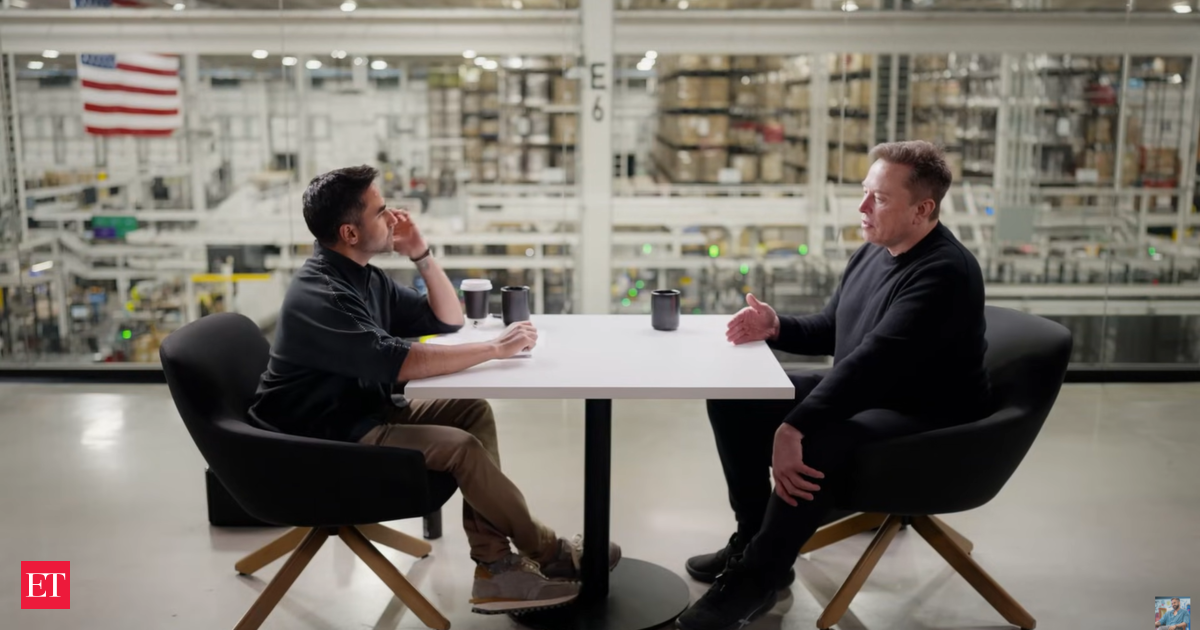
Elon Musk, in a conversation with People by WTF host Nikhil Kamath, expressed deep concern over falling global fertility rates and their long-term impact on civilisation. He warned that humanity could face a future of decline if current demographic trends continue. “Well, I don’t want humanity to disappear. But a ‘decline’ and ‘disappear’ are completely different things, right?” he said, adding, “Well, if the trend continues, we disappear.”
Musk argued that his broader philosophy is tied to the idea that expanding human consciousness requires more people, not fewer. “If we want to expand consciousness, then fewer humans is worse, because we have less consciousness,” he said. When asked whether consciousness rises simply by increasing population, he replied, “Yes. I mean, just like consciousness increases from a single-celled creature to, you know, a 30 trillion-celled creature. We’re more conscious than a bacteria. At least, it seems that way.”
Elon Musk asks Nikhil Kamath to have kids Musk said a larger population offers a better chance at understanding fundamental questions about existence. “A larger human population will have increased consciousness. We’re more likely to understand the answers to the nature of the universe if we have a lot more people than if we have fewer.”
When Kamth mentioned that he had no kids Musk responded saying, “ Well, it’s– Maybe you should.” After laughter, he added, “You won’t regret it.” Asked about the best part of parenthood, Musk said, “I mean, you’ve got this little creature that loves you, and you love this little creature. I don’t know, you kind of see the world through their eyes as they grow up, and their conscious awareness increases… from a baby that has no idea what’s going on… to… they start walking, then talking, and then having interesting thoughts.”
He reiterated the existential stakes, saying, “I think we fundamentally have to… have kids or grow extinct, you know?”
The host asked whether having children carried an element of ego. “Well, yeah, I mean, it’s ’cause apple’s not gonna fall that far from the tree, you know?” He acknowledged that parents often see reflections of themselves in their children. He described the mix of genetic and environmental influence: “Kids are gonna be like half-you genetically, and then… to the degree that they’re growing up around you, there’s gonna be some transfer of… I don’t know, understanding… So then, you know, yeah, obviously kids are just, you know, just gonna be half yo
Read More