

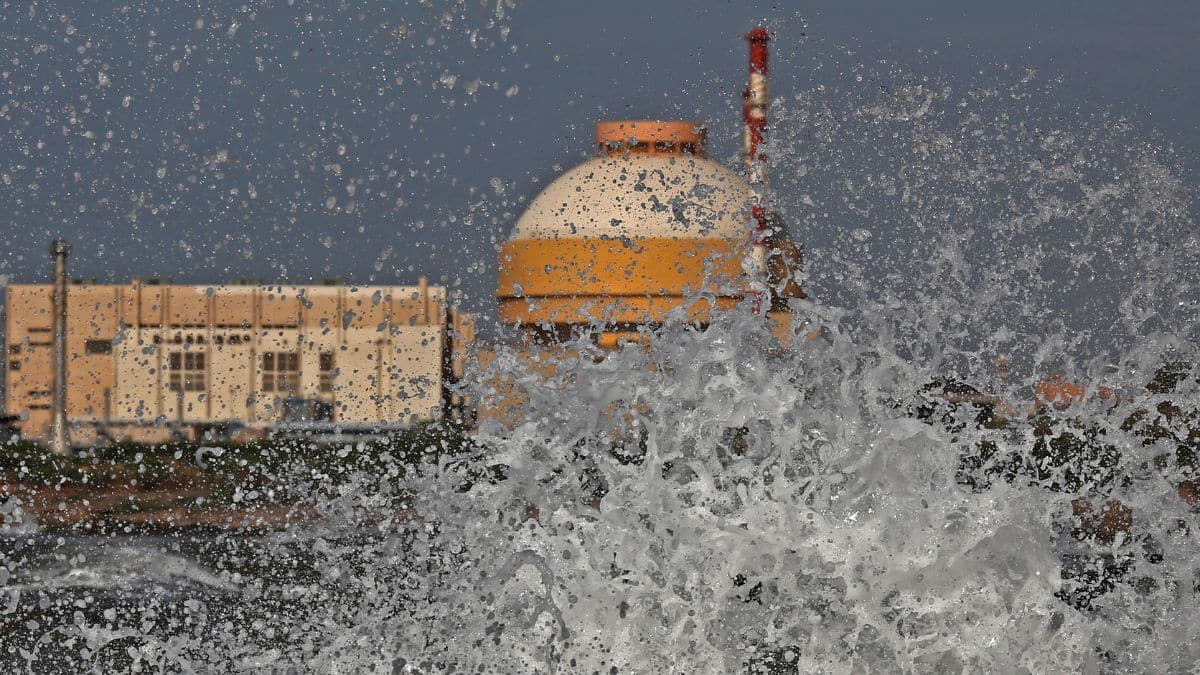
Kudankulam Nuclear Power Plant (KKNPP), India’s largest nuclear facility, received a critical boost as Russian President Vladimir Putin arrived in New Delhi for the 23rd India-Russia Annual Summit.
At a joint press briefing on Friday with Prime Minister Narendra Modi, Putin said, “We’re conducting a flagship project to build the largest Indian nuclear power plant, Kudankulam. Two out of six reactor units have already been connected to the energy network, and four are still under construction. Getting this nuclear power plant to full power output will make an impressive contribution to the energy requirements of India,” Putin said.
STORY CONTINUES BELOW THIS AD
Coinciding with Putin’s arrival on Thursday, the Russian state atomic energy corporation, Rosatom,
delivered the first batch of nuclear fuel for Unit 3 of the Kudankulam plant.
The development comes as India accelerates its push toward “Net Zero” emissions by 2070, a goal that relies heavily on expanding its nuclear baseload capacity.
For Russia, the continued progress at Kudankulam serves as a potent symbol of its ability to deliver on strategic projects despite a web of Western sanctions designed to isolate its economy.
How Unit 3 of KKNPP has come to life
The fuel assemblies for Unit 3 were transported by a specialised cargo flight from Russia, highlighting the “uninterrupted” supply chain Putin promised Modi
during their delegation-level talks.
“Russia is a reliable supplier of oil, gas, coal, and everything that is required for the development of India’s energy,” Putin told Modi, reiterating Russia’s commitment to the full completion of the Kudankulam project, which is slated to host six VVER-1000 reactors in total.
The arrival of the fuel assemblies is significant because it allows engineers to begin the “initial loading” process, a critical step where nuclear fuel is inserted into the reactor core for the first time.
This moves Unit 3 one step closer to “criticality” — the point at which a nuclear chain reaction becomes self-sustaining — and eventual grid connection.
STORY CONTINUES BELOW THIS AD
According to Rosatom, the fuel supplied is advanced, allowing for longer operating cycles. Unlike older reactors that required refuelling every 12 months, the new VVER-1000 units at Kudankulam are designed to operate on 18-month fuel cycles.
This efficiency boost means less downtime for refuelling and higher availability of electricity for India’s southern grid.
What we know about KKNPP
Located in the Tirunelveli district of Tamil Nadu, the Kudankulam Nuclear Power Plant is the crown jewel of Indo-Russian technological cooperation.
When all six units are operational, the plant will have a total installed capacity of 6,000 Megawatts (MW), making it the largest power generating station of any kind in India.
Currently, the status of the plant is as follows:
-
Units 1 & 2 (Operational): These two 1,000 MW reactors have been generating power since 2013 and 2016, respectively, supplying electricity to Tamil Nadu, Kerala, Karnataka, and Puducherry.
-
Units 3 & 4 (Construction/Commissioning): Unit 3 is now entering its pre-commissioning phase with the fuel arrival. Unit 4 is in advanced stages of construction.
-
Units 5 & 6 (Under Construction): Concrete pouring and civil works are ongoing, with ensuring a long-term engagement between Indian and Russian engineering teams.
Originally conceived in a 1988 agreement between Prime Minister Rajiv Gandhi and Soviet leader Mikhail Gorbachev, the project survived
the collapse of the Soviet Union and the subsequent economic chaos in Russia.
Today, it stands as the only foreign-built nuclear power plant producing electricity in India, a stark contrast to stalled projects involving American and French companies which remain on paper due to pricing and liability disagreements.
How the Indo-Russia discussion has pivoted towards SMRs
A major topic of discussion between the two leaders was also cooperation on Small Modular Reactors (SMRs).
SMRs are defined as nuclear reactors with a power capacity of up to 300 MW(e) per unit, which is about one-third of the generating capacity of traditional nuclear power reactors.
STORY CONTINUES BELOW THIS AD
They are “modular,” meaning systems can be factory-assembled and transported as a unit to a location for installation.
During the visit, Rosatom pitched its SMR technology as an ideal solution for India’s diverse energy needs.
Specifically, the Russian delegation highlighted the potential for supplying dedicated, carbon-free electricity to energy-intensive industrial clusters (like steel or aluminium plants) that need 24/7 power but cannot rely on intermittent renewables, as well as powering isolated areas where extending the national grid is prohibitively expensive.
Rosatom Director General Alexey Likhachev, part of the