

Tuesday 14 July 2026 5:52 am
| Updated:
Monday 13 July 2026 1:01 pm
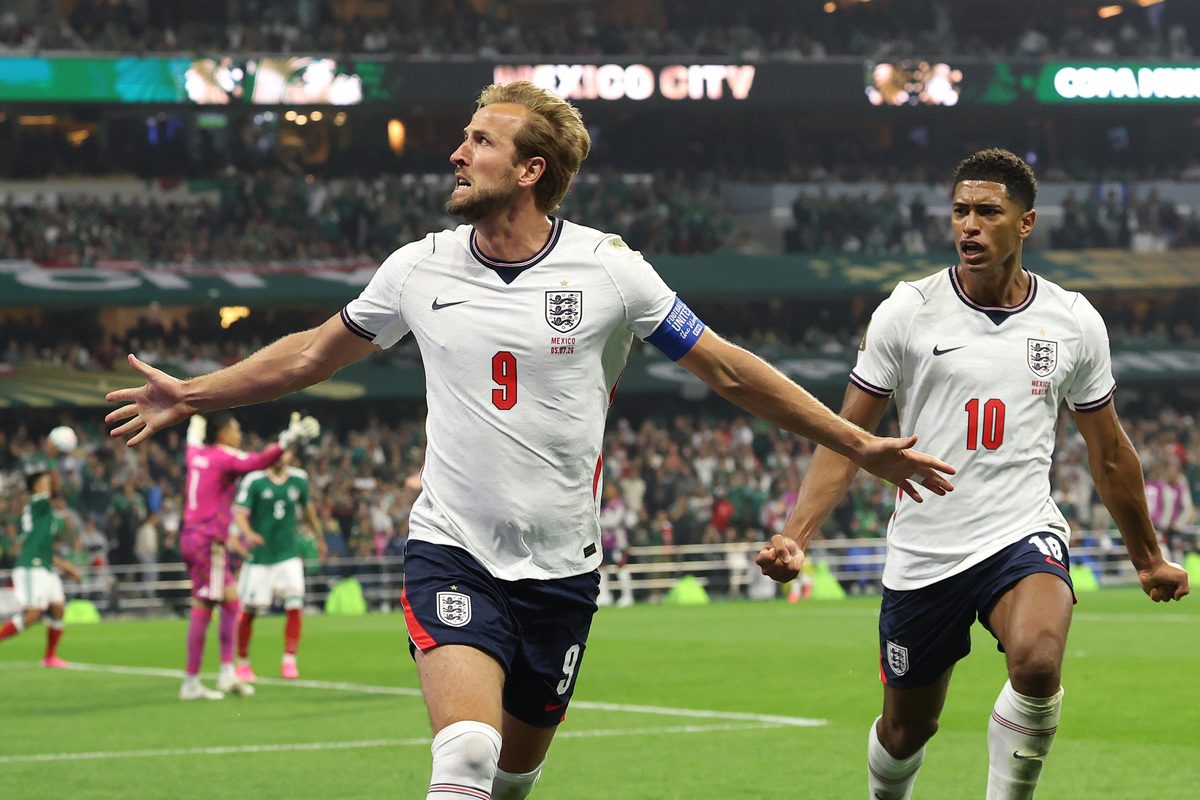
MEXICO CITY, MEXICO – JULY 05: Harry Kane #9 of England celebrates after scoring his team’s third goal during the FIFA World Cup 2026 Round of 16 match between Mexico and England at Mexico City Stadium on July 05, 2026 in Mexico City, Mexico. (Photo by Charlotte Wilson/Getty Images)
The equity markets of World Cup-winning countries frequently outperform immediately after victory. A Goldman Sachs study of tournaments from 1974-2014 found that every winner except Brazil in 2002 subsequently enjoyed a period of market outperformance, says Helen Thomas
If football finally came home, what might it do for financial markets, aside from a late start for Cable traders?
Research conducted before previous tournaments has found that the equity markets of World Cup-winning countries frequently outperform immediately after victory. A Goldman Sachs study of tournaments from 1974-2014 found that every winner except Brazil in 2002 subsequently enjoyed a period of market outperformance.
Brazil’s exception is instructive. Its fifth World Cup arrived amid recession, political uncertainty and acute concerns about the country’s public finances. Even Ronaldo, Rivaldo and Ronaldinho could not overcome the macroeconomic backdrop.
But they can have an impact on sentiment. A 2007 study by Alex Edmans, Diego Garcia and Øyvind Norli examined football results and stock-market returns across dozens of countries. It found that defeat in an important international match produced a statistically significant fall in the losing country’s equity market on the next trading day. The evidence for a corresponding victory bounce was weaker. That is consistent with one of behavioural economics’ most dependable observations: people feel losses more intensely than equivalent gains. England fans are already well aware of this.
Still, history offers examples of winning markets enjoying a lift. Greece’s stock market substantially outperformed the wider European market in the months following its unexpected Euro 2004 triumph. Spain’s market also performed better than its European benchmark after its 2008 and 2012 victories, even though both tournaments occurred amid severe financial turmoil.
The relevant word, however, is “relative”. Spain’s shares could fall and still outperform because other European markets fell further. Football did not end the global financial crisis or the eurozone debt crisis.
Improving sentiment For England, there is another complication: the FTSE 100 is not a particularly good proxy for the domestic economy as most of its revenues are generated overseas. Its largest constituents include multinational energy companies, global banks, pharmaceutical groups and miners whose earnings depend much more upon oil prices, currencies, interest rates and Chinese demand than the England team’s fortunes.
A victory could nevertheless produce some identifiable winners. Pub operators, broadcasters, supermarkets, bookmakers, travel companies and retailers might benefit from additional spending and a prolonged national celebration.
Sterling could also respond to a burst of optimism, although the historical relationship between tournament success and currencies is far less convincing. A stronger pound would, in fact, reduce the sterling value of overseas earnings reported by many FTSE 100 companies.
The more domestically focused FTSE 250 might therefore be a better place to look for any England effect. Even there, investors would need to distinguish a few weeks of additional beer, food and merchandise sales from a material improvement in long-term profits.
Gilts might gain a boost through a combination of improved sentiment towards the UK and a stronger pound bearing down on inflation. But euphoria in both consumer spending and potential for greater risk appetite could see flows out of government bonds.
A football-driven spending surge would be far too small and temporary to determine monetary policy on its own but it could form part of a wider confidence effect.
If stronger sentiment encouraged households to spend rather than save, businesses to invest and workers to press for higher wages, the Bank of England might become marginally more cautious about cutting rates. The Bank would also need to separate any increase in real economic activity from price rises caused by stretched capacity in pubs, hotels and transport. A country celebrating more enthusiastically is not necessarily producing more efficiently.
The Monetary Policy Committee’s verdict would therefore be deeply unromantic: enjoy the football, but show us the data.
The most significant economic channel may be confidence.
Britain has spent much of the past decade moving from one political or economic disappointment to another. Consumer confidence remains fragile and businesses have repeatedly delayed investment amid uncertainty about taxes, regulation and demand.
A World Cup victory would not solve low productivity, weak investment or the public finances. But confidence is not entirely trivial. Happier consumers may spend more freely. Business owners may feel slightly more optimistic. A country accustomed to expecting disappointment may briefly revise up its assumptions.
Confidence also has a political impact. Andy Burnham will be dogged by the lack of a mandate from the moment he enters Downing Street. With his political capital at its strongest before he has had to make any tough decisions, he might choose to trigger a snap election in the wake of an England victory. For a country that has been riven with division and dissatisfaction, it will be very politically tempting to rally around Captain Kane.
But national mood is not the same as voting intention. Football supporters do not automatically reward the party in power, and an attempt to exploit sporting success could easily appear opportunistic. Once an election campaign began, discussion would quickly return to living standards, public services, immigration, taxation and the new government’s programme.
Victory would not make a snap election likely. It would simply nudge the odds a little in that direction.
Football can move markets because markets are made up of human beings. National success affects mood, mood affects risk appetite and risk appetite can affect prices. A cathartic purge of sixty years of hurt might finally provide the catalyst needed to bring investors back to UK assets.
Helen Thomas is founder and CEO of Blonde Money