

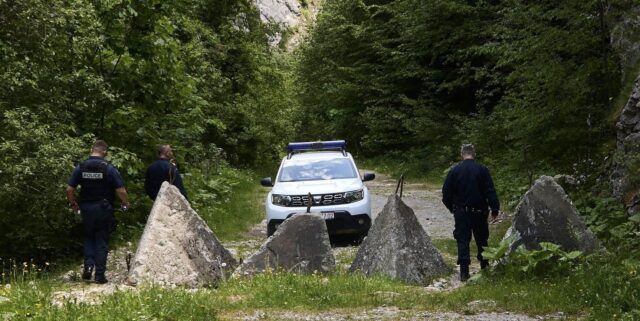
The flow of people and goods through the Accursed Mountains was disrupted by the turbulence of the 1990s and has yet to be fully restored.
Once a year, Mehdi Berisha travels from Kosovo to Montenegro to pay tax on the 23 hectares of land he owns in the mountainous Bjehulle region, near the Cakorr/Cakor pass straddling the border between the two countries at some 1,850 metres above sea level.
Generations of Berisha’s family cultivated the meadowland in the Accursed Mountains, back when Kosovo and Montenegro were both part of socialist Yugoslavia, the former a southern province of Serbia, the latter a Yugoslav republic.
There was no border, so the Berishas could travel direct from their village of Dubovik, in Kosovo, to the meadowland in Montenegro.
In 1999, however, NATO-led peacekeeping troops stationed in Kosovo in the wake of the 1998-99 war closed the old road that the Berishas had taken since 1972, following complaints from Montenegro about wood smuggling.
Kosovo declared independence nine years later and was recognised by Montenegro, but they have yet to finalise the demarcation of their joint border, and the road remains closed.
To access his land, Berisha must cross the border at Kulla, the main crossing point connecting Peja/Pec in Kosovo with Rozaje in Montenegro. That’s a journey of 110 kilometres one way; it makes little financial sense.
Berisha is among dozens of landowners in the area – Albanian as well as Montenegrin – who say the lack of a local border crossing has left them isolated, hurting the local economy and efforts to develop tourism.
“I grew up in this part of Cakorr, just like my father and grandfather, when there was no border,” 48 year-old Berisha told BIRN. “It has been 27 years, and we are still waiting for a solution regarding our property.”
“We are asking for a border crossing point to be opened in Cakorr. This would significantly shorten the journey and make it possible for us to use our properties.”
Border demarcation
Muhamet Nikci, one of the organisers of the campaign to reopen the road. Photo: BIRN
In 2014, Kosovo and Montenegro agreed to open an international border crossing on the road at Kotlovi-Kucishte. The following year, the neighbours signed a deal on the demarcation of their 79-kilometre border, based on the 1974 Yugoslav constitution. After much political wrangling, Kosovo lawmakers ratified the agreement in 2018 as a condition for clinching a visa waiver from the European Union.
But the process of marking the border line on the ground is still to be finished, as does construction of another 1.9 kilometres of road on the Kosovo side of the border before the road can be reopened.
Berisha and others have protested several times, demanding the old road be reopened and a border crossing set up.
“For nearly three decades, the closure of this important route has worsened the situation of many families, blocked access to properties, and caused difficulties in movement,” said Peja/Pec resident Muhamet Nikci, one of the organisers of the movement.
Agron Nikqi, a representative of nine villages in the region, said the road has existed since the 1920s.
“We are asking the authorities to open the border because it will make life easier for thousands of residents,” he told BIRN.
Bogacevica, near Kosovo-Montenegro borde. Photo: BIRN
Authorities in Kosovo have blamed the delays to the border demarcation on “technical issues”.
“Once these technical issues are resolved, the Ministry will work to facilitate border traffic,” the government said.
Montenegro’s interior ministry said “there is not a single problem” on its side of the border.
“Over the last decade, several initiatives have been sent to Kosovo authorities through diplomatic channels for the implementation of this Agreement, but there has been no response from their side,” the ministry told BIRN.
“The reasons for the non-implementation of the Agreement lie exclusively on the Kosovo side.”
The consequences, however, are felt on both sides.
Near Velika, a village on the slopes of Cakorr/Cakor mountain near the Lim River, an old military bunker stands as a ruined reminder that this was once a stronghold of the Yugoslav People’s Army, JNA.
“The troubled days are behind us, the years lived under the shadow of watchtowers and military outposts are gone, but we need to move freely,” said 56-year-old Vuksan Vuletic, who spends every summer with his family on Cakorr/Cakor mountain. He joined the road protest last month.
“The states must make a decision on this,” Vuletic told BIRN. “It would make a huge difference if this road were reopened for the entire Lim Valley and beyond.”
In Murino, another of the mountain villages, café owner Nedzad Cecunjanin said the city of Peja/Pec in Kosovo was “like a second mother” to people like him.
“We were educated there and relied on it for many of our needs,” he said. “During the war, it was where we found safety. We have many family ties and godparent relationships there. We even have our cemeteries there.”
“But all of that has gradually been disrupted because we have been cut off from Peja/Pec since 1999.”
“We appeal to the governments of Kosovo and Montenegro, as well as the EU and foreign embassies, to help reopen this road as soon as possible,” he said.
Not everyone agrees. Some villagers on the Montenegrin side fear the reopening of the road may lead to Kosovo seeking more land.
Unfinished road
Local residents protest about the blocked road near the Kosovo-Montenegro border in April 2026. Photo courtesy of Muhamet Nikci.
Cakorr/Cakor is not the only area where residents are calling for the opening of roads and border crossings.
In the Beleg Mountains, a road connecting Decan/Decane and Plav in Montenegro has been unfinished for more than a decade due to a series of obstacles.
Local authorities and many residents say the road is important for the local economy, with some 70 per cent of the population reliant on forestry, agriculture and farming in an area rich in pine forests, streams and rivers.
“The road should be opened to help people access their properties and develop their family businesses,” said local resident Agron Demukaj.
Work on the road was first delayed by issues related to Kosovo’s Law on Special Protective Zones around the 14th-century UNESCO-protected Visoki Decani Monastery. Later, the project stalled after the contractor failed to complete its obligations.
Bashkim Ramosaj, mayor of the western Kosovo municipality of Decan/Decane, said he has repeatedly asked the Kosovo interior ministry to initiate procedures for opening a new border crossing.
“The border police have taken measurements on the ground, but so far there has been no progress,” said Ramosaj.
He said the municipality is preparing a new tender to complete construction of the road, telling BIRN: “This road and this border crossing remain priorities.”
Again, however, the interior ministry of Montenegro said Kosovo had shown no readiness to open a border crossing on the road.
“I can’t wait to see a crossing point opened,” said Ahmed Rakovic, who was hiking in the village of Bogacevica on the Montenegrin side. “Every road that is opened in these mountains is a door opened to people.”