

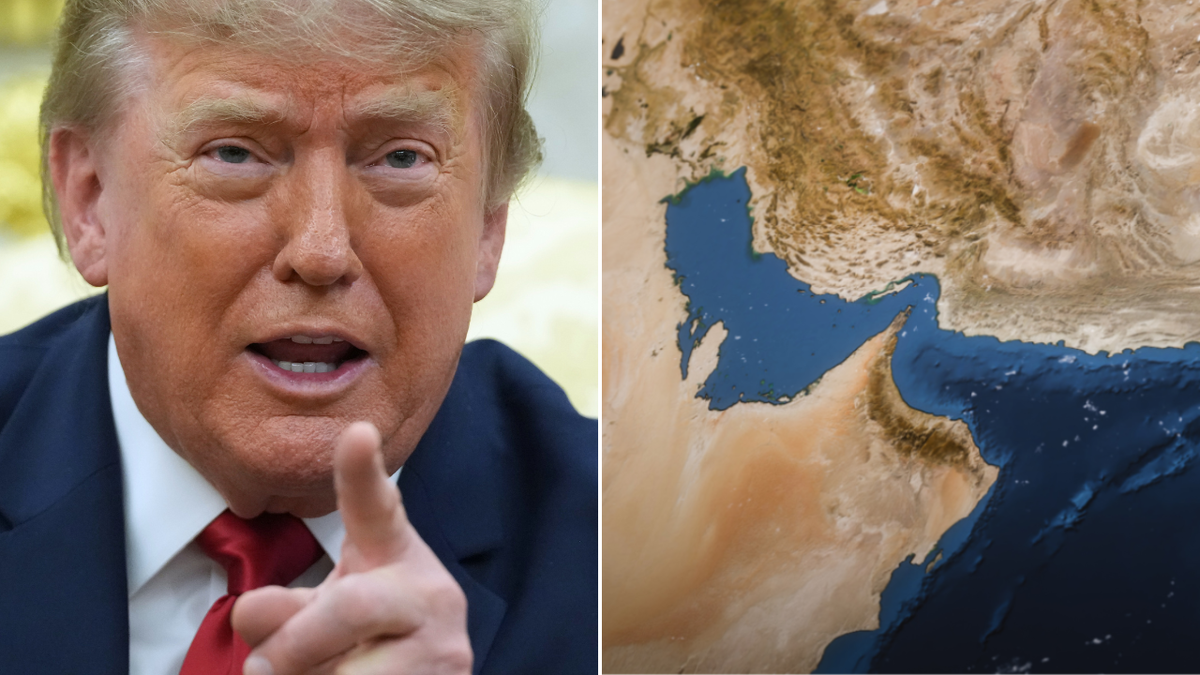
President Donald Trump has claimed the US will “bomb and destroy one bridge or power plant” every time Iran targets a ship transiting the Strait of Hormuz.
“From this point forward, any time the Islamic Republic of Iran shoots at a ship in the Strait of Hormuz, whether it be by Missile, Rocket, Drone, or any other device or weapon, the United States will bomb and destroy ONE BRIDGE OR POWER PLANT, including those located next to, or in, the Capital City of Tehran,” Trump wrote on Truth Social on Wednesday.
Trump has previously threatened to target Iranian civilian infrastructure — which could be considered a war crime — including in an interview with Fox News last week when he said the US would “knock out all (Iran’s) bridges unless they get to the table and negotiate.”
Know the news with the 7NEWS app: Download today Arrow
Donald Trump has launched a new threat at Iran. (EPA PHOTO) Credit: AAP US President approves nuclear deal with Saudi Arabia It comes as the US President on Wednesday approved a nuclear deal with Saudi Arabia that could lead to the kingdom enriching its own fuel for civilian reactors without adopting the “gold standard” of international oversight, according to two US officials and a source familiar with the matter.
The deal would last 30 years, according to one US official, who added that it would involve American companies providing technology and expertise to develop the Saudi program.
Any agreement to give Saudi Arabia access to nuclear technology could prove controversial, both domestically and within the wider Middle East region, since the ability to enrich nuclear fuel could, in theory, eventually lead to the creation of nuclear weapons.
The Trump administration is set to send the deal to Congress after it is announced. CNN previously reported that the administration let the deal languish for months over concerns about the Iran war and the potential for congressional disapproval.
Before uranium enrichment could begin, a joint US-Saudi team would explore whether it is warranted and commercially viable, and Americans would build the facility without transferring the sensitive technology to Saudi Arabia.
President Donald Trump shakes hands with Saudi Arabia’s Crown Prince Mohammed bin Salman during a dinner in the East Room of the White House, Tuesday, Nov. 18, 2025, in Washington. (AP Photo/Alex Brandon) Credit: Alex Brandon/AP The deal otherwise bars Riyadh from developing its own enrichment technology or purchasing it from other countries for a decade, according to the Wall Street Journal, which first reported the deal’s approval.
The agreement includes limits on what inspections might be carried out on the Saudi program, according to the officials and sources, which may draw skepticism from lawmakers.
The kingdom is notably not required to sign a standard agreement called the Additional Protocol with the International Atomic Energy Agency, like the United Arab Emirates did in 2009 when it signed a “gold standard” nuclear cooperation deal with the US, an official said. The Saudis long balked at signing the protocol over concerns that it could theoretically allow inspectors to enter the holy city of Mecca or royal palaces.
The deal instead includes a bilateral safeguards agreement that resembles the model protocol but lacks the portions that offended Riyadh, a US official told CNN. The IAEA Board of Governors will have to ratify its terms.
Israel, a country that is widely believed to have undeclared nuclear weapons, has long been wary of Saudi Arabia accessing nuclear technology.
President Donald Trump points to a reporter as he meets Saudi Arabia’s Crown Prince Mohammed bin Salman in the Oval Office of the White House, Tuesday, Nov. 18, 2025, in Washington. (AP Photo/Evan Vucci) Credit: Evan Vucci/AP Iran, Saudi Arabia’s main rival in the region, has a stockpile of enriched uranium and has vowed to cling to its nuclear program even after months of US bombardment, claiming the program is for civilian purposes.
Saudi Crown Prince Mohammed bin Salman has pledged to seek a nuclear weapon if Iran were ever to produce one.
Uranium enrichment and plutonium reprocessing are the two main pathways to create the core materials necessary to build nuclear weapons. Most countries with civilian nuclear reactors that require enriched uranium don’t produce it domestically — they instead purchase the material from vendors like the US or Russia and receive it in sealed shipments under strict international supervision.
The US has been eying a Saudi civilian nuclear agreement for years. Under the Biden administration, such an arrangement was viewed as part of a broader normalisation pact between Saudi Arabia and Israel. But those efforts faltered after the October 7, 2023, Hamas terror attacks. The Trump administration picked up the nuclear discussions last year.