

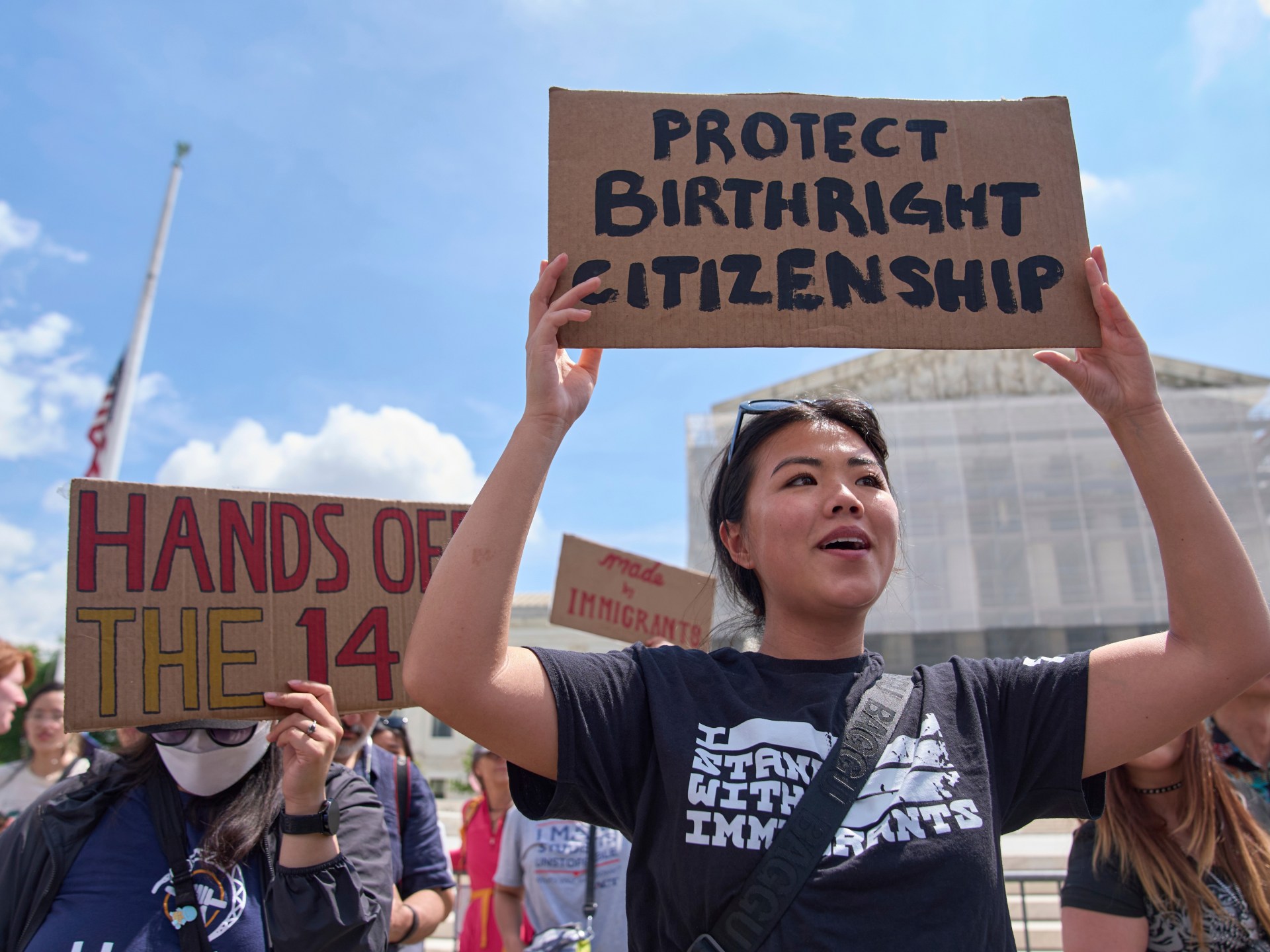
Trump’s latest effort to limit birthright citizenship comes after Supreme Court ruled against his initial push to reinterpret the constitutional right.
United States President Donald Trump has signed two executive orders seeking to limit birthright citizenship, weeks after the Supreme Court upheld the practice as protected under the Constitution.
The orders signed on Thursday were far narrower than Trump’s previous attempt to restrict the practice, which confers citizenship to nearly all children born on US soil.
Recommended Stories
list of 3 items
- list 1 of 3Trump official says White House will fight birthright citizenship decision
- list 2 of 3US Supreme Court upholds birthright citizenship: Who wins, who loses?
- list 3 of 3Despite marquee losses, Supreme Court term grows Trump’s presidential power
end of list
One of the orders seeks to expand a narrow exception to birthright citizenship, which bars US citizenship from being conferred to the babies of foreign diplomats or invading forces.
Trump’s expansion would also exclude the children of alleged “terrorists”, people deemed to be attempting to “purchase” citizenship and certain people born in US territories.
The second order calls on the secretary of state and the secretary of homeland security to halt so-called “birth tourism”, the practice of mothers travelling to the US for the sole purpose of giving birth.
Like Trump’s earlier attempt, the new executive orders are expected to face legal challenges.
Speaking from the Oval Office, Trump denounced the Supreme Court for making a “very unfortunate decision” in striking down his initial effort to limit birthright citizenship.
“They’ve taken birthright citizenship and they’ve made a joke out of it,” said Trump, adding that his administration is “making adjustments” to its approach.
On January 20, 2025 – the first day of his second term – Trump had signed an executive order seeking to reinterpret the 14th Amendment of the Constitution, to tighten the category of people who qualified for birthright citizenship.
The order argued that children born to immigrants on temporary visas or without documentation were not “subject to the jurisdiction” of the US, and therefore could not be automatically granted citizenship.
But in June, the US Supreme Court ruled that Trump’s “attempts to narrow” birthright citizenship were unlawful, citing the Constitution’s Citizenship Clause.
“If Congress intended to limit American citizenship to the children of those domiciled in the United States, nothing in the succinct language of the Citizenship Clause conveyed that design,” the majority opinion said.
Trump has made a hardline approach to immigration a centrepiece of his political career. However, the Supreme Court ruling represented one of the largest legal setbacks of his second term.
Despite a conservative supermajority on the nine-judge panel, six justices voted against Trump’s effort to transform who is eligible for birthright citizenship.
The crux of the administration’s argument was that the 14th Amendment was meant to apply only to the children born to newly freed slaves and had been misinterpreted since its ratification in 1868.
Chief Justice John Roberts, a conservative, wrote that there was “scant evidence for this dramatically revisionist view”.
“The Framers of the Fourteenth Amendment extended that promise to ‘every free-born person in this land,” he wrote. “We keep that promise today.”
Legal experts believe Trump’s new birthright citizenship orders also face steep odds in the courts.
Kimberly Wehle, a constitutional law expert, told Al Jazeera the orders are likely to be deemed unconstitutional. But she speculated that Trump may be seeking to appeal to his far-right base at a time when his poll numbers are slumping.
“It looks like what Donald Trump is setting up is a clash between himself and the authority of the United States Supreme Court,” Wehle said.
“Lots of things aren’t looking up for Donald Trump, so he’s trying to make political hay out of something that, frankly, is resolved.”