

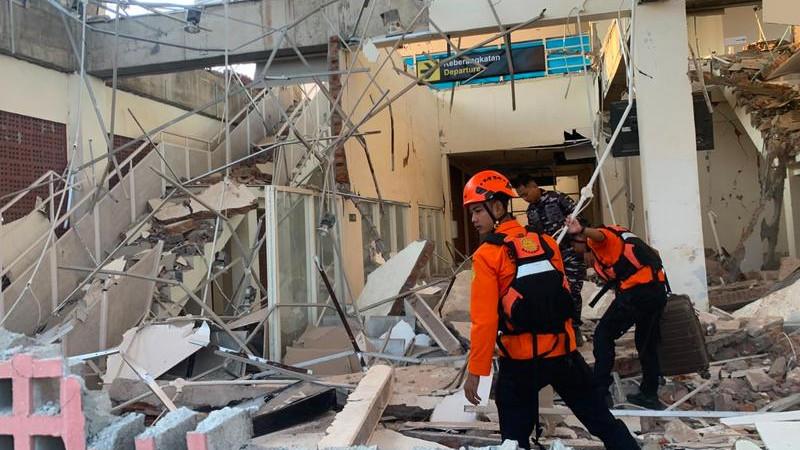
Dozens are dead after two major earthquakes — a 7.7 magnitude and a 6.9 magnitude — and dozens of aftershocks in Indonesia.
At least 47 people have been killed in the island nation’s east, with tremors felt across parts of the country, including in Bali.
The desperate search for survivors continues on Sunday, the National Disaster Mitigation Agency says.
Know the news with the 7NEWS app: Download today Arrow
WATCH THE VIDEO ABOVE: Major earthquake hits Indonesia.
The first and largest quake hit the island of Flores about 6am local time on Saturday morning.
A 6.9 magnitude quake rattled Northern Sumatra hours after, followed later by a third 5.7 magnitude quake roughly 966km to the north, off the Minahasa Peninsula, the United States Geological Survey said.
Seismologist Adam Pascale told Sunrise that the largest tremor was “the equal biggest earthquake we’ve had this year.”
“For this region, there hasn’t been one for quite a while. So the impact is quite significant.”
Pascale said it is important for those heading on holiday in Indonesia to “be aware of what to do,” specifically in Bali as a lot of Australians travel there.
“In Australia it seems ridiculous to know what to do in an earthquake as we don’t have them very often, but we do travel to parts of the world where there are large earthquakes,” he said.
“Drop, cover and hold on to protect yourself from falling debris.”
He said the earthquakes would have “certainly” been felt in Bali.
Roads blocked by landslides and and disrupted communications are still blocking rescue teams from reaching the region closest to the epicentre, Nagekeo, officials said.
“The quake was massive, the shock was so strong,” said Nona, a 51-year-old resident of Talibura, a village in East Nusa Tenggara.
“There were 13 of us inside the house and we all ran to save ourselves.”
Tsunami waves of less than 1m were recorded in several parts of the Southeast Asian nation after the early morning quake. Authorities lifted a tsunami warning about three hours later.
Destruction followed a powerful quake in Indonesia on Saturday. Credit: Facebook/Paulus Njauk/CNN Fault lines reach breaking point Pascale said the impact of the earlier quake could have triggered those which followed.
“When you have a large earthquake like this, it does change the stress regime in the whole region. And it might push some faults that are close to breaking, to that breaking point,” he said.
“It’s quite likely that these are related.”
He told Sunrise that more quakes could still take place.
“In the first few hours, days and even weeks, aftershocks can occur and potentially even earthquakes of the same magnitude or larger. So we need to be aware of the possibility of those larger events in the short term,” Pascale said.
Early rescue efforts paint grim picture Rescuers in the port town of Maumere earlier found 20 people dead, six injured and two people trapped under rubble, local rescue agency head Fathur Rahman said.
Maumere is the main town in Sikka Regency on Flores Island in eastern Indonesia.
Suharyanto, head of the National Disaster Mitigation Agency, said residents remained trapped in several buildings across the affected area, while there were reports of landslides blocking several roads.
Teams have yet to reach Nagekeo and mobile communications in the region were affected, Fathur told Reuters earlier.
Attempts to reach the area by road were thwarted by landslides, while another team was trying to reach it by ferry, he said.
About 2000 residents in Nagekeo evacuated, and damage was reported to homes, warehouses and government buildings, the National Disaster Mitigation Agency said.
Authorities also reported power outages and traffic congestion in parts of the regency.
At least five people were killed when buildings collapsed as they slept, East Nusa Tenggara Governor Emanuel Melkiades Laka Lena said at a press conference.
Preliminary data showed 157 homes were heavily damaged, 41 moderately damaged and 148 lightly damaged.
Damage was also reported at 87 schools, 18 health facilities, five places of worship and six office buildings, along with other infrastructure.
Parts of a building collapsed into dust and rubble as people screamed and ran in the street, according to a Facebook video, verified by Reuters as being filmed at a port in Maumere.
Rescuers were searching for survivors beneath a partially collapsed port building.
‘We still worry there might be more’ Siti Sulfia Bira, 37, who lives with her family near the port in Maumere, said she rushed to higher ground when the tremors started.
“At the moment we don’t dare to go home just yet because the situation isn’t stable; we still worry that there might be more tremors coming,” she told Reuters.
Strong shaking was felt across East Nusa Tenggara, West Nusa Tenggara and parts of South Sulawesi, with residents in several areas reporting tremors lasting about a minute.
“Most of the people felt the shock and scattered out of their homes,” the agency said.
Rescue teams have yet to reach Nagekeo and mobile communications are affected. (EPA PHOTO) Credit: AAP A hospital in Ende district in East Nusa Tenggara was moving patients outside, Kompas TV footage showed, while Kompas.com reported at least one landslide.
Indonesian geophysics agency recorded the first quake at a depth of 15km, followed by several aftershocks.
The agency said the same area was hit by a magnitude 7.5 earthquake in 1992 that caused extensive destruction.
Australia’s tsunami warning centre said the undersea quake posed “no tsunami threat to the Australian mainland, islands or territories”.
Indonesia straddles the Pacific Ring of Fire, a seismically active zone where tectonic plates meet, triggering frequent earthquakes and volcanic eruptions.
In 2018, a magnitude 7.5 earthquake and tsunami struck the city of Palu on Sulawesi island, killing more than 4000 people.
—With CNN and Reuters