

Kindness is strength training — and that’s no longer a metaphor. We grow up believing strong hearts are the hardened ones, the ones that stopped letting things in.
Psychology says the opposite: doctors at University Hospitals explain that random acts of kindness are literally cardioprotective — dilating blood vessels, lowering blood pressure, letting the heart receive more oxygen — while University of Wisconsin researchers found compassion works “like weight training,” a muscle anyone can build.
The strongest hearts, in other words, are the ones that kept lifting for other people. Here are 10 of them — real stories of empathy , love , and human connection doing their quiet reps in 2026.
Six weeks after my mother passed, a dance studio called my father to confirm his Tuesday lesson. He said there’d been a mistake. The instructor said, “No, sir. Paid in full. One year. There’s a note — I’m supposed to read it to you if you try to cancel.”
The note was in my mother’s handwriting: “You’ll want to stay home. Don’t. Tuesdays you dance. You need somewhere to be, and hands to hold that aren’t mine.”
He went, furious, and grieving, and obedient. What she hadn’t told him: the instructor quietly fills that class with the newly widowed. It’s a grief group wearing dance shoes. Nobody ever says so out loud.
Dad can waltz now. He teaches the box step to the terrified new ones — the ones still coming because of a note they can’t disobey. He says the first thing he tells them is: “I know exactly whose handwriting sent you. Come stand by me.”
Our son’s condition means a 2 a.m. injection when his numbers crash. My husband and I hadn’t slept a full night in years — one of us was always half-awake, on call.
Our neighbor, a retired engineer with no medical background, showed up one day with a notebook. He’d asked our son’s clinic if a non-family member could be trained. They’d said yes. He’d already done the course.
“There are three people alive who can do your son’s 2 a.m.,” he said. “Two of them made him. The third lives forty feet away and doesn’t sleep well anyway.” Once a week, we sleep the whole night. It took me a month to stop crying about it and just sleep.
The summer before college, my dad and I started building a canoe. We fought — the big fight, the one about my whole life’s direction — and I left with it half-finished. We barely spoke for fifteen years. Holidays, weather, nothing real.
When he got sick, I came home. The canoe was in the garage, finished. Beautiful. Never once in the water — the hull was still factory-dry.
He said, “It’s a two-man boat. I was waiting on my other man.” He’d finished my half the same year I left. Then he waited fifteen years.
We launched it that October, him wrapped in blankets, laughing at my paddling. After he was gone, I flipped it for re-varnishing and found two dates carved under my seat: the day I left, and the day I came home. Nothing else. He’d been keeping score of exactly one thing.
At seventeen I did something stupid enough to earn community service. The program placed me in a care home, visiting a man named Gus. I was angry, silent, useless. He didn’t seem to mind.
My hours ended in March. I kept coming for six years. I never told him why I’d started.
At his service, his daughter handed me an envelope with my name on it. Inside, in shaky handwriting:
“They think I don’t know the program sends me the court kids. I request them. I ask for the angry ones specifically. The lonely fix the angry and the angry fix the lonely — the trick is never telling either one which one they are.”
I thought I’d been serving time. I’d been being raised. There was one more line: “Your hours were done in March. You came back in April. That’s the only visit that ever counted, and it counted for all of them.”
I do the program’s intake interviews now. I always ask for the angry ones.
When she was eight, a paramedic carried her out of the worst night of her family’s life and stayed beside her stretcher, telling her about his dog until she stopped shaking.
She wrote him a thank-you card. He wrote back. Twenty years of occasional letters followed — graduations, his retirement, her engagement.
Her father is no longer living. So last June, at the end of the aisle, it was a retired paramedic in a rented tux, sixty-eight years old, terrified of tripping.
“You carried me once,” she told him when she asked. “It’s one more time. It’s a short distance.” He practiced walking slowly in his kitchen for three weeks. Her mother says he was the only person in the building more nervous than the groom.
When my grandfather downsized, everyone expected the piano to be sold — a beautiful old upright, his late wife’s, worth real money.
He donated it to the elementary school instead. One condition, written into the paperwork like a legal clause: a standing invitation to every recital, front row.
He hasn’t missed one in six years. Little kids who mangle scales all year play their two-minute pieces to a silver-haired man who claps like it’s Carnegie Hall. The music teacher told me the students call him “the piano’s grandpa.”
He told me something else: “She taught piano for thirty years. I just make sure her piano still gets taught on. And that someone she’d approve of is listening.”
My sister was the strong one. Oldest of four, mother half-absent, she packed lunches at eleven, signed permission slips at thirteen, and got us all raised. We let her, because children take what’s given.
Last year, at fifty-one, her marriage ended and something in her finally buckled. She called me apologizing for needing help.
I drove through the night. When she opened the door, still saying sorry, I said the sentence I’d been rehearsing for two hundred miles: “You were on shift for thirty years. Tap out. It’s my rotation.”
She laughed once, then went to pieces, then slept twelve hours while I fielded her phone. Strong runs in the family. She taught it to me. She just forgot it could point back at her.
After we lost the baby we were expecting, my husband started “working late” on Mondays. I checked, once, hating myself. He wasn’t at work.
He was at his mother’s. His mother finally called me herself: “He comes here to fall apart so he can be solid for you at home. I’ve let it go on for months. But you should know what the solid is costing him.”
The next Monday I just showed up at her door. He was at her kitchen table with his head in his hands, and when he saw me he tried, even then, to straighten up. I sat down next to him instead.
His mother made tea and left the room. We fell apart properly, together, for the first time.
We still go, every month. She calls it “tea with Mom” and pretends it’s about the tea. Three cups on the table. She drinks hers in the other room, guarding the door.
My grandfather’s will was mostly ordinary — the house, the savings, the tools. But each grandchild also received one handwritten instruction card.
My cousin got “Teach someone to fish before you’re thirty.” My brother got the recipe for Sunday gravy and orders to host.
Mine said: “Check on Walter, first Tuesday of every month. He will say he’s fine. He is lying. He has been my responsibility since 1971 and now he is yours. He likes butterscotch and losing at checkers.”
Walter is eighty-nine. I’ve been his first Tuesday for three years now. He was gone before I could ask my grandfather what happened in 1971 — and Walter just smiles and says “long story” and moves his checker.
I inherited a friendship with a locked history, and honestly, it’s the best thing anyone’s ever left me.
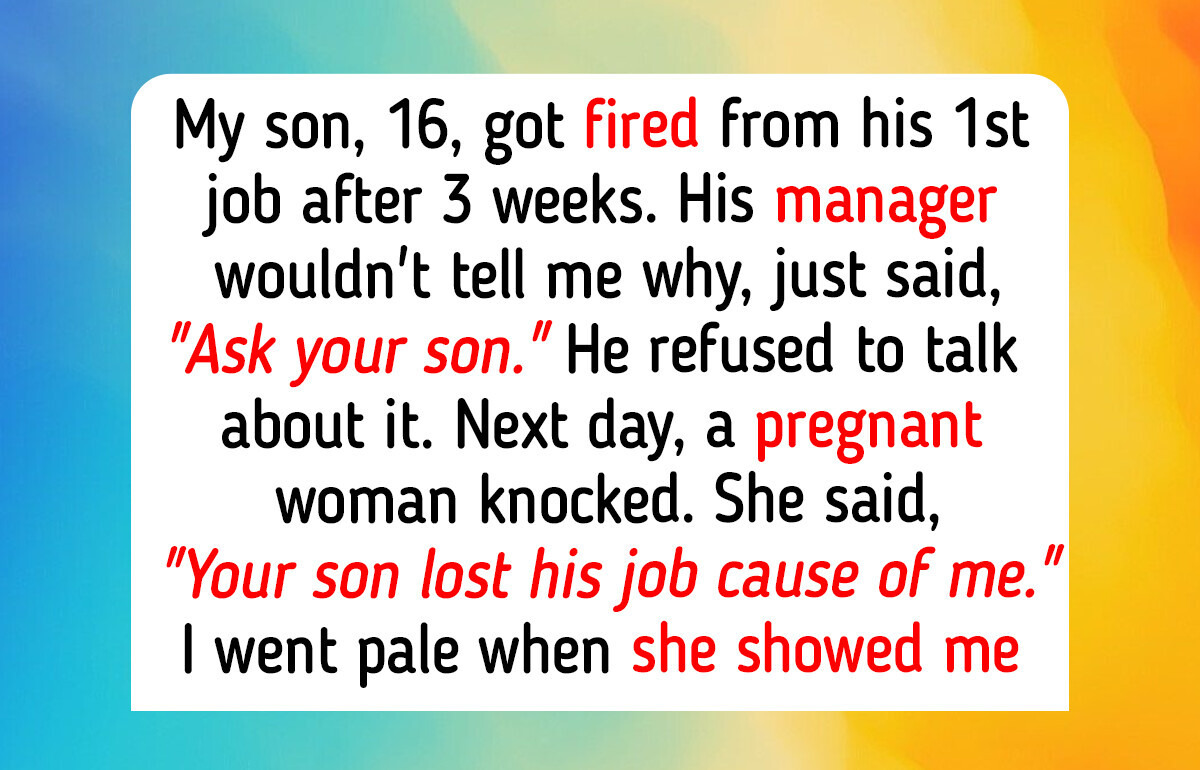
My son, 16, got fired from his 1st job after 3 weeks. His manager wouldn’t tell me why, just said,
“Ask your son.” He refused to talk about it.
Next day, a pregnant woman knocked. She said, “Your son lost his job cause of me.” I went pale when she showed me a text thread on her phone between her and my son, dozens of messages over 2 weeks, arranging times to meet by the store’s back dumpster.
She explained that as part of closing shift, employees were required to throw out unsold bakery items and expired-but-still-good produce at the end of each night, and store policy strictly banned giving any of it away, citing liability.
She’d been struggling since losing her job at six months pregnant, and one night my son caught her quietly looking through the dumpster after close. Instead of walking away, he started setting bread, fruit, and dented cans aside for her before they hit the trash, texting her the pickup time each night.
A new assistant manager doing a surprise walk-through caught him handing her a bag last week and fired him on the spot for “unauthorized distribution of store property,” even though everything was already marked for disposal.
My son never told me why, worried it would sound like he was making excuses. Standing in my doorway, she said she couldn’t let him carry that silently while she said nothing.
That night, I hugged my son and told him I was proud of him, job or no job, for having the kind of heart that chose someone else’s hunger over his own paycheck — and in 2026, his story is proof that real compassion sometimes breaks small rules to fix bigger, quieter struggles that nobody else notices.
Comments Lucky you! This thread is empty,
which means you’ve got dibs on the first comment.
Go for it!
Related Reads
Read More