

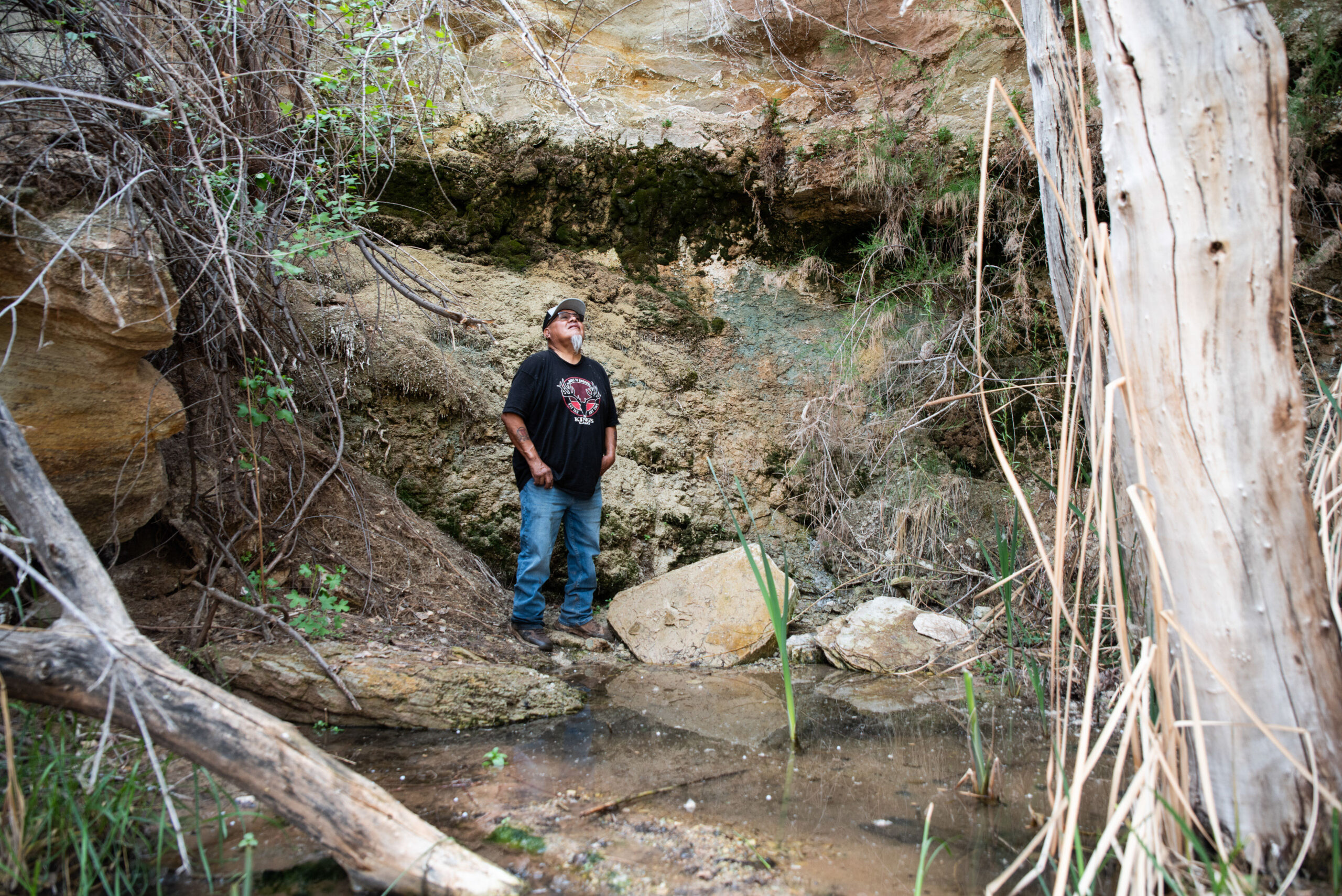
WHITE MESA, Utah — On a hot April day, Malcolm Lehi maneuvered his Jeep Wrangler over a rough dirt road past junipers and sagebrush in search of Entrance Spring on land long connected to his tribe, the Ute Mountain Ute.
The cool, mossy spring lies just across the highway from White Mesa Mill, the nation’s only remaining conventional uranium mill, which produces yellowcake for nuclear power fuel.
For decades, the mill has sparked debate over whether radioactive contamination threatens human health by getting into the water and the air. Concerns run especially deep in the White Mesa Ute Community, where Lehi and about 200 members of his tribe live some 5 miles south of the facility.
State regulators and the company that owns the mill contend that any pollution associated with it is contained. That’s little consolation to nearby tribal members, who — aware of uranium’s deadly legacy across the Colorado Plateau — have raised questions about the potential spread of toxic waste. Many won’t drink the local water, relying on bottled water instead.
Now the tribe’s concerns have taken on new urgency as the U.S. pushes to revive domestic uranium production. A federal law, passed in 2024, bans imports of Russian uranium by 2028, increasing pressure to develop domestic fuel supplies. President Donald Trump set a goal to quadruple U.S. nuclear energy capacity by 2050. He issued orders to prioritize mining on federal lands and fast-track approval of mining projects. The Velvet-Wood uranium mine in Utah, for instance, zipped through federal environmental review in 11 days, to the dismay of local tribes who were given one week to offer input.
Trump’s goal of quadrupling nuclear power capacity will be hard to meet, because it would require constructing more reactors — which are difficult to build and often meet local opposition, said David Hart, a senior fellow for climate and energy at the Council on Foreign Relations. But data centers and rising electricity demand have intensified interest in nuclear power as a low-carbon energy source, he said. And more states are opening the door to it.
So the effort to obtain the key ingredient, uranium, is underway.
The White Mesa Mill, built in 1980 near what is now Bears Ears National Monument in southeastern Utah, is a focal point of this latest uranium boom — and the tensions between local tribal concerns and national economic interests. Increased demand draws a steady flow of trucks carrying uranium ore to the mill from regional mines, including one near the Grand Canyon where the Havasupai Tribe lives. That ore is trucked through the Navajo Nation. And the mill plans to expand its waste storage, as well.
A former tribal councilmember, Lehi is part of a growing opposition that includes members of the Havasupai and Navajo (Diné) tribes, who are now linked by the uranium trucking routes passing through their lands. The Havasupai and Ute Mountain Ute tribes share concerns that toxic wastewater from uranium mining and milling may move through the ground and poison drinking water for future generations.
A History of Distrust
One spring morning in White Mesa, Yolanda Badback gazed out an open door not far from the highway and watched three uranium trucks drive by.
“There goes another one,” Badback said with a tone of exhaustion. She is a Ute Mountain Ute member and leader of the White Mesa Concerned Community advocacy group that has been fighting the mill.
The mill receives 10 to 15 trucks each weekday, said Curtis Moore, senior vice president of marketing and corporate development at Energy Fuels, which has owned the facility since 2012. The majority pass through White Mesa.
The mill’s business is picking up after a quiet 15 years, Moore said. The White Mesa Mill produced 1 million pounds of yellowcake last year; the company plans to more than double that this year, he said. The mill has also diversified into processing radioactive waste from as far away as Estonia and Japan, and received a $725 million conditional loan commitment from the Defense Department to scale up its domestic processing of rare earth elements.
The new rare earths business alone could create 100 permanent jobs, Moore said. About half of the mill’s 105 workers are Indigenous; Moore estimated that no more than two belong to the Ute Mountain Ute Tribe.
“When it comes to tribes in the area, I do very much understand their skepticism of uranium,” Moore said. “They’ve been lied to before.”
A uranium boom driven by the U.S. government from the 1940s through the 1980s, much of it concentrated around the Four Corners area of Arizona, New Mexico, Utah, and Colorado, exposed miners to heightened rates of mortality from lung and other cancers. Federal reviews found that the miners, many of them Navajo (Diné), were not warned about radiation risks even after government scientists understood the dangers. Mining companies left behind thousands of abandoned waste sites that have leached contamination into surrounding soil and water, including over 500 spots on and near the Navajo Nation.
But Moore said things have changed a lot since the 1950s. He said workers today are exposed to 15% to 20% of allowable radiation limits, and outside the