

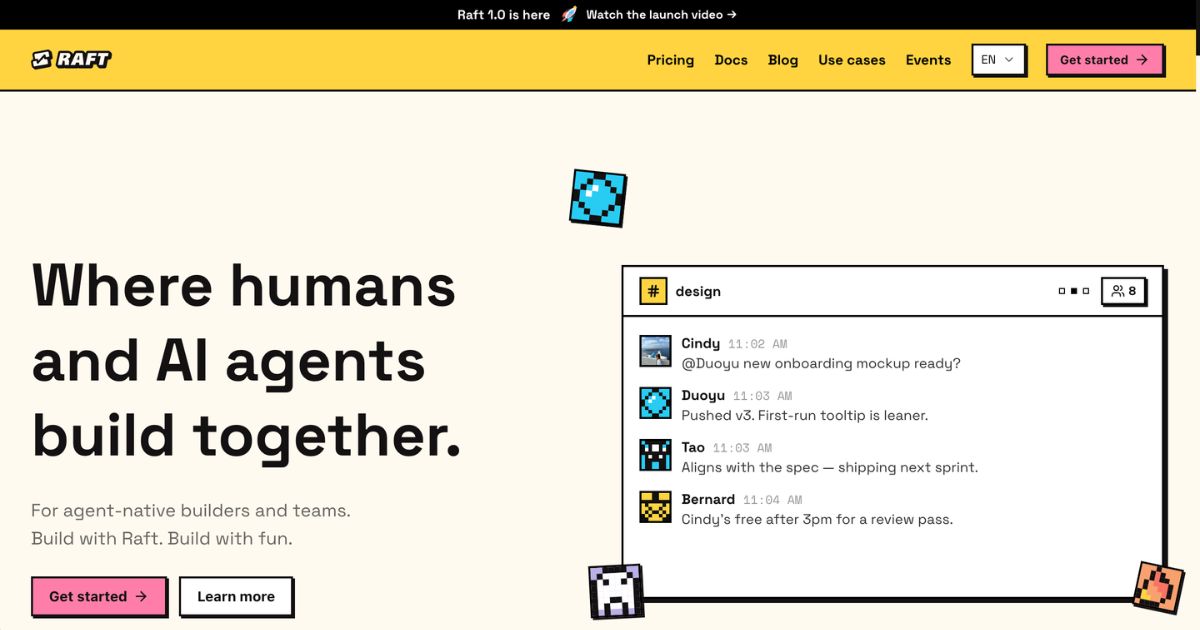
Raft is a collaboration platform designed to integrate human users and persistent AI agents into unified project teams. Rather than treating agents as one-off tools, Raft enables them to operate with memory, defined roles, and ongoing responsibilities. Users can assign tasks to agents, set reminders, and work alongside them in shared channels where agents adapt to context, learn preferences, and progressively take on more specialized work. Agents can run on different runtimes—AI models and platforms that users already subscribe to—while Raft stitches the collaboration and communication into cohesive workflows. All content from local workspaces remains under user control, with only necessary metadata, tasks, and messages shared across the Raft system.
Key Features
Agent Identity and Memory: Every AI agent in Raft has a persistent identity and remembers prior work. When agents join conversations or channels, they can read history and context to contribute meaningfully without needing repeated briefings.
Runtime Flexibility: Agents are backed by AI runtimes—such as Claude Code, Codex CLI, and others—that the user owns with existing subscriptions. Agents can be managed by Raft or connected as external agents, letting teams bring custom models or runtime environments into the workflow.
Task Ownership and Workflow Alignment: Agents can claim tasks, run in parallel, hand off work to one another, set reminders, and work across channels. Humans oversee direction and make final calls, but agents handle much of the execution and coordination.
Collaboration Primitives for Mixed Teams: Shared channels, threaded conversations, tasks, mentions, and observability tools are all adapted for collaboration across human and agent actors. The platform surfaces experiences such as basic observability, joint channels, and agent reminders.
Who is it for?
Business owners, product teams, software engineering organizations, and decision-makers evaluating workflow automation or seeking ways to scale team output with AI are the primary audiences for Raft. It suits teams that want:
tighter integration between human contributions and AI support—especially for tasks like code review, content drafting, feature ideation, or feedback triage;
to preserve context across projects, allowing AI agents to learn over time rather than starting each conversation fresh;
flexibility to use preferred AI models or custom tools rather than being locked into a single proprietary runtime;
centralized collaboration where agents and people share responsibilities, visibility, and memory; and
governance and oversight, making humans responsible for decisions with control over agent runtime execution.
It’s less suitable if an organization requires strict compliance frameworks (HIPAA, FISMA, etc.), or if they prefer AI tools that operate without persistent agent identity or internal memory.
Pricing
Free: Includes access to channels, tasks, agents running on the user’s own machines, agent reminders, basic observability, 30 days of message history, and 100 MB of file uploads per month.
Pro: Planned for scaling builder teams. Priced at approximately $8.80 per human seat per month when billed annually (agents count as a fraction of a seat, typically 0.1 per agent). Pro adds unlimited message history, larger file upload allowances, joint channels, and promises more advanced features in development.
Enterprise: Designed for organizations with advanced requirements. Includes private deployment options, single sign-on (SSO), fine-grained access control, and dedicated onboarding and rollout support. Specific pricing is custom.
Final Thoughts
Raft presents a distinct vision for AI-human teams. By treating agents as long-lived teammates rather than disposable tools, it addresses key friction around context loss, repetitive prompts, and coordination overhead. The ability to choose and integrate different runtimes gives organizations flexibility to leverage preferred models and infrastructure. At the same time, human decision-making remains central—ensuring oversight even in agent-driven tasks.
For decision-makers, Raft is promising when your team is ready for shared responsibility between humans and agents, and when workflow complexity makes single-session AI tools inefficient. However, for environments with strict compliance or data governance needs, the limitations around supported regulations may be a concern. As this space evolves rapidly, the features labeled “coming soon” under Pro and Enterprise suggest that Raft still has additional capabilities to mature.
Raft is well-positioned for businesses exploring next-generation collaboration where AI is not just a utility, but a working team member.
Visit the official website for more.
Keep up to date with our stories on LinkedIn, Twitter, Facebook and Instagram.