

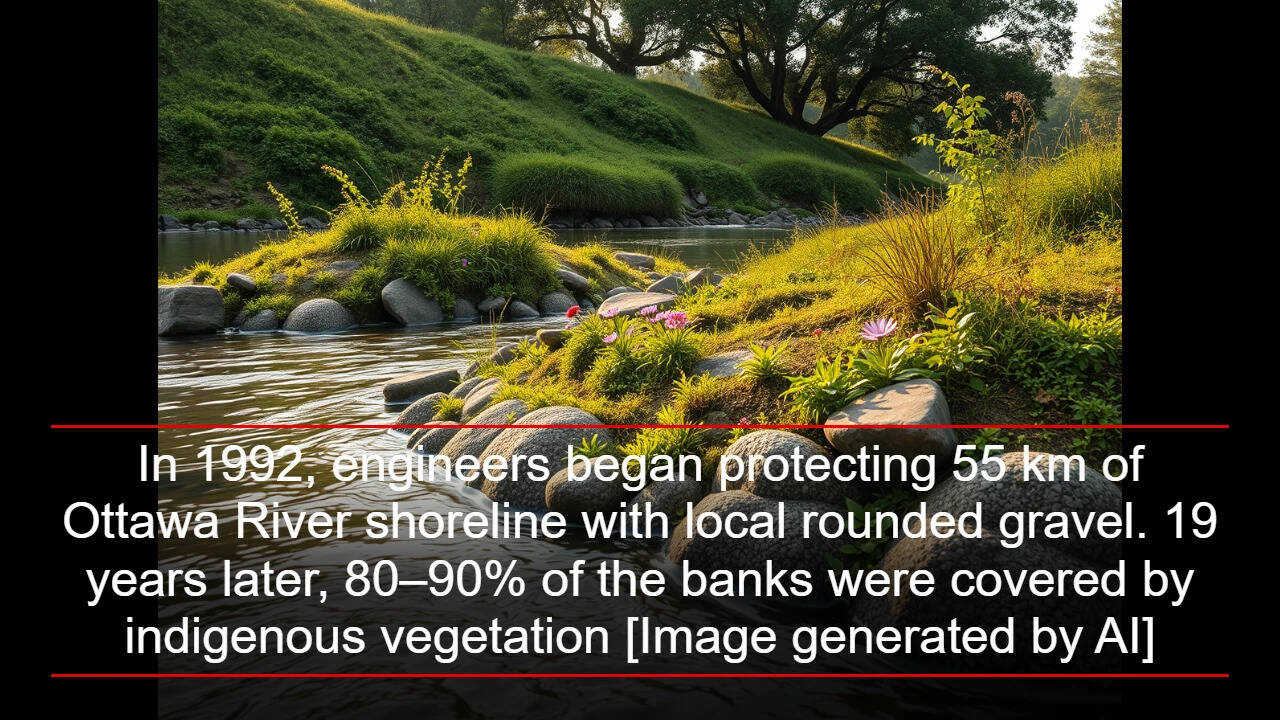
Riverbank erosion can be difficult to control without heavily altering the shoreline. Along the Ottawa River, engineers tried a different approach in the 1990s, using rounded granular material from nearby gravel pits rather than relying on traditional riprap or extensive bioengineering. The project eventually protected 55 kilometres of riverbank.
What made the method particularly notable was what happened afterward. A 2011 follow-up, 15 to 20 years after much of the work had been completed, found that indigenous vegetation had naturally returned across 80–90% of the banks and structures, while the vegetation was as diverse as that found on unstabilized sections.
The report is based on a research article. The research paper, A riverbank erosion control method with environmental value, by Line Bariteau, Denis Bouchard, Guylaine Gagnon, Mylène Levasseur, Stéphane Lapointe and Michel Bérubé, was published in Ecological Engineering , Volume 58, in 2013, pages 384–392.
How did the Ottawa River method work? Between 1992 and 1998, rounded granular material of glaciofluvial origin was placed along sections of the Ottawa River that were vulnerable to erosion. The material came from local gravel pits, making access to suitable sources an important part of the project.
Unlike some conventional riverbank stabilization methods, the approach did not require the slopes to be reshaped. Engineers also avoided installing a key or geotextile membrane, and there was no planting program designed to establish vegetation.
Instead, the method was based on allowing the structures
Read More