

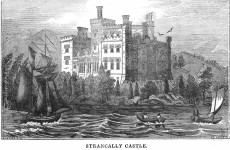
Strancally in County Waterford.
Column meta gaffs
Mark Zuckerberg’s castle purchase in Waterford is only the latest in a string of grand Irish estates snapped up by the super-rich. Just 40 years ago it was the rock stars.
Lise Hand
Journalist-at-large
FOR ANY BATTLE-SCARRED survivors of 1980s Ireland, a faint aroma of Eau du Déjà Vu has been wafting around one particular news yarn over the past week.
Amid all the heavy headlines about wars and droughts and carnage on our roads came the glad tidings that one of the world’s richest tech bro titans had nipped to the shops for some bits and returned home with Strancally Castle in County Waterford.
Cue a chorus of hosannas from media outlets desperate for a bit of lightness in these dog days of August. Excellent – a story involving castles which has bugger-all to do with relentless notice-boxes Meghan and her gormless plus-one Harry, and a story to boot which relates to the Meta boss’s spendiness as opposed to all the other weird and worrisome stuff he gets up to.
The 19th-century Strancally is even obligingly photogenic, all castellated turrets, tangles of climbing ivy and dramatic Gothic vibes, surrounded by rolling forested countryside and a winding river.
And then – better and better – it transpires that Zuckerberg isn’t the only massive moneybags who has captured a castle in this country. In fact, a whole clatter of financial boldface names have also quietly bagged Big Houses for themselves in recent times.
The Don with Zuck. Alamy Stock Photo
Alamy Stock Photo
And so a flurry of media happily ferreted out who lives where: practically next door to Strancally is Ballynatray House, an 18th-century Georgian manor bought by billionaire British inventor James Dyson in 2024 for more than €30 million. (Ironic, really, that the selfsame hot-air chap who loudly backed the Brexit referendum as the Path to Freedom for Blighty from EU tyranny, is now semi-ensconced in the EU country most royally screwed over by Brexit).
Another near-neighbour is Texas billionaire Kelcy Warren, who paid €20 million in 2019 for the beautiful Palladian mansion Castletown Cox on the Kilkenny-Waterford border – earlier this year Warren was revealed to be the mystery investor behind the €30 million plan to extend Waterford Airport’s runway.
Billionaire James Dyson. Alamy Stock Photo
Alamy Stock Photo
And only a short helicopter hop away in county Laois is Limerick-born John Collison, the co-founder and president of fintech company Stripe, who forked over about €20 million to acquire the opulent Abbeyleix House, a huge 1,120-acre estate once the ancestral home of the De Vesci family.
Then there is Liberty Media billionaire John Malone, who’s practically a native son by now, given he’s owned Humewood Castle in Wicklow and the 750-acre Castlemartin estate in Kildare for over a decade, both snapped up in the aftermath of the financial crash.
Indeed, last year Malone told a US newspaper that Zuckerberg had tried to buy Castlemartin – the former home of late Irish tycoon Tony O’Reilly – from him, proving the Meta megabucks had actually had one of his oddly beady eyes on acquiring a posh gaff here for some time.
So why is there a distinctly familiar ring to these heady headlines about the rich folk flocking to these shores? Well, because we’ve been here before, back in the mid-1980s when suddenly Ireland was awash with famous faces.
Whose land is it anyway?
Back then it was the ritzy south Dublin coastal enclave of Dalkey/Killiney which saw an influx of big names, prompting a blizzard of ‘Bel Éire’ headlines and lists of the rich and famous hanging out in Bono’s ‘hood. It caught the attention of the international media who were intrigued – and well they might have been.
The first flight of the well-heeled to these shores 40 years ago was an entirely different story. In the mid-80s, most of the wealthy refugees were creatives, mainly musicians, seeking shelter from the slings and arrows of outrageous tax bills.
At that time, Ireland was far from being a desirable destination. The country was stony-broke; our GDP stood for God Damned Poor. Our biggest export was mostly young people (over 450,000 left during the decade) whose financial and social prospects were blighted by sky-high unemployment and stymied by the breathtakingly hypocritical hierarchy of the still-dominant Catholic Church.
We used to read ‘Peig’ for a bit of light relief. When we travelled and announced we were from ‘Ireland’, we were met with incomprehension, queries as to whether we had said ‘Holland’, or worse still, “that is part of Britain, yes”? No, non, nein, nyet, não, tiocfaidh ár lá . Or worst of all, Irish was the country at war, wasn’t it, with bombs going off left right and centre. This belief was particularly prevalent among Americans who weren’t convinced that any trouble of that sort was happening over the border, a whole 70 miles from Dublin, given that the average American thought nothing of driving that distance to buy milk or a few six-packs.
But what we did have were tax breaks inspirationally conjured by the government in 1969, which allowed artists, writers and musicians to keep a hefty chunk of their earnings, and to double their money by taking advantage of a loophole in UK tax law which allowed them big savings if they steered clear of Britain for a year.
And this paid serious dividends when a wave of British bands began making out like bandits in the ‘80s, many having broken into the lucrative US markets via the wildly popular MTV and had to get out of (tax) Dodge. And it was the enforced exiles of MTV’s A-listers such as Frankie Goes to Hollywood, Spandau Ballet and Def Leppard which caught international media attention, sparking endless hot takes about the ineluctable hipness of Hibernia, its cool nightlife, its handiness to the rest of Europe.
Eric Clapton bought Barberstown Castle in Kildare in 1979 and sold it again in 1987. Alamy
Alamy
As the 1980s progressed, Ireland began to get its economic act together, the influence of the church was in retreat to secular progressivism, and the arts and culture sectors began to soar, supercharged by the likes of U2, filmmakers Neil Jordan and Jim Sheridan, Roddy Doyle’s Barrytown trilogy about our capital and its sweary denizens.
By the early 1990s Ireland was on the up – and was also increasingly tax-friendly to more than people who made music for a living. Apple came for a tax holibobs in 1980 and then was induced to remain. Other mighty multinationals took note, and Ireland Inc. took off.
However, the earnings which that first wave of celebrity refugees was trying to protect was loose change, compared with the jaw-dropping strings of zeroes at the disposal of today’s wave of recently-arrived billionaires and multi-millionaires.
Actor Jeremy Irons owns Kilcoe Castle in West Cork. Alamy
Alamy
Despite the flurry of publicity, though, this second wave hasn’t yet been bestowed with any snappy new ‘Bel Éire’ sobriquet – though given the number of tech tycoons in the vicinity of Waterford, maybe ‘Silicon Blaalley’ could be a contender. Instead, multiple recent articles, mostly in non-native media, have posed the question: why oh why are the ultra-rich snapping up castles in Ireland?
Well duh. The simple answer is because they can.
The wider answer is because 2020s Ireland is a world away from where we were in 1980. Inequality may still be rampant and the housing crisis a scourge, but (for now) we are a stable, peaceful, prosperous democracy with (for now) a temperate climate, and we’re a mere Gulfstream G550’s throw from the US east coast and from mainland Europe.
Maybe as well as all that, some buy castles here to keep connected to their own Irish roots – or else to try and claim them, little understanding that heritage is one of those inconvenient things which even a gigantic fistful of dollars can’t buy. Others come to golf and fish in privacy, others to place the width of the Atlantic between them and the increasingly crazy realm of the mad king.
Zuckerberg’s super yacht. Alamy Stock Photo
Alamy Stock Photo
And perhaps the nautical mickey-waving competition to own the world’s biggest super-yacht has become a costly bore. Mark Zuckerberg has a 387-foot super yacht worth about $300 million – his new castle cost a tenth of that. So if Jeff Bezos (skipper of a 417-foot, $500 million (€428.67 million) floating palace) is spotted in rural Ireland with a handful of brochures, we’ll know the game’s afoot.
I dunno – I’m sure it’ll all be grand, and perhaps locals might benefit from Zuck and Co.’s largesse a la Waterford airport, but I kind of wish it was more of an ‘80s vibe, when creatives were kings of our castles.
And heaven forfend that they should ever be lumbered with (almost) the same grumbling description used by British locals to describe American GIs stationed in the UK during World War II – overpaid, undertaxed and over here.
Lise Hand is a journalist and writer. This column runs every Wednesday.