

When Jess Newman heard that Temple Israel in Detroit was attacked last March, her first thoughts went to her extended family.
“I grew up going to services there,” she said. “The attack was awful. My Jewish identity is very important to me.”
On 12 March, Ayman Ghazali, a naturalized US citizen from Lebanon, drove his truck into the Temple Israel, causing a fire and injuring a security guard. But even amid her anxiety for her family, Newman was startled by the response from some community members.
“The reaction to it from people close to it that I know in my family is ‘we need AK-47s under our beds,’” she recalled.
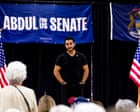
Today Newman, a political organizer who sits on the Ferndale school board, spends about 10 hours a week volunteering for the campaign of Abdul El-Sayed, a vocal critic of Israel and the Democratic party’s candidate for Michigan Senate in November midterm elections.
“There is a problem with antisemitism,” she says. “I think it is made all that much harder to deal with when you can’t have a sensible conversation about why violence is happening … you cannot divorce violence invited upon people from violence being done around the world.”
Newman’s experiences reflect the broader disagreements facing Michigan’s diverse Jewish communities this year. An estimated 130,000 Jewish Americans live in Michigan, where a 2021 study reported that 61% identified with or leaned Democrat and that Jewish adults are less likely to identify or lean Republican (31%) than all Michigan adults (42%). El-Sayed won the Democratic party’s Senate primary last month by just 15,000 votes.
In a battleground state, El-Sayed’s unapologetically progressive campaign focuses on affordability rather than conflict in the Middle East, which has drawn ire from Republicans. But his positions on Israel-Palestine, including calling for an end to offensive and defensive military aid from the US, have become the focus of an active campaign to urge Jewish Michiganders to vote for his Republican opponent, Mike Rogers – as well as a counter-effort on El-Sayed’s behalf.
Just six miles northwest of Newman’s progressive Ferndale neighborhood, Oak Park is the heartbeat of Michigan’s Orthodox Jewish community, home to Jewish retirement homes, synagogues and kosher bakeries. On the eve of the recent Rosh Hashanah holiday, there was a steady stream of customers buying bread and sweet treats from kosher stores as children furiously cycled from the stores to a nearby synagogue.
It was here, last April, that antisemitic graffiti was sprayed on the outside a synagogue.
“In the Jewish community, I think we have an awareness that it’s not if something is going to happen, it’s when something is going to happen. This isn’t the first incident we’ve had here,” Rabbi Robert Gamer of the Congregation Beth Shalom told CBS Detroit in April.
El-Sayid was criticized for comments he made in March about the Temple Israel attack, saying, in part, that “hurt people hurt people”, referring to the Temple Israel attacker. An FBI investigation concluded that the attacker was inspired by Hezbollah. Ghazali’s two brothers, a niece and a nephew, had been killed in an Israeli airstrike in southern Lebanon days before.
Law enforcement vehicles in the parking lot of Temple Israel as an Israeli flag blows in the wind on top of the building following an active shooter on 12 March. Photograph: Emily Elconin/Getty Images The Democratic candidate has also drawn criticism for links to Hasan Piker, the leftwing streamer who has become a target for attacks from Republicans and centrist Democrats.
In the Democratic primary, El-Sayed lost Oak Park’s Oakland county to Haley Stevens by nearly 20,000 votes – a number larger than his final winning margin.
El-Sayed later apologized for those comments, saying that he had jumped too quickly to provide “context” for the attack, “but it wasn’t the time for context”.
Still, El-Sayed’s message has particularly resonated with young Jewish Michiganders angered by the variety of challenges facing working people, and aligned with his positions on Israel. Since his primary win, he has made a concerted effort to meet with Jewish leaders, including the Michigan Democratic Jewish Caucus, which has not yet endorsed him.
Several campaign initiatives reflect divisions among Jewish communities. An open letter supporting El Sayed, signed by Michigan Jews for Democracy, has about 1,000 signatures. Other rabbis and Jewish leaders have formed the Nonnegotiable Michigan campaign, a petition that demands, among other things, that candidates for office support “Jewish sovereignty in Israel”. (El-Sayed has said he supports “equal rights to peace, dignity, and self-determination” for both Israeli and Palestinians, through whatever political system both peoples choose.) A third initiative is openly calling for Jewish Democrats and independents to back Rogers, claiming: “All of us have felt threatened and alienated by the politics and allies embraced by Abdul El-Sayed.”
In June, Jewish Voice for Peace (JVP), a pro-Palestine organization that represents about 750,000 members and supporters nationwide, endorsed El-Sayed in a first for the organization, helping him defeat Stevens, who received tens of millions of dollars from the American Israel Public Affairs Committee (Aipac), the pro-Israel Super Pac.
Others joined after the primary results were settled.
“After the primary, some of the members of our [T’chiyah] congregation who voted for Stevens started showing up to the Jews for Abdul meetings because they were just like: ‘We don’t totally align with him on [Israel], but we are very clear that the alternative is really bad,’” says Jackson Koeppel, a 33-year-old Detroit-based volunteer with Jews for Abdul, a group critical of Israel, citing El-Sayed’s platform on universal healthcare and getting money out of politics.
Last month, Rogers, El-Sayed’s Republican opponent, asked Aipac not to publicly spend advertising money on his own behalf, acknowledging a growing concern Michigan voters have with the powerful pro-Israel lobbying organization. Polls have put El-Sayed and Rogers in a dead heat.
For Josh Whinston, a rabbi at Temple Beth Emeth in Ann Arbor, a reform congregation, it was comments El-Sayed made the morning after his primary win last month that prompted significant concern.
“When I hear Dr El-Sayed, the morning after the primary, talk about Israel as bloodthirsty and then in the evening tell me that he cared about my security, that really created such a dissonance in my head,” said Whinston, who has joined the “Nonnegotiable” initiative. He said he viewed the term “bloodthirsty” as playing into an antisemitic trope.
At the same time, Whinston, who has met El-Sayed in a one-on-one meeting, says his door is not closed to the idea of voting for the Democrat. “He is an inspiring leader I think he has the potential to do amazing things in our country,” he says. “He is moving in the right direction; he has not moved far enough.”
Meanwhile, Republicans and right-wing media have seized on his platform.
Last month, vice-president JD Vance spoke personally with a rabbi and a security guard from Temple Israel, who also attended a rally Vance held in nearby Sterling Heights in which the vice-president claimed El-Sayed is “very, very evil”. (Temple Israel declined an interview request from the Guardian.)
El-Sayed’s campaign also faces a formidable challenge in the shape of massive sums of out-of-state campaign spending.
“In Detroit, we have a lot of work to do in terms of getting people excited,” says Newman. Elon Musk has already spent $1m in Michigan on online ads targeting El-Sayed.
For his part, Newman, who went on a birthright trip to Israel when she was 18, says the contrast between El-Sayed, an epidemiologist, and Rogers, who with his wife has a net worth of between $7m and $14m, is clear.
“He’s principled; he believes in and has actually done work to build better conditions for people in the [Michigan] health departments,” she says. “He’s running a campaign that I can respect; he’s not taking any corporate money, which is a huge piece of this.”