

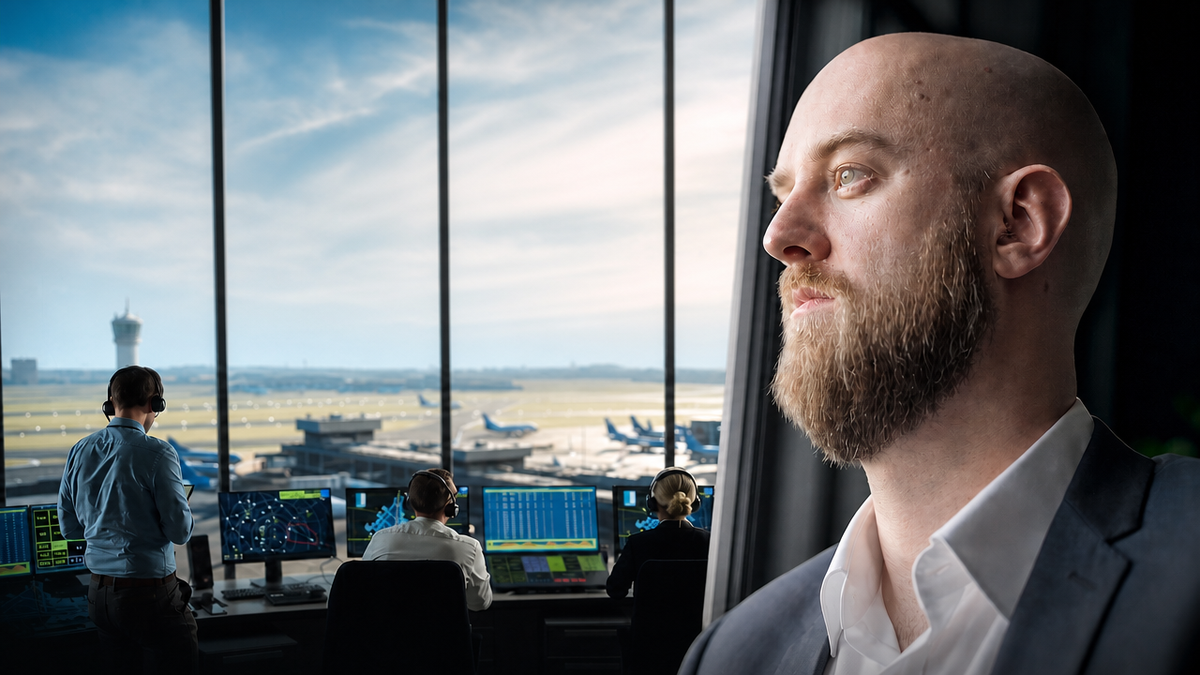
It is rare to hear from an Australian air traffic controller.
For most travellers, they are invisible — working behind the scenes, directing aircraft through some of the country’s busiest airspace.
But after a string of recent near-misses at Sydney airport and growing scrutiny of Australia’s aviation system, the people in the control room are increasingly in the spotlight.
Know the news with the 7NEWS app: Download today Arrow
Two airport employees have been stood down after two planes almost collided on the tarmac in Sydney. (HANDOUT/Dani Brown) Credit: AAP Scott Nugent has worked as an air traffic controller for eight years and currently directs aircraft in Sydney.
He is also the president of the Civil Air association representing controllers.
Scott Nugent, President of the Civil Air Credit: Spotlight While cautious about drawing conclusions about individual recent incidents, Nugent says there is a broader issue at the heart of many of the challenges facing Australian air traffic control: staffing.
“Air traffic controllers are critical. They’re absolutely critical assets to the system that we have. And without them, things start to fall apart.”
‘20 days in 21’ Nugent says staffing pressures have been building for years and are placing significant demands on controllers.
He claims some controllers are working 10 days in a row, followed by one day off, before working another 10 days.
“That leads to fatigue,” he says.
Asked whether fatigue can lead to mistakes, his answer is blunt.
“Of course it can.”
Sydney Airport boss breaks silence on near miss and traffic chaos Credit: 7NEWS Nugent says some controllers are also working extraordinary amounts of overtime.
“There is no world where any worker should be expected to work 800 hours of overtime per year,” he says.
“Some people do. Some individuals are, yes. And that’s not right and it’s not safe.”
Nugent says responsibility for addressing those pressures ultimately rests with Airservices Australia management and decisions made over many years.
Those decisions, he argues, have left Australia struggling to maintain an adequate workforce.
A workforce shortage that could take years to fix One of the key moments, Nugent says, came during the COVID-19 pandemic.
About 140 air traffic controllers aged between 56 and 65 were encouraged to retire, according to Nugent.
“We let 15 per cent of Australia’s air traffic control workforce go and we’ve struggled to replace them,” he says.
He believes the loss of experienced controllers has contributed significantly to the current pressures.
Nugent says it could take months or years, for the system to reach a point where staffing is stable enough to prevent the service disruptions seen in recent weeks.
He estimates the broader shortage could take as long as five years to resolve.
Western Sydney Airport adds another layer of complexity The staffing challenge comes as Australia’s aviation network undergoes another major change.
The new Western Sydney International Airport is preparing to welcome passenger services, adding another layer of complexity to already busy skies over western Sydney.
The airport is also introducing a technology Australia has not previously used for a major passenger airport: a digital air traffic control tower.
New flight paths take effect as Western Sydney Airport prepares for first landings Credit: 7NEWS Instead of controllers sitting inside a conventional tower at the airport, cameras and other technology provide views of the airport from a remote tower centre approximately 17km away at Eastern Creek.
Nugent says the technology presents new challenges.
“That’s a new technology. It’s the first time in Australia that that has been used,” he says.
“It’s certainly not the same as a traditional physical tower.”
The arrival of passenger aircraft will increase the demands on the system.
New flight paths take effect as Western Sydney Airport prepares for first landings Credit: 7NEWS “Come October, when passenger aircraft start flying in and out during the day, it will become more complex,” Nugent says.
“That will be a real challenge for our members to work through.”
‘You cannot keep pressuring controllers to do more’ For controllers, the pressure is not simply about the number of people available to work.
Nugent says controllers can also face pressure to return for additional shifts when staffing levels are tight.
He describes situations where a controller finishing a late shift may be asked to return early the following morning.
“When you go home at 10 o’clock and your boss has asked you to come back at 6am in the morning and put the hard word on you and said, ‘If you don’t do that, there’s going to be cancellations’ — that’s stressful,” he says.
Asked whether controllers can simply refuse, Nugent says technically they can.
“But it’s harder to do when you’re in the hot seat.”
He says controllers have been raising the issue with Airservices.
“You cannot keep pressuring controllers to do more and more and more instead of just giving them the resources they need to do their job.”
The mental health toll The pressure extends beyond fatigue and staffing.
Dave Riley, a US air traffic controller with more than three decades of experience, says the mental health challenges facing controllers have come increasingly to the forefront.
In the United States, at least 12 air traffic controllers died by suicide in 2024.
Riley says excessive overtime caused by staffing shortages can exacerbate existing pressures.
“The mental health piece has really come to the forefront in recent years,” he says.
Nugent agrees that mental health needs greater attention across the aviation industry.
He says aviation professionals working in cockpits and control towers need to be able to seek treatment without fearing that doing so could threaten their careers or livelihoods.
“If we actually want to stop aviation professionals in cockpits and in control towers from having these mental health concerns, we need to find a way that we can let them approach it and seek treatment without putting their career, their livelihood in jeopardy,” he says.
‘Don’t forget about us’ For all the attention focused on aircraft, pilots, runways and terminals, Nugent says one group remains largely unseen.
The controllers.
“Don’t forget about us,” he says.
“We are invisible.
“Everyone sees the plane, they see the pilots, they see the runways, they see the terminals. They don’t see air traffic controllers.”
They are, however, responsible for managing the movements of those aircraft — often under intense pressure and with little margin for error.
Nugent maintains that controllers remain highly trained and dedicated professionals.
“That’s what our members do,” he says.
“We’re highly trained, expert, dedicated professionals.”
But he says that expertise cannot substitute indefinitely for adequate staffing.
Australia’s aviation system is entering a period of significant change, with new infrastructure, new technology and growing demands on the airspace.
For the people working behind the scenes and for passengers, the question is whether the workforce will be ready to meet those demands.
The Civil Aviation Safety Authority and Airservices Australia declined requests for an interview.
Watch the full documentary Beyond the Tower now on 7plus.
CASA provided these answers to our questions regarding information featured in Beyond the Tower
Q. CASA assessed safety at Proserpine/Whitsunday Coast Airport in 2018. Is it due to be reassessed, and if not when would safety at the airport be reviewed given the growth in airline activity and passenger numbers?
CASA regularly monitors certified airports and can undertake further assessment where operational circumstances, traffic patterns or safety data indicate a review may be warranted.
Any decision to undertake a further formal airspace review would be based on a range of factors, including traffic growth, aircraft mix, operational complexity and safety evidence.
Changes have been made to address radio frequency congestion at Proserpine and VFR waypoints have been added to help pilot situational awareness.
2. Does CASA have a response to Dick Smith’s comments that he has told his family not to fly into Proserpine Airport because of safety concerns in uncontrolled airspace?
While CASA respects the expertise of Mr Smith, in this case CASA does not share Mr Smith’s view. CASA’s decisions are based on evidence, operational data and formal safety assessments.
Q: CASA determined Ballina Byron Gateway Airport should be upgraded in its 2022 review. According to CASA’s review it was informed of serious safety concerns in 2019. Why does it take years for CASA to investigate, review and reassess safety issues?
Legitimate safety concerns raised by industry participants form part of CASA’s decision-making process. However, airspace and aerodrome assessments require detailed analysis of safety data, operational trends, traffic movements, local conditions and consultation with affected stakeholders.
Changes to airspace arrangements are significant regulatory and operational undertakings that require detailed design, consultation and implementation planning.
CASA’s focus is ensuring any changes are evidence-based and deliver the intended safety benefits.
Q: Why did Ballina’s reclassification take four years to implement after the 2022 review?
The establishment of controlled airspace involves a number of stages, including safety assessment, airspace design, consultation with the aviation community, regulatory processes and implementation by Airservices Australia.
Following CASA’s review and recommendations, a phased implementation involved multiple organisations and a range of technical, operational and resource considerations.
Improvements made around Ballina included changes to radio frequencies used by pilots to reduce congestion, provision of a Surveillance Flight Information Service (SFIS) to provide pilots with information about other aircraft in the area, and the introduction of an Automatic Dependent Surveillance-Broadcast ground station to allow appropriately equipped aircraft to be more easily detected by air traffic control.
These actions were supported by safety campaigns to inform pilots, briefing sessions and new air routes to and from Ballina.
However, growth and increasing complexity of operations at the airport meant there was a need to introduce controlled airspace and air traffic services in the near future. In November 2023, CASA issued a directive to Airservices Australia to expedite the process based on an understanding of the agency’s resources. The SFIS was retained until the airspace was reclassified and tower became operational on 9 July 2026. At no time did CASA assess there was an unacceptable level of safety.
Questions about the implementation of air traffic services and the corresponding infrastructure should be directed to Airservices Australia
Q. What is the current status of airports including Port Hedland, Geraldton, Bundaberg, Mount Isa, Proserpine, Ayers Rock, Orange and Bathurst?
We continue to monitor safety performance and operational activity at airports across Australia as part of our role to determine the appropriate airspace classification at each facility.
Q. Does everything get down to money?
CASA’s overriding priority is safety.
Aviation safety is always evolving. CASA and the aviation industry continually reviews safety data and learns from accidents and incidents. We invest in pilot education, and adopt new technologies and risk controls where needed. Our focus remains on making evidence-based decisions that strengthen safety and support Australia’s strong aviation safety record.