

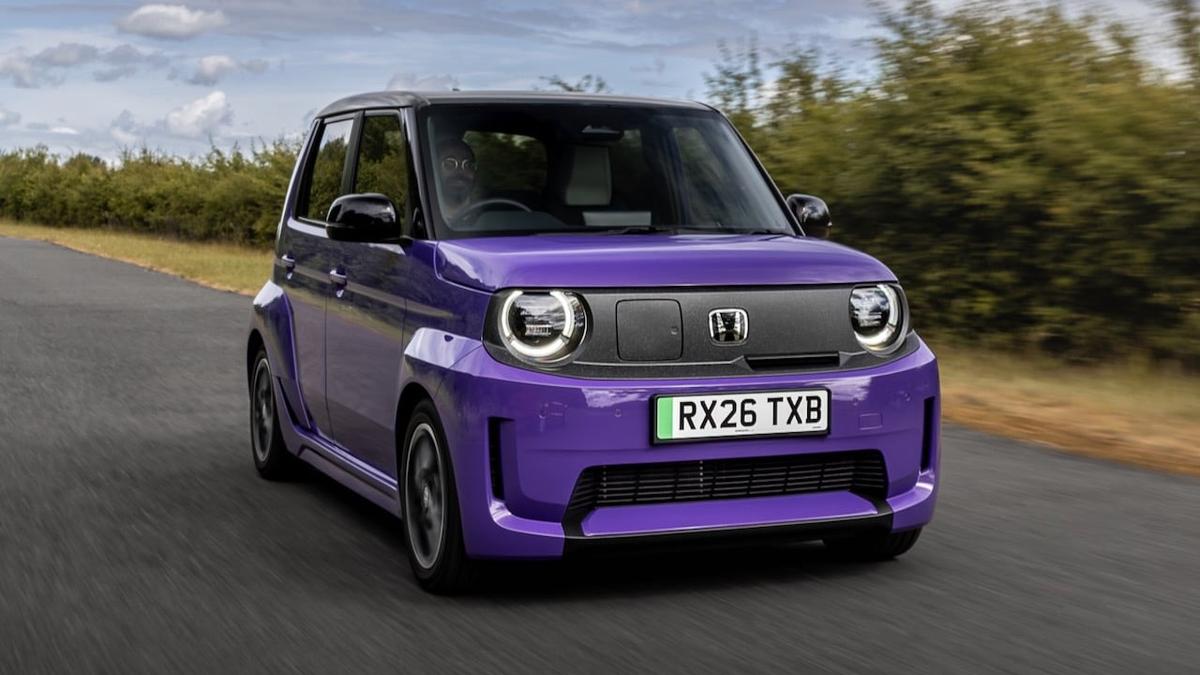
The upcoming Super-One is by no means Honda’s first attempt at an electric vehicle (EV), but the battery-powered micro-car will be the first EV sold in Australia by the Japanese automaker when it arrives later in 2026.
2026 Honda Super-One: Quick drive Credit: CarExpert An enhanced version of the N-One e: kei car from Japan, the Super-One places major emphasis on its hugely appealing exterior, along with the promise of impressive driving thrills that, previously in this most compact class of EV, have been mainly lacking.
Know the news with the 7NEWS app: Download today Arrow
To find out if the Super-One has the dynamic talents to back up its boxy chops, we headed to the south of England for a quick drive in Honda’s all-new pint-size EV.
How much does the Honda Super-One cost? We still don’t have cast-iron prices as yet, but from what we know about its market positioning in Japan, and also how inexpensive it is in the UK (where it’s sold as the Super-N, not the Super-One), we’re very hopeful that Honda can bring this car to market in Australia for less than $30,000.
2026 Honda Super-One: Quick drive Credit: CarExpert Whether it would be able to get down to the sort of level that makes the BYD Atto 1 Essential Australia’s cheapest new EV (at $23,990 before on-road costs) remains to be seen, but the Super-One could compete with the grander Premium spec ($27,990 plus on-roads) of that electric hatch – and that would mean it could seriously undercut the Hyundai Inster, which costs almost $40,000 in its most affordable specification.
To see how the Honda Super-One lines up against the competition, check out our comparison tool
What is the Honda Super-One like on the inside? A mix of the excellent and the not-so-good, the Honda Super-One’s cabin can broadly be deemed a success. But let’s start with the compromises first.
2026 Honda Super-One: Quick drive Credit: CarExpert The main drawback of this kei-derived car is that its minuscule exterior dimensions make it strictly a four-seater, like the Atto 1 and Inster. There’s no centre seat belt or middle squab in the rear, for example.
And those sitting up front had better be of the smaller persuasion, or at the very least reasonably well-acquainted with their passenger, because the narrowness of the Honda’s body does mean that larger folk will be rubbing shoulders and/or elbows a lot of the time.
Also, bigger drivers might find themselves feeling somewhat hemmed up against the right-hand door, rather like piloting a shrunken version of the old Land Rover Defender.
There’s more. There’s no wireless smartphone charger in the Honda Super-One and not really any place to stow a smartphone – save the door-pull slots themselves – while the central shelf is all shiny and not very sculpted, so stashing anything there means it’ll probably just slide off into a footwell at the first corner you take with any vim.
2026 Honda Super-One: Quick drive Credit: CarExpert 2026 Honda Super-One: Quick drive Credit: CarExpert 2026 Honda Super-One: Quick drive Credit: CarExpert 2026 Honda Super-One: Quick drive Credit: CarExpert Indeed, general storage throughout the car isn’t great, while the boot measures just 162 litres with all seats in use. There’s no frunk either, before you ask, and sitting underneath the rear boot’s floor is the subwoofer for the uprated Bose sound system within the passenger compartment, which means there’s no place to store charging cables except in the main boot area – and there’s no spare wheel, either.
Finally, some of the cabin plastics are extremely basic. That’s understandable at this value-conscious end of the car market, but you might have been expecting a degree of better material polish from Honda.
That’s where our carping ends, though. There’s a cheerful ambience and sound ergonomic design inside the Super-One, and while the plastics may be simplistic, everything feels very well put together.
The twin digital screens work sweetly enough, the infotainment system supports Android Auto and Apple CarPlay wirelessly, and we reserve special praise for the lovely little two-spoke steering wheel, the deliciously sculpted and supportive front bucket seats, and the ambient interior lighting that’ll switch to a purple theme when the car is in Boost mode.
2026 Honda Super-One: Quick drive Credit: CarExpert 2026 Honda Super-One: Quick drive Credit: CarExpert 2026 Honda Super-One: Quick drive Credit: CarExpert 2026 Honda Super-One: Quick drive Credit: CarExpert In the rear, there’s a completely flat floor, plus just about enough legroom and headroom that the idea of seating four fair-sized adults onboard the Honda EV in reasonable comfort isn’t completely daft.
However, the second-row bench is mounted quite low, so taller passengers’ thighs tend to be angled upward, which isn’t always the most comfortable seating position long-term.
Good news for parents: there are two ISOFIX anchors for child seats in the back of the Super-One. And, in finest Honda style, the clever, tumbling Magic Seats are incorporated in the rear – along with 50/50-split/folding backrests – so that you can clear out the floor to carry taller items or drop the chairs to liberate up to 967L of outright cargo capacity.
To see how the Honda Super-One lines up against the competition, check out our comparison tool
What’s under the bonnet? A very modest 47kW electric motor on the front axle, driving through a single-speed reduction-gear transmission, is pretty much standard kei-car fare. However, the Super-One doesn’t have to conform to those regulations, so it has a Boost mode which, when activated, ramps up the output to 70kW.
2026 Honda Super-One: Quick drive Credit: CarExpert This is ably abetted by 162Nm of twist, which it makes in all five drive modes (Econ, City, Normal, Sport and Boost) – it’s just that in Boost, the Honda holds onto the peak figure for slightly longer before tailing off the torque as road speeds rise.
Weighing in at just 1097kg as tested, the Super-One takes a leisurely 14.5 seconds to hit 100km/h from rest when it is outputting just 47kW.
But with the full 70kW on flow, it trims 4.5 seconds from that sprint for a flat 10-second run.
There’s just the one battery for the Super-One and it’s a slim, lightweight, lithium-ion affair rated at 29.6kWh.
2026 Honda Super-One: Quick drive Credit: CarExpert On the WLTP combined cycle, the heavily city-biased Honda Super-One is said to go up to 206km on a charge. Perhaps the WLTP city test return is a better indicator of what you might get in the real world if you stick to urban routes, as then the EV can travel up to 320km without needing a top-up, according to Honda.
The charging speeds max out at 10kW on AC and 50kW on a DC fast-charger. On a typical 7.4kW domestic wallbox, expect a full 10-100 per cent charge of the Super-One to take 4.5 hours, while at its very fastest rate of replenishment, a 10-80 per cent cycle will require half an hour.
To see how the Honda Super-One lines up against the competition, check out our comparison tool
How does the Honda Super-One drive? Honda has made a big deal about how much fun the Super-One is to drive, because not only does it have more power than an N-One e:, but it also has 50mm-wider tracks and retuned suspension and steering to provide a sharper drive.
2026 Honda Super-One: Quick drive Credit: CarExpert It can also, in either Sport or Boost mode, mimic a seven-speed dual-clutch automatic transmission if you pull back and hold the left-hand paddle on the steering wheel. This is accompanied by synthesised noises which aim to replicate the engine and exhaust sounds of both the City Turbo II of the 1980s and the legendary DC2 Integra Type-R, two of Honda’s highly revered products of the past.
We’ll get this out of the way now: the Super-One doesn’t sound anything like either of them. In fairness, the noise it does emit is not bad, although our passenger reckoned the thick, deep buzzing note was reminiscent of “distant motorcycles” more than anything else, but there’s no doubting both this soundtrack and the simulated gearshifts bring an extra element of involvement to the Super-One.
The net result is that it’s a little hoot to drive. A genuinely brilliant small EV and far more engaging than almost all of its worldwide competitors, this side of a Renault 5 E-Tech. Of the drive modes, we’d steer clear of Econ. The slow accelerator response and power delivery make the Honda feel considerably undernourished, especially when you encounter only a modest uphill gradient and you need some sprightly acceleration.
2026 Honda Super-One: Quick drive Credit: CarExpert Both City and Normal are better, the former even bringing in a one-pedal driving function with supremely well-judged regenerative braking.
Indeed, the stoppers deserve praise throughout, because the pedal is beautifully progressive and the brakes’ bite is strong, despite the fact the Super-One runs drums at the rear.
Sport does allow you access to the ‘gear shifting’ we mentioned above, as well as bringing up some more driver-focused dials in the 7.0-inch instrument cluster. Yet the Honda remains running 47kW in this setting.
But the real joy is in Boost. We’re not about to say the Honda is in any way fast in this mode, you understand; but when the car weighs less than 1.1 tonnes, you soon realise that 70kW and 162Nm are more than ample figures to make the Super-One feel enjoyably lively.
2026 Honda Super-One: Quick drive Credit: CarExpert Aiding all of this is some fabulous steering for a city car, which is well-weighted, precise and direct, and suspension which does a grand job of convincing you the Honda EV is not as tall and narrow as it actually is.
Body roll is suitably contained, wheel control is top-drawer for a small car like this, and understeer is resisted even under rigorous provocation.
The Super-One even rides smoothly in most instances and is surprisingly adept for refinement and stability at highway speeds, even if that’s not its natural environment.
2026 Honda Super-One: Quick drive Credit: CarExpert The only slight fly in the kinematic ointment here is that the Honda can occasionally display a sharp-edged gait if the tarmac is particularly pockmarked or you’re encountering a lot of speed bumps – both scenarios commonplace in its preferred habitat of city environments.
But we’d never call the Super-One actively uncomfortable and, overall, we don’t mind this occasional moderate lumpiness as a payoff for the superb way the Honda can dissect corners when it’s out on interesting, open roads.
To see how the Honda Super-One lines up against the competition, check out our comparison tool
What do you get? We can only speculate, again going by both the Japanese and UK specifications we already know about.
2026 Honda Super-One: Quick drive Credit: CarExpert 2026 Honda Super-One: Quick drive Credit: CarExpert 2026 Honda Super-One: Quick drive Credit: CarExpert 2026 Honda Super-One: Quick drive Credit: CarExpert But the Honda Super-One should come to Australia in a single specification that includes:
15-inch alloy wheels Heated front seats and steering wheel Climate control air-conditioning Adaptive cruise control 9.0-inch infotainment touchscreen Apple CarPlay and Android Auto connectivity 7.0-inch digital driver’s display 8-speaker Bose premium sound system with boot-mounted subwoofer Honda Sensing safety suite Keyless entry via proximity key LED headlights To see how the Honda Super-One lines up against the competition, check out our comparison tool
Is the Honda Super-One safe? It hasn’t yet been tested by either Euro NCAP or ANCAP, so we can’t say as yet. But we anticipate a decent showing in this regard from the Super-One, as the Honda Sensing suite includes advanced driver-assistance systems like front and rear autonomous emergency braking, forward collision warning, traffic jam assist, traffic sign recognition, post-collision mitigation braking, adaptive cruise control, and a lane-keeping assist system.
2026 Honda Super-One: Quick drive Credit: CarExpert Honda also reckons that despite its minute size and relative lack of metal around the passenger compartment, the Super-One has a strong structure thanks to Advanced Compatibility Engineering – a network of front-frame construction processes that aim to absorb and deflect the energy from a big frontal collision.
To see how the Honda Super-One lines up against the competition, check out our comparison tool
How much does the Honda Super-One cost to run? With its small battery, recharging sessions won’t break the bank, although you’ll be performing more of them if you’re a high-usage driver who travels much more than 100km daily.
2026 Honda Super-One: Quick drive Credit: CarExpert While yet to be confirmed, Honda Australia typically offers a five-year, unlimited-kilometre warranty, five years of premium roadside assistance, and five years of low-price scheduled servicing (from just $199 each). Owners can even extend the warranty and the assistance packages to eight years, provided certain conditions are met.
To see how the Honda Super-One lines up against the competition, check out our comparison tool
CarExpert’s Take on the Honda Super-One You have to accept that the Honda Super-One is a short-distance EV and one that has a couple of compromises to swallow, as a result of its tiny footprint.
2026 Honda Super-One: Quick drive Credit: CarExpert But if you can get past those – or you’re just looking for an urban commuter car that’s going to cost cents to run, and which is chock-full of character – then you’ll likely adore Honda’s newest release.
It’s a delight to drive, it’s packed with equipment that you’d normally find only on much bigger cars, it’s likely to be one of the most inexpensive EVs on sale in Australia if our market prices follow global trends for the car – oh yeah, and it looks like that on the outside.
It’s a marvellous little city EV and it, along with the revival of the Prelude coupe, shows that maybe, just maybe, Honda is finally getting its mojo back.
2026 Honda Super-One: Quick drive Credit: CarExpert CarExpert can save you thousands on a new Honda Super-One. Click here to get a great deal.
MORE: Explore the Honda Super-One showroom
Pros Fabulous looks Great to drive Plenty of kit Cons Four-seater only Short driving range A few practicality issues
Read More