

The gap between smartphone chips in 2026 is absurd. The fastest chip we’ve tested is roughly 15 times more powerful than the slowest one still found in modern smartphones. And yet both can run essentially the same apps, games and operating systems. Mobile silicon has become wildly diverse.
Of course, raw performance isn’t everything. Software optimization, thermal management, storage speed and app behavior all play a huge role in how fast a phone actually feels day to day. But when it comes to demanding workloads, there’s still no substitute for brute computational power.
So we decided to strip things down to the fundamentals.
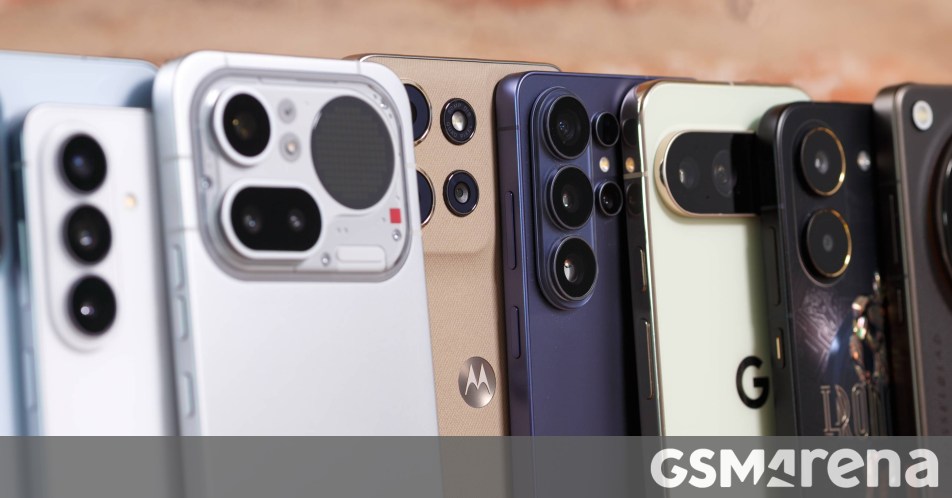
Just several of the hundreds of phones we’ve tested
This comparison focuses purely on raw chipset performance using three benchmarks from our review database: GeekBench single-core, GeekBench multi-core and 3DMark Wild Life Extreme. No camera processing comparisons, no AI claims, no connectivity features and no manufacturer marketing promises – just CPU and GPU performance across 70 smartphone chips from the last two and a half years.
The results are sourced from our own device reviews, with median scores used where multiple devices with the same chipset were tested.
To make the charts easier to read, the tool uses a dynamic 100% baseline system. Select any chip, and all others are recalculated relative to it. You can also view the underlying benchmark numbers for each individual test.
By default, the “Popular” filter is enabled, showing the 30 most-viewed chips in our database based on recent reader interest. Disable it if you want to browse the full list.
Enough setup – dive in.
Chipset performance comparison
Benchmark scores, displayed as relative performance versus a selectable 100% baseline.
A few things jump out immediately when looking at the dataset (as of June 2026).
The flagship race is compressing at the top. Five or six years ago, one company would usually dominate an entire generation. Now Snapdragon 8 Elite Gen 5, Dimensity 9500, Exynos 2600, and Apple A19 Pro all effectively occupy the same ultra-high-end performance tier. There are differences, but they are not dramatic. The real market split is now between flagship and everything else, not between flagship vendors themselves.
Apple still owns single-core. This is probably the cleanest observation in the entire dataset. The A19 Pro is still the single-core king, even against Qualcomm’s latest monsters. Single-core performance is incredibly important in UI interactions, so Apple is clearly prioritizing responsiveness and burst performance more than anything else.
Qualcomm’s dominance is increasingly GPU-driven. Qualcomm’s strength lies in delivering the most balanced performance across CPU and gra
Read More