

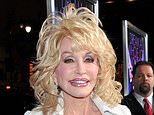
I met Dolly Parton, who died yesterday at the grand ol’ age of 80 after a battle with cancer, when she was 60, or ‘sexty!’ as she exclaimed as she tried to give me a bear hug, her famous rhinestone-covered boobs getting in the way.
The location was The Turning Stone resort, a ‘dry’ hotel built on land owned by Native Americans in upstate New York. Dolly was due on stage but still spared me two hours for the interview for this newspaper.
I was expecting a diva, but she turned out to be a girl’s girl – ‘I saw you waiting in the corridor and I thought, “Who is that attractive young woman?”’ – who when I said I’d be in the audience later, exclaimed: ‘I hope I don’t disappoint. I’ll try extra hard, Honey!’
Everything about Dolly was a contradiction. Born in a one-room cabin by the Smoky Mountains of East Tennessee, the fourth of 12 children (‘We all thought we were Mama’s favourite’), they only ate food that they could catch or grow, and she had a morbid fear of ever getting fat: ‘I only eat very small portions. If I am going to a really fine dinner, I won’t eat that day… My boobs just look big as they’re hanging on an itty bitty person!’
Her vital statistics when we met were 40-20-36. ‘I heard rumours saying I’d had ribs removed to make my waist small but it’s not true. Small waists run in my family.’
Despite the perfectly curated image, she wasn’t vain. I sat beside her in her backstage dressing room and she gazed at her face dispassionately, though told me, peering closely, ‘I see every little thing. I hate fluorescent lights worse than life. Or bright sunlight. But you can’t do much about God’s spotlight! My shoulders are so bony.’
Her songs were about heartbreak but she never had man problems: she met her husband, Carl, when she arrived, aged 18, in Nashville, chaperoned by an uncle.
She and Carl were devoted to each other: she made sure they never spent more than two weeks apart, and the marriage worked as he was not involved in the music business, but merely relished her tales second hand.
Dolly Parton revealed to Liz Jones that she always wore make-up, even around the house
He died in March last year, and her family announced yesterday that Dolly had neglected her own early symptoms as she had been focused on caring for her husband when he was dying.
There never was a Jolene, the title of her 1974 hit, she just thought it ‘a pretty name’; she wrote the song, she said onstage later, ‘after a female bank teller looked at my husband funny’.
She was curiously old-fashioned, never taking the upper hand in her marriage, never relaxing about looking good, even off duty: ‘When I’m home, I usually wear make-up because I don’t want to go around looking like a slouch for my husband. I work with a lot of stars who come to the studio looking so bad you wouldn’t even know them. I think, I wouldn’t even look that bad at home!’
There was never a rivalry with Whitney Houston, who covered her I Will Always Love You for the film The Bodyguard in 1992, despite reports to the contrary. In fact, Houston’s cover earned Dolly royalties of $6million (£4.4million) and counting: ‘Man, I wanted to kiss her and hug her, jump up and down, ’cause she did such a spectacular job!’
In fact, Dolly was generous when I asked about Houston’s problems with drugs and alcohol: ‘Of course I’m not that great of an artist, so I haven’t had that same type of pressure, mine was more of a down-home kind of stardom, you know?’
The country singer won 11 Grammys and had 25 No 1 hits during her long career
Dolly put her timeless looks down to the fact ‘I have good skin. Of course I’ve had nips and tucks here and there, but no doctor can give you good skin. I never smoked or drank alcohol ’cause I know that’s very drying. I’ll never be at an age where I don’t care how I look’.
And she took no offence when I asked what was under the famous blonde wig: ‘My hair’s longer than the wig I have on now,’ she said, not in the least offended. ‘I usually keep my hair about shoulder-length and I keep it blonde. I pull it up in little scrunches.’
The 100million-plus record sales (she won 11 Grammys and had 25 number ones) made her very wealthy, but she told me she could never retire – she had worked full-time since graduating from high school; even when she died on Tuesday, she had numerous projects on the go, including more than 100 relatives on the payroll. She never had children but raised five of her siblings; a partial hysterectomy in 1984, when she was 38, was the only time she ever felt depressed.
She had no fear of being poor again because ‘I grew up knowing how to raise a garden, how to plan food; I would know how to survive’. She kept striving as ‘I’m the one with the money, the one who can help. I feel like I have to go to work every day because I have a very large family to support. I can’t be selfish and say, “Oh, I’m taking my money and I’m going to retire” ’cause I could never do that’.
She still lived in the Nashville area, and had, at the age of 40, opened Dollywood, a 25-acre amusement park that revitalised the region. Her Dollywood Foundation funds student scholarships and provides every child born in the county with a new book every month, from birth until the age of five.
They really don’t make women like her anymore!
There was no hint of resentment: ‘I try to be sharing and giving. They [the Foundation] can have half of anything I got, I’m there for them. It’s a joy. It gives me a good feeling, like I’m not just taking… Sometimes I wish I didn’t worry as much as I do. It’s just on a bigger scale with me than it is for normal, regular people.’
As we parted company she told me: ‘I hope I live to be a hundred. As long as I’ve got my health and an audience, I’ll be out there doing it ’til I fall over.’