

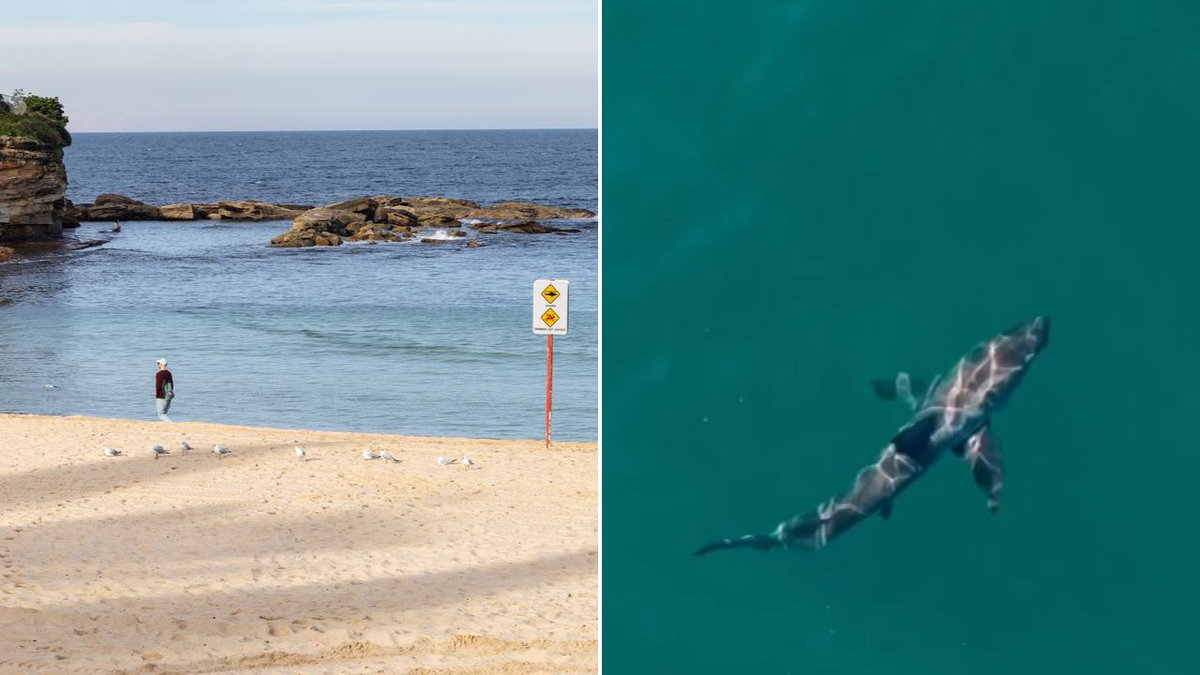
When 18-year-old surf lifesaver Milton Coughlan was killed by a shark at Coogee Beach in February 1922, Sydney struggled to make sense of what had happened.
The teenager was one of countless young Australians embracing a growing national obsession.
WATCH THE VIDEO ABOVE: Shark attack at Coogee sparks drone debate
Know the news with the 7NEWS app: Download today Arrow
Beach culture was booming, surf lifesaving clubs were expanding, and families were flocking to the coast in record numbers. The ocean had become a symbol of freedom, recreation and community.
Then, in a split second, it became a source of fear.
As news of the attack spread, so too did public anxiety. Newspapers carried extensive coverage of the tragedy, while concern spread well beyond Coogee.
For many Sydneysiders, the attack challenged a growing belief that the beach was a place of safety and enjoyment. If a young surf lifesaver could be killed in waters he knew so well, who was safe?
Authorities searched for answers while the public demanded action. In the years that followed, anti-shark rallies attracted thousands of people, fishermen hunted sharks along the coastline, and Coogee Beach eventually installed a steel shark-proof enclosure stretching across part of the bay.
At one gathering, a man emerged from the water holding a dead grey nurse shark above his head as the crowd cheered.
The people wanted a shark to pay, and many did. But Australians in the water were still not safe.
More than a century later, they still aren’t.
When Sydney mother and teacher Leah Stewart was attacked by a suspected great white shark while swimming at Coogee Beach this month, the public response felt strikingly familiar.
The 35-year-old wasn’t surfing offshore or diving in remote waters. She was swimming close to shore at one of the country’s most popular beaches, doing the very thing millions of Australians do every summer.
Her injuries horrified the nation and reignited calls for shark culls, just as previous attacks have done for generations.
More than 100 years separate the attacks on Coughlan and Stewart, but the response has remained remarkably consistent. A shark attacks a swimmer. The public demands action. Attention turns to removing sharks from the water.
Yet despite decades of shark control programs, shark nets, drumlines and calls for culls, Australians are still being attacked.
Which raises an uncomfortable question: despite more than a century of shark control measures, why does the threat remain?
The politics of fear For shark policy expert Christopher Pepin-Neff, the fact Australia continues to revisit the cull debate after every major attack is hardly surprising.
While concern after a serious attack is a natural human response, Pepin-Neff said incidents involving everyday swimmers often strike a deeper nerve because they challenge Australians’ expectations about beach safety.
That was particularly evident following the attack on Stewart. Unlike many previous shark attack victims, she wasn’t surfing offshore or engaging in a high-risk activity. She was swimming close to shore at a popular suburban beach in broad daylight.
“There is a social construction around the beach and the public and when it is safe to use the beach,” Pepin-Neff said.
“The argument is that she was in the right place but the shark was in the wrong place.”
Leah Stewart was attacked by a shark. Credit: 7NEWS When that expectation is shattered, pressure quickly shifts to governments.
Communities want reassurance, swimmers want confidence, and families want to know everything possible is being done to prevent another attack.
For more than a century, that pressure has often led to the same solution.
“Shark culls are quick. They are cathartic. The public feels better. It demonstrates action by the government,” Pepin-Neff said.
That desire for visible action helps explain why the cull debate continues to resurface after major attacks, despite ongoing questions about whether killing sharks meaningfully reduces risk.
“I always say shark culls protect politicians. They don’t protect swimmers,” Pepin-Neff said.
Do shark culls actually work? At first glance, the logic behind a shark cull appears straightforward — if a shark attacks a swimmer, remove the shark.
But experts say the reality is far more complicated.
One of the biggest misconceptions, according to Pepin-Neff, if the belief that a single shark is responsible for the danger.
“There is a historical idea that there’s one shark that’s responsible and if you kill the one shark, that has solved the problem and the beach goes back to being safe,” Pepin-Neff said.
“The beach is always the wild.”
All of Sydney’s eastern suburbs beaches were closed on Sunday after a shark attack at Coogee. Credit: AAP In other words, removing one shark does little to change the broader environment in which attacks occur.
White sharks are highly migratory animals capable of travelling vast distances along Australia’s coastline.
“The shark you see on Monday could be from Auckland and the shark you see on Tuesday could be from Brisbane,” Pepin-Neff said.
“So killing one has literally no effect — literally nothing — on actual beach safety.”
Fisheries management expert Daryl McPhee believes the conversation often becomes confused because people use the term “cull” to describe a range of very different measures.
McPhee said governments have long relied on a combination of shark nets, drumlines and surveillance measures to reduce risk, but warned there was no solution capable of eliminating it entirely.
“Government can’t make our waters 100 per cent safe,” McPhee said.
That reality can be difficult for the public to accept after a life-changing or fatal attack.
More than 100 years after people hunted sharks along Sydney’s coastline in the aftermath of Milton Coughlan’s death, the uncomfortable truth remains the same: there is no evidence that killing a shark guarantees the next swimmer will be safe.
The hunt for a better solution So, if culls are not the answer, what is?
For many experts, the future lies not in removing sharks from the oceans but in finding ways to help people avoid them while still being able to enjoy the ocean.
Following the Coogee attack this month, renewed attention has been placed on technologies including drones, shark listening stations, tagging programs and SMART drumlines.
McPhee believes drone surveillance may be one of the most promising tools at our disposal.
In fact, he believes the recent attack on Stewart is one of the few incidents where drone surveillance may have made a difference.
“I don’t think I’ve actually ever said it before but this is one bite, the Coogee bite, where I think it could have been avoided through the use of drones,” McPhee said.
“Had that drone been flying, I think that shark would have been relatively easy to see.”
While no technology can ever fully eliminate the risk of shark attacks, surveillance tools are becoming increasingly sophisticated and provide governments with opportunities that simply didn’t exist in previous decades.
For experts, this represents a fundamental shift in thinking. Rather than attempting to remove every potential threat from the ocean, the focus would turn towards risk management and early detection.
Even if sharks culls did work, what could be the cost? One of the biggest challenges in Australia’s shark debate is that sharks are almost always discussed as a threat, but for Pepin-Neff that framing overlooks a more fundamental question: what role do sharks actually play in the ocean, and what could be lost if they disappeared?
They argued much of the public conversation focuses on the danger sharks pose to humans, while paying far less attention to the role they play in maintaining healthy marine ecosystems.
Rather than seeing sharks solely as predators, many communities view them as indicators of a healthy ocean. Their presence signals that fish populations are thriving and that the broader ecosystem is functioning as it should.
“In Hawaii, sharks are revered,” they said.
“Sharks bring life, because the presence of sharks means there are other fish.
“The sharks are there because they’re hunting something. Which means life for the local community.”
The ecological role of sharks is often absent from discussions about culls, despite growing scientific concern about the consequences of removing apex predators from marine environments.
Pepin-Neff said many people instinctively focus on the risks associated with species such as bull sharks in Sydney Harbour, but rarely stop to consider what the harbour might look like without them.
As predators at the top of the food chain, sharks help regulate populations below them and contribute to the balance of entire ecosystems.
Scientists warn that removing large numbers of sharks can trigger “a trophic cascade”, where changes at the top of the food chain flow through to other species in ways that are difficult to predict.
In Sydney Harbour, for example, bull sharks play an important role in controlling populations of dusky sharks.
“There are many more dusky sharks in the harbour than there are bull sharks, but the bull sharks keep the dusky sharks in check. That’s the balance of the ecosystem,” Pepin-Neff said.
“So now you overkill the bull sharks. And now, God knows what the dusky sharks do.
“When you mess with mother nature, it messes back.”
The question Australia keeps asking
Milton Coughlan’s death sparked panic, outrage, and demands for action. More than a century later, the attack on Leah Stewart did the same.
More than a century separates the two attacks, yet the public response remains remarkably familiar.
People still search for answers. Politicians still face pressure to act. And Australians are still trying to find a way to make the ocean feel safe.
That search has produced shark nets, drumlines, enclosures, surveillance systems, and repeated calls for culls. Yet despite all of it, the risk has never disappeared completely.
Perhaps that is why the debate refuses to go away. Every shark attack forces Australians to confront the same uncomfortable reality that confronted Sydney in 1922, the ocean can never be made entirely safe.
The question Australia is still grappling with is whether killing sharks makes the ocean any safer at all — or whether, for more than a century, it has simply provided the reassurance people were searching for.