

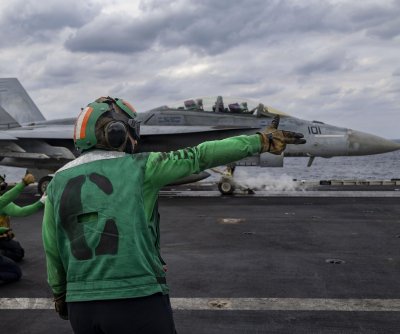
The United States on Sunday carried out a second night of airstrikes against Iranian targets as their dispute over transit rights in the Strait of Hormuz threatened to escalate beyond the region. U.S. Navy file photo by Mass Communication Specialist Seaman Zoe Simpson
July 12 (UPI) — The U.S. military said late Sunday ithad completed a new wave of attacks against Iran, as world leaders raised fears that a fragile cease-fire would collapse and the conflict could widen beyond the region.
The Sunday attack was the second consecutive night that the United States had attacked Iran and was the fourth round in a week, prompting retaliatory strikes from Tehran against regional U.S. military assets following each operation, as the two sides battle over the vital Strait of Hormuz shipping route.
U.S. Central Command said its forces had completed the wave of strikes, claiming to have hit dozens of targets with precision munitions with the intent to “degrade Iran’s ability to continue attacking international shipping flowing through the Strait of Hormuz.”
Iranian air-defense systems, coastal radar sites, missile and drone capabilities and small boats were among the targets attacked by U.S. fighter jets, naval assets and aerial and sea drones on Sunday, CENTCOM said.
“The Strait of Hormuz is a vital maritime corridor for global trade,” CENTCOM said in a statement.
“Iran does not control it.”
The announcement of the operation’s conclusion came hours after CENTCOM said it had begun and after the U.S. military refuted Iran’s claims that it had closed the vital waterway in response to what it characterized as violations of the 25-day-old U.S.-Iran memorandum of understanding that established the shaky cease-fire.
“The Strait of Hormuz is open to all vessels seeking to lawfully transit the international waterway,” CENTCOM declared. “U.S. forces are positioned and prepared to ensure that freedom of navigation remains available despite unwarranted Iranian aggression, harassment, threats, and arbitrary declarations. Iran does not control the strait.
“Traffic is flowing.”
Late Sunday, Iranian media reported explosions near Sirik and west of Bandar Abbas in the country’s south during the second night of U.S. strikes, which came shortly after Iran’s Islamic Revolutionary Guard Corps targeted what it called American military assets in Qatar, Oman, Bahrain, Kuwait, Jordan and the United Arab Emirates.
As CENTCOM announced the completion of its strikes, state-run Islamic Republic of Iran Broadcasting reported that Iran’s Islamic Revolutionary Guard Corps was targeting U.S. bases in Jordan.
Those attacks drew condemnation from the Gulf states and warnings from world leaders that events were spiraling quickly.
Pakistan’s foreign ministry said it is “following with deep concern the recent incidents that are further escalating the regional tensions.”
Islamabad, which mediated the memorandum of understanding, “reiterates its strong support for the sovereignty and territorial integrity of all brotherly countries in the region, and urges all sides to exercise restraint, take immediate steps towards de-escalation, and uphold respective commitments under the [MOU].”
U.N. Secretary-General António Guterres on Sunday similarly expressed “deep concerns” over what he called a “serious escalation & renewed military confrontations in the Gulf, including the Iranian attacks on ships in the Strait of Hormuz, the attacks by the U.S. on Iran, and the attacks by Iran on targets in the neighboring countries.
“These attacks must all stop,” he said, warning that “a return to full-scale hostilities would have catastrophic consequences — for the peoples of the region, for international peace & security & for the global economy.
“I urge Iran & the U.S. to urgently resume negotiations & to address outstanding issues through diplomacy,” Guterres said.
The fighting comes as the two sides were negotiating the implementation of the MOU, with the Strait of Hormuz appearing to be a sticking point.
The United States resumed striking Iran on Wednesday after Iran attacked three commercial ships in the vital chokepoint. The Trump administration is seeking to regain freedom of navigation through the strait, while Iran seeks to maintain control over ships transiting it.
A missile identified as “Khorramshahr-4” was on display during a public rally in Tehran’s Enghelab Square on April 21, 2026. Photo by Behnam Tofighi/UPI | License Photo