

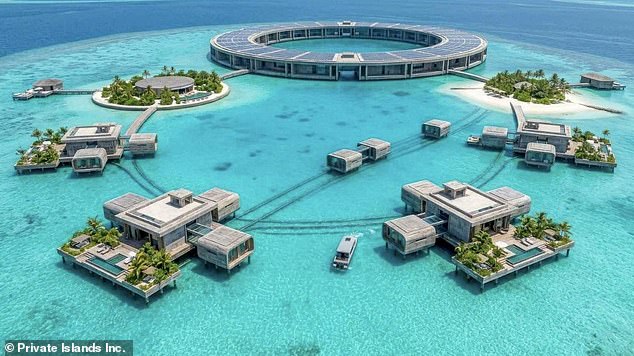
A one-of-a-kind private enclave in the Maldives is on the horizon, designed to brave both earthquakes and climbing sea levels. Fancy owning this tropical paradise? It can be yours if you have a hefty $450 million to spare.
Spanning 155 acres, this man-made marvel is more than just a retreat; it’s a testament to future-proof engineering. Dubbed a “deep-water lagoon,” it promises to elevate safely beyond the projected ocean rise of 2100, positioning itself as a haven for the next century.
But this eco-friendly sanctuary awaits a visionary buyer. It’s the ultimate doomsday refuge featuring a children’s club, a subterranean rail network, and more – perfectly aligned with sustainable luxury living.
Emanating the aura of a villain’s lair straight out of a Bond film, this secluded escape lies in the heart of the ocean. It’s a hideaway distanced by thousands of miles from urban hustle, sparking scenes of masterminds conjuring their diabolical plots within its isolated bounds.
Boasting 10 imposing ‘mothership’ fortresses and a sophisticated, earthquake-resistant underwater rail system, this extravagant getaway is tailored for discerning owners. Whether it’s for idyllic retreats or a shadowy base, this $450 million (£335 million) resort blueprint could soon become a reality in the Indian Ocean.
The concept, created by a company whose unique business is to sell private islands to ‘ultra-high-net-worth individuals’, is designed to withstand rising sea levels, in theory providing a safe haven from natural disasters as though it’s a 22nd-century apocalypse hideout.
This theoretical island, named the Adaptive Atoll, is listed online by Private Islands Inc., a website founded nearly 30 years ago in Canada. The company has around 800 islands for sale on its website, starting at $49,000 (£37,898).
The resort is marketed as the ‘permanent situation in an uncertain world… It is a legacy asset designed to remain fully operational and high-yielding well into the 22nd century’ amid what the company describes as ‘the land-submersion crisis’.
Pictured is an AI-generated concept of how the $450million Adaptive Atoll could look. The private island would include ten Brutalist ‘fortresses’ and an underwater rail network
The 155-acre development is designed to be a ‘permanent situation in an uncertain world’ amid rising sea levels
Pictured here is the kids’ club that could be included as part of the ‘mega-asset’ development in the Maldives
It features a ‘massive, earthquake-resistant guiding rail system built into the lagoon floor’ and ten huge Brutalist fortresses, or ‘master estates’, crafted from raw timber and coralline stone which are ‘designed to rise with the ocean’. Other USPs include space for more than 30 guest suites and a kids’ club.
The central building provides ‘100 per cent solar energy’, and tunnels that ‘sit safely above projected 2100 sea levels’.
The ‘future-proof logic’ behind the £335million island? ‘As sea levels rise, your resort simply floats higher. No dredging, no reef destruction, and no loss of beach acreage- because your “land” is the ocean itself.’
Chris Krolow, the 53-year-old chief executive who founded Private Islands Inc. in 1999, tells the Daily Mail: ‘Traditional overwater resorts face rapid depreciation from rising sea levels and the relentless operational costs of sand dredging. This isn’t a distant, theoretical risk – it’s visible in real time.
‘Flying into the Maldives today, you can already see the seawall being built around the capital, Malé, and sandbags lining the shores of luxury resorts working to hold back the water. The Adaptive Atoll concept was born out of a desire to create a “built for 2100” legacy asset that solves this problem directly.’
He says the core purpose of the resort is to ‘bypass the land-submersion crisis’ with technology developed by Private Islands that ‘combats rising sea levels by decoupling the resort from fixed land’.
The underwater rail network would be a ‘massive guiding system’ constructed on the lagoon floor on which it would be possible to move the fortresses across the estate as sea levels rise.
Mr Krolow adds: ‘The 155-acre deep-water lagoon concession is a real, physical site in the Maldives. To ensure seamless international access for high-profile clients, the layout specifically accommodates fly-in capabilities, meaning owners and guests can arrive directly via seaplane, private helicopter, or adjacent flight access points.’
The ideal client for the £335million island, says the chief executive, is an ultra-high-net-worth individual, including ‘highly successful entrepreneurs, tech founders, and corporate entities who already own high-end waterfront properties’. The CEO has previously suggested that rich, American men who support Donald Trump form a significant part of his company’s customer base.
He previously told The Telegraph: ‘At the end of the day, if you want island ownership in the sense that it’s yours, you’re there and there’s no one else, it’s possible. And you don’t have to be super rich, but you do need to be a little crazy. You need to have a set of balls, and you need to have been bitten by that island bug.’
Private Islands Inc., which created the blueprint, said the island is targeted at ultra-high-net-worth individuals, sovereign wealth funds or ultra-luxury hospitality brands
Pictured is another concept for how the private island, which is designed for the next century, would come to life
And, yes, he confirms. It is a serious idea.
The salesman-turned-CEO says: ‘This is a serious architectural and marine engineering concept, and the underlying technology exists today, drawing on precedent from floating and reclaimed-land marine infrastructure built elsewhere.
‘To be clear on where this stands, it’s currently a concept, not a project underway. No formal contractor quotes or engineering estimates have been commissioned yet. That’s the next stage.
‘It would be built by specialised marine industrial contractors using heavy-duty offshore construction methods, similar to what’s used for deep-water anchoring, large-scale hydraulic systems, and off-grid marine utilities.
‘The $450million figure is a preliminary estimate, not a quote. A working projection based on the scale of marine infrastructure required, rather than a land-value calculation. As the concept develops, that number would be refined through formal engineering and related estimates.’
But Brutalist architecture doesn’t exactly scream ‘luxury’ the way an extremely rich person with nearly half a billion dollars to spend on a ’22nd century-proof’ island in the Maldives might want. Quite the opposite, it’s reminiscent of Soviet Russia – or Milton Keynes.
It’s this particular style that lends the Adaptive Atoll the look of a classic Bond villain who is carefully plotting his next diabolical plan to take over the world – or destroy it.
Why, then, choose the look of ‘evil villain’s lair’ over ‘Maldivian luxury’?
Mr Krolow explains: ‘Brutalist architecture was intentionally chosen to convey (the concept’s) permanence. Fragile, traditional thatched roofs and slender wooden stilts do not visually or structurally communicate resilience against a changing ocean.
‘By building the ten permanent fortresses from heavy raw timber and coralline stone, the design creates a heavy, anchored, “mothership” aesthetic that provides structural synchronisation and a rock-solid, land-locked feel even during heavy swells.’
Mr Krolow says that ‘while $100million-plus mega-assets attract headlines’, the majority of private islands sales settle between $1million (£745,000) and $3million (£2.2million). However smaller, rustic islands in Canada or Belize dip below $500,000 (£373,000).
‘Island sales are a bit different from traditional real estate,’ he says. ‘The sales cycle on islands is notoriously slow. Deals rely heavily on navigating cross-border tax structures, foreign corporate holding companies, and hidden infrastructure costs – such as power, water and waste – required to make an island habitable.
‘The Bahamas remains the undisputed king of the market due to its proximity to the US and freehold ownership, while areas with severe foreign ownership bans, political instability, or extreme weather windows are the most difficult to move.’