

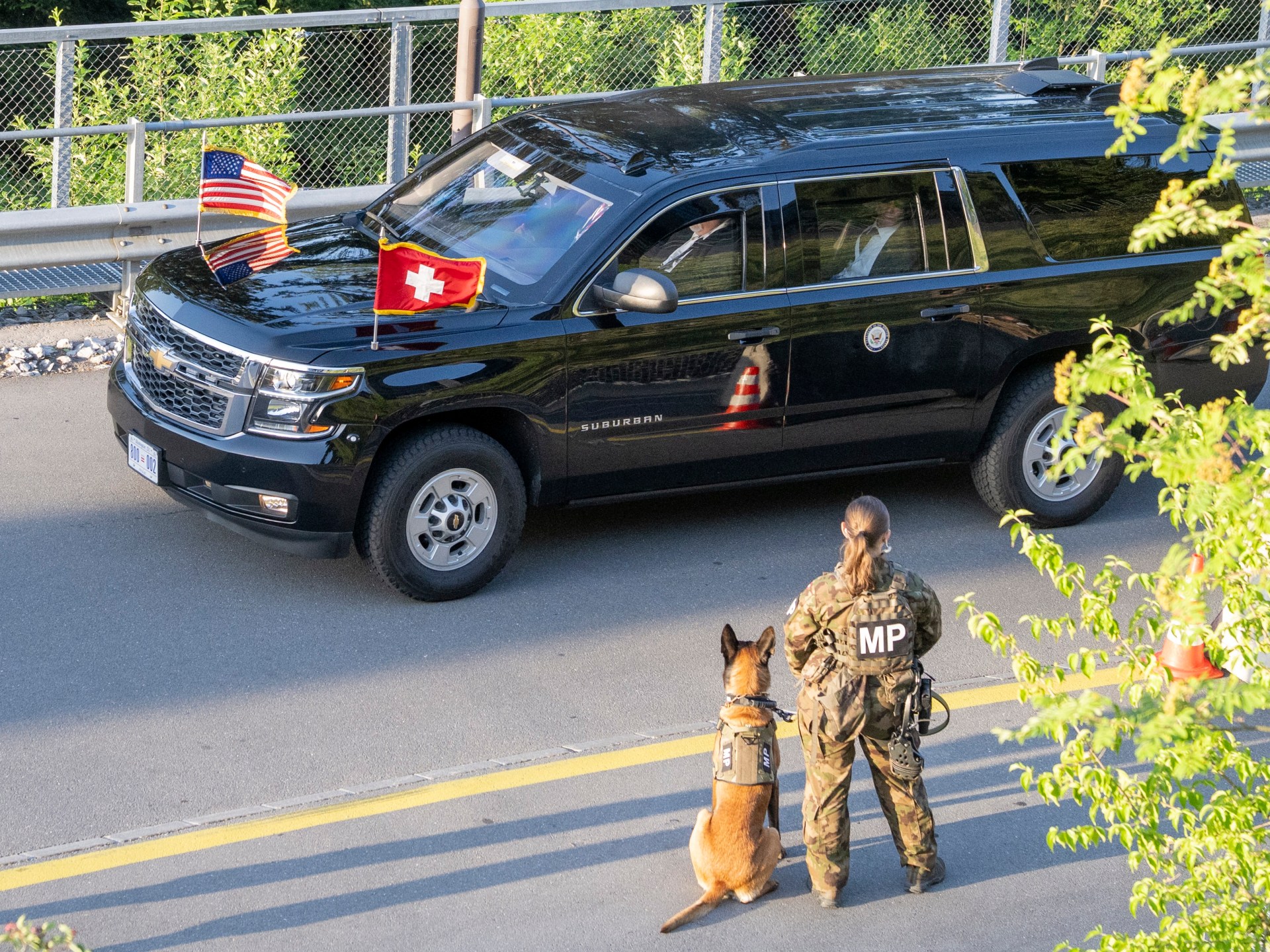
United States Vice President JD Vance says Washington wants to “turn over a new leaf” in the Middle East as talks on the interim deal to end the war with Iran are under way in Switzerland.
His comments came even as US President Donald Trump again threatened fresh strikes on Iran.
Recommended Stories
list of 4 items
- list 1 of 4Overplaying Strait of Hormuz card will turn Iran into a pariah state
- list 2 of 4Iran closes Strait of Hormuz as Pakistan says new talks with US due Sunday
- list 3 of 4Iran shuts Strait of Hormuz as Israel tests MOU with Lebanon strikes
- list 4 of 4Trump vows Iran will not charge Strait of Hormuz tolls, but says US might
end of list
The US and Iran agreed to a 60-day ceasefire extension for the negotiations earlier this week, but Iran’s Islamic Revolutionary Guard Corps (IRGC) announced another closure of the Strait of Hormuz on Saturday in response to Israeli attacks in Lebanon, although the US military said commercial vessels kept operating.
The talks, with the presence of mediators, started Sunday at the Swiss mountain resort of Burgenstock and are being led by Vance and Iranian chief negotiator Mohammad Bagher Ghalibaf.
Inside the meeting room, Vance addressed reporters alongside Pakistani Prime Minister Shehbaz Sharif and Qatari Prime Minister and Foreign Minister Sheikh Mohammed bin Abdulrahman bin Jassim Al Thani.
The vice president first called Iran a “driver of regional instability” before speaking about the future.
“The opening of the Strait of Hormuz, the ending of the Iranian nuclear programme – all of these things have been accomplished,” Vance said, without mentioning Iran’s re-closure of the waterway. “The question before us is now how much more can we accomplish together.”
“Can we turn over a new leaf? Can we change relations in the Middle East?”
Sharif struck a more cautious tone, saying he hoped the discussions would lead to “very productive results”.
“Hopefully, when we go back to our homes, we will have a wonderful paper in our hands that will promote peace, progress and prosperity around the globe,” he said.
The Iranian delegation did not speak during the opening remarks, nor appear in photos or footage alongside Vance.
A first-round quadrilateral meeting between Iran, the US, Qatar and Pakistan ended after 80 minutes around 15:00 GMT for “internal consultations”, according to Iran’s Fars news agency. Talks were expected to continue throughout the afternoon.
Iran’s Foreign Ministry Spokesperson Esmaeil Baghaei said in a video shared by IRNA state news agency that the ongoing conflict in Lebanon would top the agenda, as well as frozen Iranian funds and sales of the country’s oil.
Al Jazeera’s James Bays, reporting from Buergenstock, said recent comments from Tehran indicated “they did not want to give the Americans a photo opportunity”, though they were “clearly” in the room.
“It shows how tense things are, that the Iranians did not speak when everyone else spoke,” Bays said.
Tension over Lebanon
A halt to fighting in Lebanon was one of the conditions agreed this week in the interim deal to extend the US-Iran ceasefire for 60 days and start talks on Tehran’s nuclear programme and other issues.
But the deal is already coming under strain, as Israel continued attacks in Lebanon on Saturday, killing dozens of people, with Iran’s IRGC citing the strikes as it declared the Strait of Hormuz shut. The US military said commercial vessels had continued operating in the waterway.
Asked about Lebanon, Vance said “we’ve seen great progress over the last couple of days in ensuring ceasefire in Lebanon holds”. Ceasefires are always a “a little bit messy”, he added.
US President Donald Trump, meanwhile, threatened Iran over Hezbollah on social media.
“Iran must immediately stop their highly paid PROXIES in Lebanon from causing trouble,” he wrote in a Truth Social post Sunday. “If they don’t, we’ll hit Iran very hard again, just like we did last week, only harder”.
US Central Command (CENTCOM) said 55 merchant ships transited the strait on Saturday, with more than 17 million barrels of oil bound for global markets. US forces will ensure commercial traffic continues, CENTCOM said.
Trump said no toll would be charged for passage through the strait during or after the 60-day ceasefire – unless the US imposes one should peace talks fail.
But pointing to what it called Israeli “crimes” in Lebanon that violated US commitments to a ceasefire, the IRGC warned ships would be at risk if they approached the strait, a vital conduit for global oil and gas supplies.
‘A continuation of war’
The developments have complicated talks to advance the interim deal brokered by Pakistan and signed on Wednesday by presidents Donald Trump and Masoud Pezeshkian to end the almost four-month war.
Mohammad Mokhber, an adviser to Iran’s supreme leader, Ayatollah Mojtaba Khamenei, accused the US on X of failing to implement the first clause of its 14-point interim deal with Iran, which stipulates a ceasefire “on all fronts”, including Lebanon.
He said that if the deal were not implemented, the flow of energy through the region would remain halted.
Ali Akbar Dareini, a researcher at the Iranian think tank the Center for Strategic Studies, called Vance’s comments “very delusional”.
“It’s wrong to even assume this is the start of the second phase of the memorandum of understanding,” Dareini told Al Jazeera. “Iran looks at this as a continuation of the war.”
However, when it comes to Lebanon, “the US and Iranian goals are somewhat on the same page”, reported Al Jazeera’s Patty Culhane from Washington, DC.
Trump has held “very feisty calls” with Israeli Prime Minister Benjamin Netanyahu in recent days, while Vance has also warned Israel shouldn’t upset “their only friend left in the world”, she said.
“So Israel is in the position where it will have to decide: does it want to anger the US side or does it want to stop hostilities?”
Israel’s Chief of Staff Lieutenant General Eyal Zamir said the ceasefire was “fragile” during a visit to southern Lebanon Sunday, as Israeli forces kept up their attacks.
“We are continuing to fight,” Zamir said, adding that troops “need to be prepared with high readiness to renew combat activity”.
The Iran-aligned Hezbollah group also announced attacks on Israeli forces. The group meanwhile condemned upcoming talks between Lebanon and the US in Washington, saying Beirut would be forced to “confiscate Lebanon’s sovereignty”.
At least Israeli six soldiers have been killed, and 20 others wounded, over the past few days in Hezbollah attacks.
Israeli attacks on Lebanon have killed 4,106 people and wounded 12,153 others since March 2, the Lebanese Ministry of Health said in its latest toll Sunday.