

Climb up from the plains of North India. While reaching the Himalayan altitude, you find that the food habits, clothing, dialect, way of worship are changing and the methods of festivals are also changing. However, within these changed festive ways, the fragrance remains the same which is considered to be the origin of these traditions, only a little local touch is added to it.
It works like a sprinkle in the local Taj Raita, as soon as one sip of it is in the mouth, there is a tingling feeling that cannot be expressed in words, but can be expressed in the experiences of Aha and Wow. Nowadays there is a similar atmosphere in Sangla, Himachal.
A splash of color in the heights of the Himalayas
There is a lot of excitement in the beautiful valleys of Kinnaur valley, there is color and gulal. There are folk songs and the fun of the valley which is calling out to see Sangla Holi by dancing in the cool breeze. Just as in the North Indian region, people come from far and wide to see the Holi of Brajmandal and Barsana, similarly Sangla Holi of Himachal also becomes a festival of enthusiasm and thrill for the tourists with faith.
related news
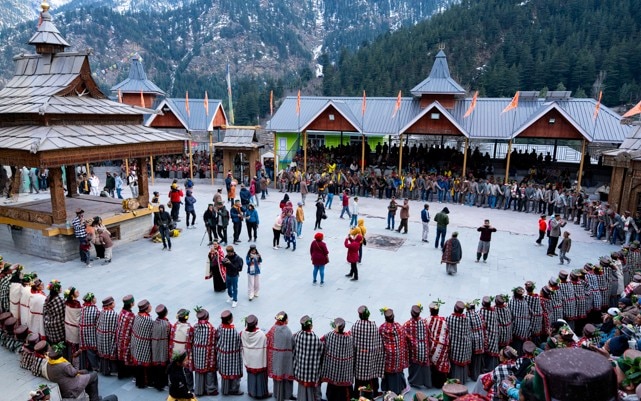
Sangla or Baspa Valley is in Kinnaur district of Himachal Pradesh, adjacent to the borders of Lahaul-Spiti and Shimla districts, situated at an altitude of about 8,900 feet above sea level, this valley is known for its natural beauty and calm environment. The Holi here is completely different from the normal urban festivals. Here, playing with colors in snow, staging the characters of Ramayana and the tribal traditions that have been going on for eight hundred years make this festival special.
Fagli: 800 years old tribal tradition
Professional photographer Kaushal Arya, who has experienced this Holi closely, says that Sangla is the name of the valley and actually it is called ‘Fagli’ or ‘Faguli’ here. He says that if we go into its history, the roots of this folk culture go back 800 years, where it is not just Holi but a recreation of the events of our mythological stories. This makes this festival one of the oldest festivals of the Himalayan region. In this festival, a beautiful blend of Hindu and Buddhist influences ingrained in the Kinnauri culture is visible and this is what makes it unique. People come from far and wide to see this.
This festival actually symbolizes the departure of winter and the arrival of the joys of spring and summer. The beginning of new crops, the joy of trees laden with fruits and the orange hue of trees laden with kinnow make this festival even more colourful. People thank nature for this and express their gratitude to her by dancing and singing. Local people remember their village deities and pray to them for the protection and prosperity of the valley.
Identity of ‘Mask Festival’
Holi of Sangla is also called ‘Festival of Masks’. Here the villagers wear masks and enact characters from mythological and folk tales. Men especially play the roles of Ramayana characters, Lord Ram, Lakshman, Hanuman and Ravana. Through these theatrical presentations the message of victory of religion over unrighteousness is given.
This festival of Fagli mainly lasts for 3 to 4 days. In this the local people perform traditional Kinnauri Nati dance. In which a special kind of flat and small drum is played. Along with this, artists dressed in characters also sprinkle gulal. During this time, local dish Sidduchhang is eaten and local deities are worshipped.
On the first and second day, the festival starts with traditional Kinnauri musical instruments (Dhol, Karnal, Shehnai). People enjoy cuisine and cultural programs. On the third day, the main colorful festival is celebrated at Sangla Chowk. People who wear traditional attire (men woolen caps and jackets, women shawls and traditional ornaments) apply gulal and celebrate with music. Traditional Fagli dance is also performed on this day. This is done in a round circle and in a group.
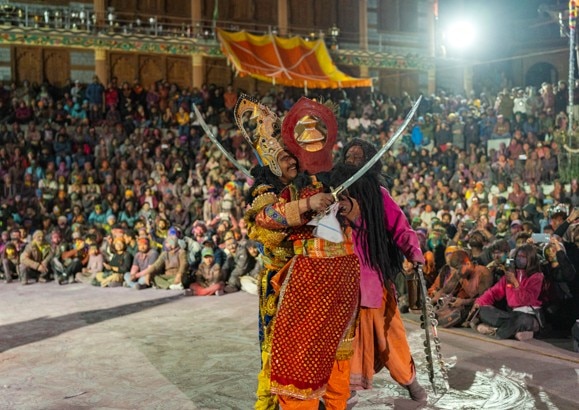
Then the fourth day becomes the last day with Ramayana acting. Local artists stage scenes from the Ramayana, especially the victory of Lord Rama over the demon king Ravana. While sharing the picture of this festival, Kaushal Arya says that on this day a community feast is organized and good wishes and congratulations are given to each other for the upcoming harvest.
Holi of Sangla gives the message of balance and respect between nature and man. The splash of colors amidst the snow capped mountains brings this harmony alive. The houses in the villages and especially the Nag Temple complex are decorated with lamps and colorful lights. This tradition also provides a glimpse of Diwali, which symbolizes the victory of light over darkness.
Villagers gather at the famous Berinag temple. ‘Siddu’, dishes made from barley and buckwheat, non-vegetarian dishes and the local drink ‘Chang’ are served during the festival. Prasad called ‘Totu’, which is prepared from whey and roasted barley flour, is distributed to all.
Confluence of nature, faith and mass celebration
Holi of Sangla is not just a festival of colors but also a symbol of cultural identity. This tradition has been going on from generation to generation. The tradition of Holika Dahan is also followed, which symbolizes the victory of good over evil. Special attraction is the staging of episodes from Ramayana, in which Lord Ram The victory over Ravana is depicted. Folk music, dramatic dances and mass celebrations turn this festival into a living folklore.
—- End —-