

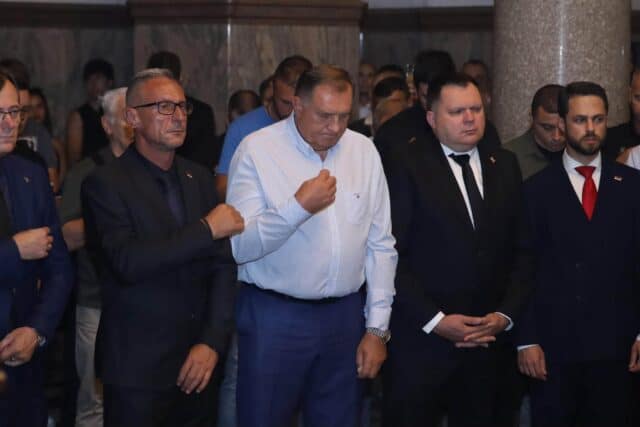
Bosnian Serb political leader Milorad Dodik (C) attending a church service for Mladic in Banja Luka. Photo: SNSD/Facebook.
Crowds of Serbs gathered in towns and cities across Republika Srpska on Thursday evening to pay tribute to convicted war criminal Ratko Mladic after his death, with hundreds marching through Zvornik chanting his name and senior entity officials attending a memorial service in Banja Luka.
Mladic, the former commander of the Main Staff of the Army of Republika Srpska, died on Thursday aged 84 at the UN Detention Centre in The Hague, where he was serving a life sentence for genocide, crimes against humanity and war crimes.
The gatherings were attended by members of the public, war veterans and government officials, while some of the events featured open glorification of Mladic and his wartime role.
In Republika Srpska’s administrative centre, Banja Luka, Milorad Dodik, the president of the ruling Alliance of Independent Social Democrats, SNSD, and Republika Srpska prime minister Savo Minic attended a memorial service at the Cathedral of Christ the Saviour, where they lit candles for Mladic.
The service was also attended by representatives of the entity authorities, veterans’ organisations and many members of the public.
Dodik said Mladic had and demonstrated “how to defend one’s people” in what he described as “an unstable, difficult period”.
“Some want this [Serb] people not to remember him, but people have feelings. You cannot ban them, you cannot erase feelings,” Dodik said.
Similar gatherings were held in Trebinje, Bijeljina, Prijedor, Srbac, East Ilidza and elsewhere. In Trebinje, former Bosnian Serb Army members, families of deceased soldiers and local officials lit candles in front of the town’s memorial room and monument to its defenders.
In Bijeljina, Bosnian Serb Army veterans, veterans’ organisations and members of the public gathered, while a memorial service was held in Prijedor.
The head of East Ilidza municipality, Marinko Bozovic, Banja Luka mayor Drasko Stanivukovic, Republika Srpska National Assembly MP Jelena Trivic and Bosnian Serb delegate to the House of Peoples of the Parliamentary Assembly of Bosnia and Herzegovina Zelimir Neskovic attended a memorial service for convicted war criminal Ratko Mladic at the Monastery of St Nicholas on Mount Ozren.
In a social media post, Bozovic wrote of the convicted war criminal: “Eternal remembrance, General, and may you enter the Kingdom of Heaven.”
The memorial service was attended by a significant number of local residents, as well as Branko Blanusa, president of the opposition Serb Democratic Party.
The attendance of ruling party and opposition politicians marked a shared approach between them to commemorating Mladic, despite his convictions for wartime atrocities.
However, scenes from Zvornik in eastern Bosnia drew particular attention. Several hundred people, including a large number of young people, gathered and marched through the town chanting Mladic’s name. According to footage circulating online, participants also carried flags and symbols associated with the Army of Republika Srpska.
Republika Srpska vice president Camil Durakovic condemned the gathering, recalling that Zvornik was the site of mass persecution and killings of Bosniaks during the war.
“This is Zvornik – this is the town where Mladic’s dogs of war carried out his orders. This is the town of mass graves of my people. This is the town from which tens of thousands of Bosniaks were expelled,” Durakovic said.
He questioned whether state institutions existed that would respond to such scenes, warning that, in his words, this represented the “final stage of genocide”.
In Bosnia and Herzegovina, the public glorification of convicted war criminals is prohibited under the state-level Criminal Code, following amendments imposed in 2021 by then-High Representative Valentin Inzko after domestic authorities failed to adopt legislation addressing genocide denial and the glorification of war criminals.
Mladic was sentenced to life imprisonment in 2021 under a final verdict, as the UN war crimes court upheld his responsibility for genocide in Srebrenica, persecution, extermination, murder, deportation, forcible transfer and terrorising civilians during the war in Bosnia and Herzegovina.