

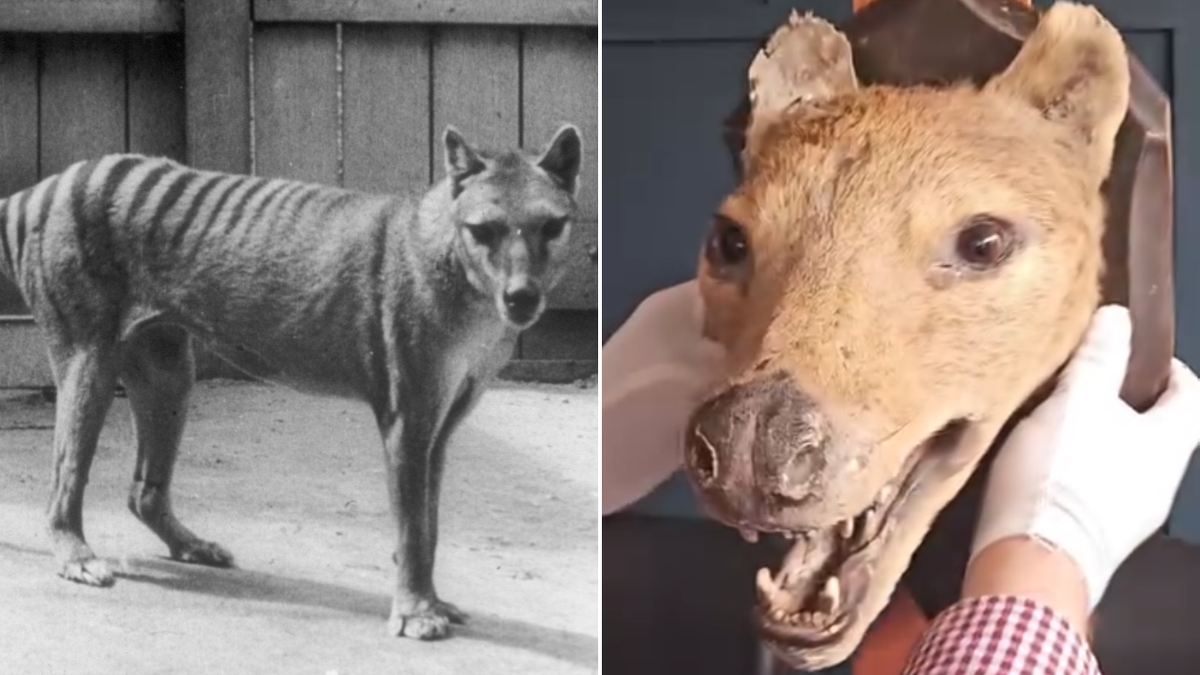
The taxidermied head of a Tasmanian Tiger (thylacine) is set to go to auction in England, almost a century after the animal went extinct.
The rare collectable is being sold by UK auction house Auctioneum at its saleroom in Bath, England, on November 26 with an estimated price of £30,000 – £50,000 ($A56,777 – $A94,628).
According to the auction house, the thylacine was shot in the head by a farmer in Tasmania around the year 1900 before being taxidermied, mounted and taken to the UK in 1905.
Know the news with the 7NEWS app: Download today Arrow
It then spent “many years tucked away beneath the current owner’s bed” before being put up for auction.
It’s only the third known thylacine head in existence, the second of which was sold by Auctioneum earlier this year.
This specific specimen is mounted to with an open mouth and displaying its original teeth, with extensive wiring to keep its pose in place.
“Set with brown glass eyes,” the auction house described the piece.
“Radiographs show the skull to be present, although a section of the cranium is missing, believed to have been sustained when the creature was shot.
“Plaster filled and with a small wire armature to support the open jaw and ears.
Be the first to know:
“Mounted on a beechwood shield plaque for display, in antiquity.”
The piece goes to auction almost 100 years after the last known thylacine died in captivity in 1936.
The legitimacy of the piece was verified by Project Director of the International Thylacine Specimen Database Dr Stephen Sleightholme, who described the species as “one of the most enduring symbols of extinction”.
One of the last Tasmanian Tigers pictured in Hobart Zoo. Credit: Dave Watts/Gamma-Rapho via Getty Images “Its disappearance stands as a stark reminder of how human persecution can destroy a unique species and how, when the last individual dies, what remains becomes an irreplaceable legacy,” Sleightholme said.
“The thylacine is more than a memory of extinction. It is evidence of what we have lost, a warning of what we may yet destroy, and a legacy we can still learn from.
“Its surviving specimens are not merely relics of the past; they are enduring witnesses to the fragility of life and the urgent need to protect what remains.”