

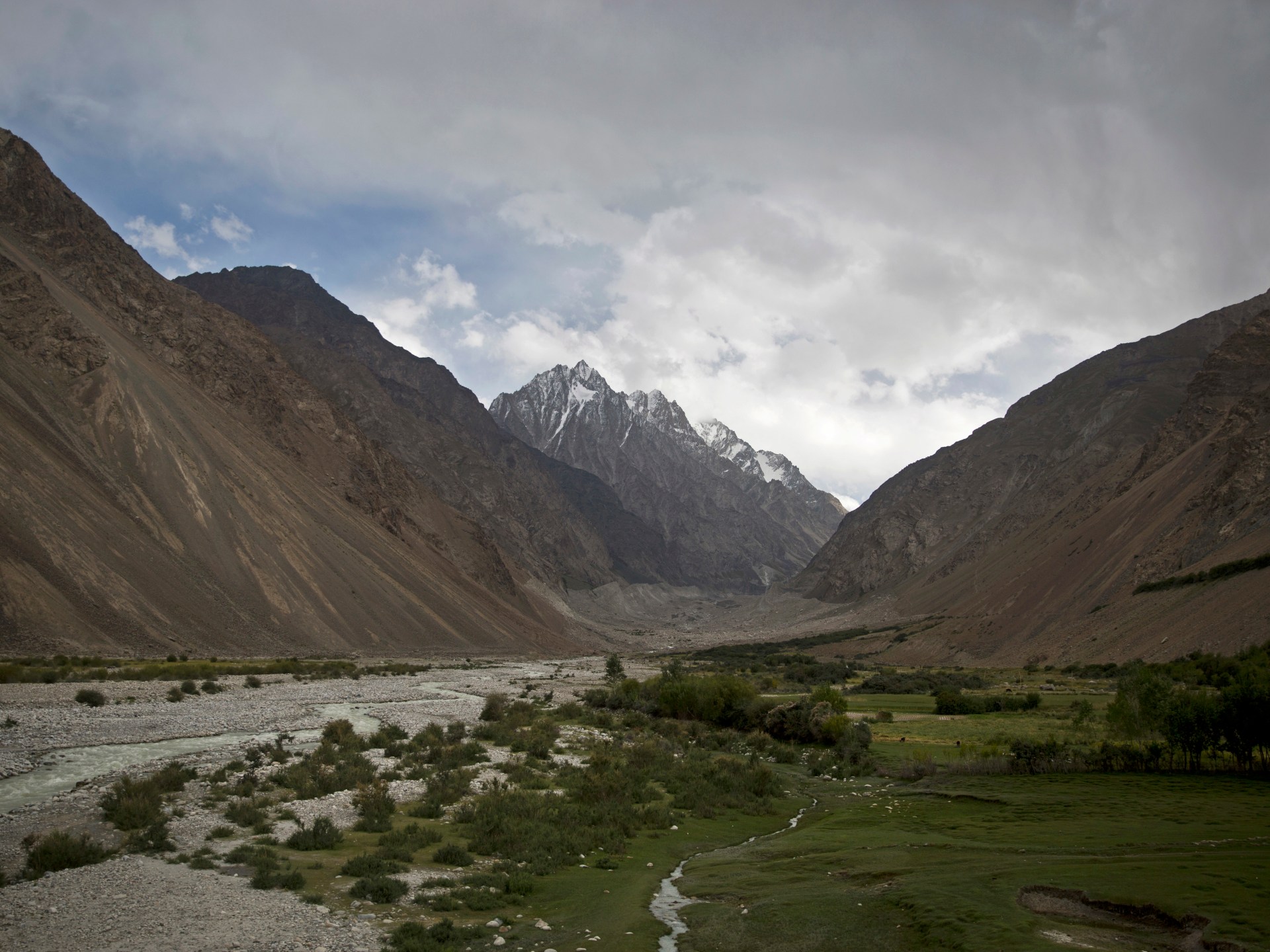
At an altitude of nearly 4,900 metres, at the Wakhjir Pass, Afghanistan ends and China begins. Snow closes the pass for at least five months of the year, and people cross it only sporadically in the months when it is passable.
There is no official border crossing here, and yet, on October 4, Afghanistan’s Taliban-led government celebrated the opening of a road leading to the frontier – but crucially not crossing it.
Recommended Stories
list of 3 items
- list 1 of 3Pakistan military reports it killed 74 ‘terrorists’ during raids
- list 2 of 3Ten police officers, 18 fighters killed in northwest Pakistan attack
- list 3 of 3Moscow summit tests Russia’s waning grip on former Soviet allies
end of list
Afghanistan’s Ministry of Rural Rehabilitation and Development said the road through the Wakhan Corridor in Badakhshan province had been built in two phases for 365 million afghanis ($5.5m).
It is a basic road – an unpaved track covered with gravel. On the other side of the border, there is no Chinese customs facility, and China’s Ministry of Foreign Affairs has not commented on the road’s opening.
For the moment, the road leads to a closed border, with no indication of when Beijing might open it to commercial traffic.
The corridor
The Wakhan Corridor is a narrow protruding stretch of land extending for about 350 kilometres (220 miles). It lies between Tajikistan to the north and Pakistan to the south, but is entirely within Afghan territory, connecting it with China.
The corridor’s unusual shape was determined by the competition between Britain and Russia over the region in the 19th century. An agreement between the two powers in 1895 delineated Afghanistan’s northern boundary with Russian territories (that now make up modern-day Tajikistan), and left Wakhan under Kabul’s control to separate the Russian-controlled land from British India.
China was not a party to the conflict, however, and Kabul and Beijing did not settle the border until 1963.
The area – on both sides of the border – is remote. But in recent years it has gradually become one of Asia’s most sensitive geopolitical crossroads, where China’s security concerns, Afghanistan’s economic ambitions, the interests of Pakistan and Iran, and Central Asian countries’ regional connectivity projects intersect.
As competition intensifies over trade and logistics routes across Asia, this narrow corridor could take on a role far beyond its geographical limits: a potential link between South, East and Central Asia, and a key to reshaping patterns of trade and influence in the region.
Project long in the works
Serious discussion of a road through Wakhan began in June 2009, during discussions between the Afghan and Chinese governments.
However, the project went no further than preliminary studies at the time, with the corridor’s rugged terrain cited as a major obstacle to implementation.
The Chinese press at the time also noted concerns over national security, particularly that Uighur fighters could use the corridor as an entry point into China.
The project was frozen until 2019, when Afghanistan began building a road in Wakhan, according to former Afghan ambassador to China, Javid Qaem.
Sixty kilometres (37 miles) were completed, “but the sudden change of government in Afghanistan in August 2021 led to the plan being postponed”, Qaem told Al Jazeera, in reference to the Taliban takeover.
Former Afghan acting defence minister, Shah Mahmoud Miakhel, who served in the position in 2021 and left a few months before the Taliban took power, told Al Jazeera that “the presence of [United States] and foreign forces and the security situation” prevented the road project from being implemented.
“Beijing considered those circumstances to be limiting the prospects for developing the corridor,” Miakhel said.
The Taliban government, however, picked up the project in the years since, making it one of its strategic projects while strengthening political and diplomatic contacts with Beijing.
It hopes to turn the corridor from an isolated border area into a gateway connecting Afghanistan to Chinese and Central Asian markets and strengthening its position in regional trade networks.
“The Taliban resumed construction of the Wakhan road in September 2023, seeking financial support from China to build this future trade route, but China has not yet agreed to open its border with Afghanistan because of security threats,” Qaem said.
In January 2024, the Taliban announced that the road had reached the Chinese border. In March 2025, the rural development ministry signed a contract with local companies for a second, 71-kilometre (44-mile) phase. The authorities say the project was funded from Afghan government resources, and the available information does not indicate any Chinese funding.
Beijing: Security before trade
In August 2025, Chinese Foreign Minister Wang Yi – the most senior Chinese official to visit Afghanistan since the Taliban returned to power – made his second visit to Kabul since the takeover.
In his meeting with Afghan Interior Minister Sirajuddin Haqqani, Wang said China “supports the early resumption of bilateral patrols in the Wakhan Corridor to maintain peace and tranquillity in the border areas”. He also called on Kabul to crack down on the East Turkestan Islamic Movement, a Uighur separatist group.
Unlike Afghanistan, China does not view the Wakhan Corridor primarily as an economic project, but as a highly sensitive security issue. Beijing’s priorities in Afghanistan fall into three main areas: protecting its western border, preventing armed groups from entering Xinjiang (East Turkestan), and safeguarding its investments in natural resources, as well as protecting the China-Pakistan Economic Corridor.
An Afghan government source, who requested anonymity, offered Kabul’s account of China’s position.
“China does not oppose opening its border with Afghanistan through the Wakhan Corridor, but it links implementation of the project to the availability of effective security guarantees,” the source told Al Jazeera. The source said that the Taliban had demonstrated their ability to maintain security and secure the border.
The question of Xinjiang, considered by the Uighur people to be their homeland, is therefore the apparent priority for China when it comes to Wakhan.
A 2022 United Nations Office of the High Commissioner for Human Rights report condemned the “arbitrary detention of Uighurs and other Muslims in Xinjiang”. China has rejected the findings, describing them as part of a Western campaign against it.
Beijing continues to proceed cautiously when it comes to Afghanistan. Major Chinese investments have stalled. In June 2025, the Taliban cancelled an oil exploration contract in the Amu Darya Basin with a Chinese company, saying it had failed to fulfil its obligations. And in May of this year, Afghanistan’s mining minister complained to the Chinese ambassador about delays in the Mes Aynak copper mine project, which has yet to begin production.
China shares land borders with 14 countries and maintains extensive economic and trade relations with most of its neighbours. But Afghanistan, alongside Bhutan, remain the only countries bordering China that have yet to benefit from a direct overland crossing for trade.
A way out
Kabul wants Wakhan to provide a route that is not controlled by Islamabad. Afghanistan is landlocked, and its routes to the sea run through Pakistan and Iran. Over the past year, both routes have been all but closed at the same time.
Mohammad Ismail Ghaznawi, who was governor of Badakhshan before becoming deputy minister of public works for road maintenance in August, said the Wakhan road project was “part of the government’s plan to diversify trade outlets and reduce dependence on Pakistani border crossings”, and referenced fighting between Afghan and Pakistani forces that has been ongoing this year.
Ghaznawi added that the US-Israel war on Iran also directly affects Afghan trade, making the opening of alternative routes a priority.
The Afghan government views the road as the beginning of a trade corridor, and perhaps a railway in the future, that would connect the country to China’s Belt and Road Initiative and generate transit fees.
“The corridor should not be viewed simply as a crossing connecting Afghanistan and China, but as a strategic corridor that could serve as a link between South Asia and Central Asia, strengthening regional trade and economic integration and contributing to security, stability, and development in the region,” Ghaznawi said.
Pakistan and Iran
Even as the Afghan side lauds the Wakhan road project as an alternative to dependence on Pakistan, China is not acting as though it is looking for an alternative.
Beijing continues to call for the China-Pakistan Economic Corridor to be extended into Afghanistan and has not opened the Wakhjir Pass. A gravel road closed by snow for months cannot replace a major crossing such as Torkham, through which a significant share of Afghanistan’s trade with Pakistan used to pass.
Miakhel, the former Afghan defence minister, also linked recent security tensions in Badakhshan to the corridor project, saying there were “attempts to obstruct its completion”.
He added that he believed “regional and international parties do not want closer ties between Afghanistan and China amid the geopolitical changes taking place in the region”.
As for Iran, the government there is looking for overland routes to reduce its dependence on the sea and sees a possible road-and-rail corridor through Afghanistan to China as a potential strategic shift in its foreign trade.
Former Afghan ambassador to Iran Abdul Ghafoor Liwal told Al Jazeera that Iran “sees the Wakhan Corridor as a strategic opportunity to strengthen its overland connection with China through Afghan territory”.
Corridor’s future: Between security and economics
Badakhshan does not appear as peaceful as the Afghan government suggests. In May 2024, the province saw rare protests against campaigns to destroy poppy fields.
And in recent months, the opposition National Resistance Front has claimed responsibility for several attacks in the province. Hours after the road-opening ceremony, the group announced that it had killed the deputy head of Taliban intelligence in Faizabad, the provincial capital.
Miakhel linked tensions in Badakhshan to the corridor project, saying: “There are attempts to obstruct its completion.” He believes regional and international actors do not want closer relations between Afghanistan and China, while emphasising that this is his personal assessment.
The future of Wakhan will remain dependent on whether the parties concerned can reconcile security requirements with economic considerations. If they succeed, the corridor could be transformed from an isolated mountain strip into one of Asia’s most important trade links over the coming decades. But if security concerns and regional competition persist, Wakhan will remain a symbol of great geographical potential that has yet to be realised.