

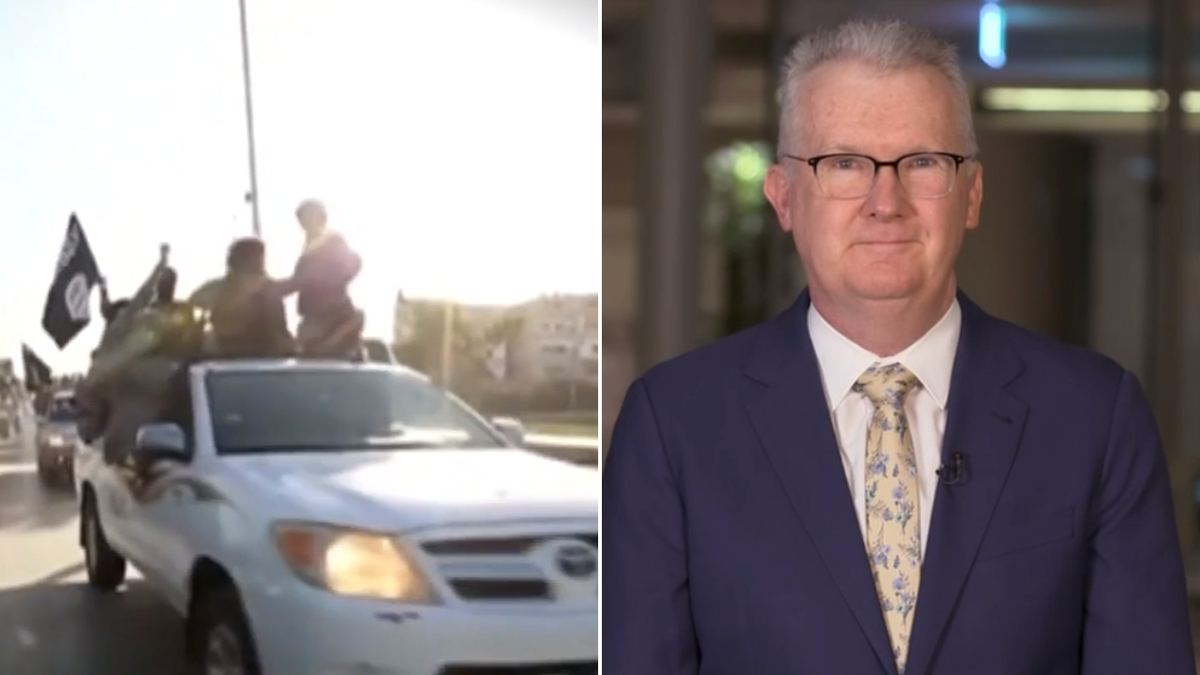
Home Affairs Minister Tony Burke has said the federal government will do nothing to help a group of suspected Australian ISIS detainees return home if they are released from prison in Iraq.
Burke said he would use every legal power available to delay or restrict the return of the 13 Australian men, making clear the government would not assist them in any way if they were freed.
WATCH THE VIDEO ABOVE: Government refuses to help suspected ISIS fighters return
Know the news with the 7NEWS app: Download today Arrow
The Home Affairs Minister told Sunrise on Monday while Australian citizens could not be permanently barred from returning, the government would take the strongest action possible where the law allowed.
“My view is anybody at all who decided to get on a plane to be part of ISIS; my view is anything we can do to restrict your return, if I get that legal option, I take it,” he said.
“And if you do find your way to Australia, then if we can charge you, you get locked up, and if we are not in a position with the evidence to be able to charge you, then the surveillance that happens on you needs to occur to keep Australians safe.
“At the moment, every single one of these people is locked up, and I’ve got no problem with that being the status quo.”
Burke drew a sharp distinction between the government’s approach to the detainees and other Australians imprisoned overseas.
“There are times when people are locked up around the world, and the Australian government takes steps to try to get them returned home, not with this crew, absolutely not,” he said.
“I won’t lift a finger to help them. And wherever we’ve got a legal power to be able to keep them away for longer, we’ll take it.”
Burke said exclusion orders were only temporary and could not permanently prevent Australian citizens from re-entering the country.
“It’s a really tough threshold to meet legally. Certainly, I’ve only had one time when the department said that the threshold was met and I was able to put an exclusion order in. I did that straight away,” he said.
Asked whether alleged involvement in atrocities such as beheadings would meet the threshold for an exclusion order, Burke replied: “Oh, well, you would hope so.”
He confirmed Australian citizens are generally entitled to a passport if they request one through an embassy overseas.
“The only time that you can temporarily suspend one is if somebody is about to engage in an act of violence at that point in time. It’s very tight for citizens,” he said.
However, Burke stressed anyone who did return would face intense scrutiny from Australia’s national security agencies.
He said 45 Australian men who travelled overseas to fight with ISIS had already returned before the current government came to office and remained under close surveillance.
“Our agencies, ASIO, the Australian Federal Police, they’re watching individuals; they’re on them. The surveillance and the restrictions that people would want is what we deal with,” Burke said.
Burke’s comments come amid renewed efforts by Iraqi authorities to repatriate foreign nationals detained over alleged links to ISIS.
Earlier this year, several Australian women linked to ISIS returned from Syria.
Within days of arriving in Australia, three were charged with offences including crimes against humanity and terrorism-related offences, while authorities said others remained under investigation.