

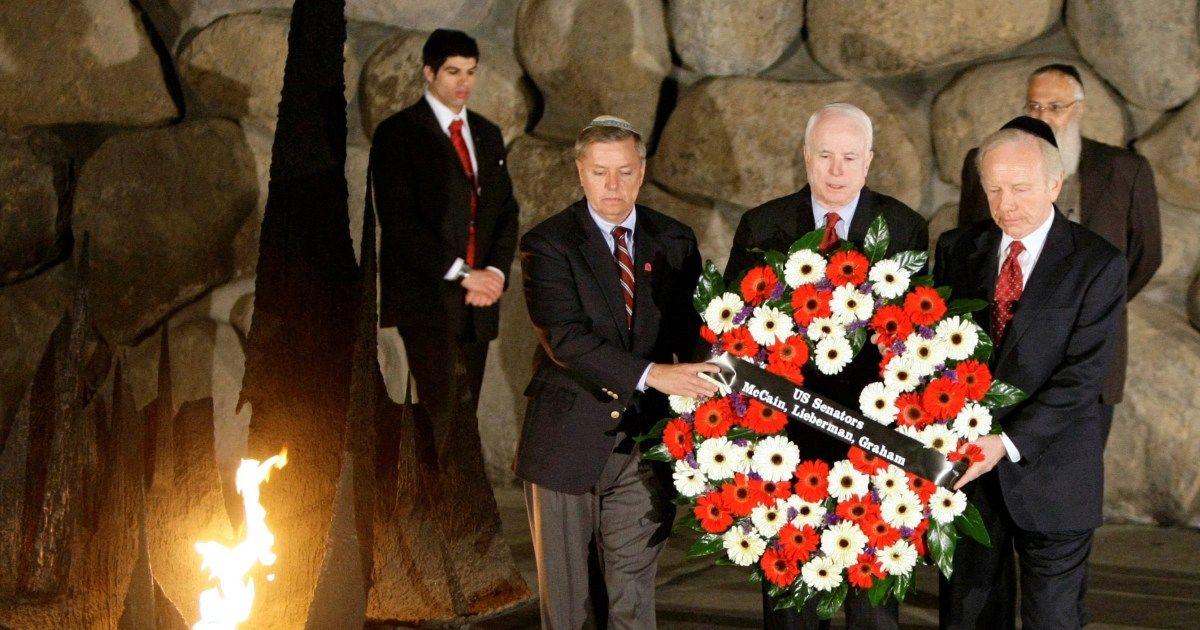
The late US Senator Lindsey Graham spent much of his political career surrounded by two close friends: senators John McCain and Joseph Lieberman. The three came to be known as the “Three Amigos” and were tied together not just by a close friendship but also by their strong devotion to Zionism and Israel’s security.
Graham’s passing marks the end of the Three Amigos. Many Israel allies remain in the US Congress but few can match the energy Graham, McCain and Lieberman spent on securing Israeli interests on Capitol Hill.
The question now is: will the death of Graham, the last of the trio, impact Israel’s standing in Washington? To answer the question, we need to explore first what the notion of “standing” really means in American politics, oscillated wildly by Donald Trump’s ascent to the presidency.
During his first term, Trump was as bewildered about presidential power and his potential use of it as the rest of the American political establishment. He surrounded himself with members of various cliques: from right-wing strategist Steve Bannon and his penchant for a traditionalist understanding of international relations to former national security adviser John Bolton, one of the most passionate advocates for regime change in Iran.
After realising that his attempt to position himself within a traditional “right-wing” framework did not truly appeal to his assets and may have cost him the 2020 elections, Trump changed his tune. “Standing” became more and more related to the ability of a country or a leader to supply Trump with what he saw as his needs in specific deal-making situations.
Israel, however, remained an exception. This had little to do with Trump’s personal likes or dislikes and much more with the well-established power structure in Washington. First, commitment to Israel has always been linked to perceived Israeli contributions through intelligence and joint operations.
Second, the American Israel Public Affairs Committee (AIPAC) has been one of the most powerful lobbies in Washington. AIPAC’s endorsement for a candidate usually meant a remarkably large campaign war chest, promising an initial advantage over rivals right from the beginning of the campaign season.
Thus, support for Israel remained one of the few constants in both Trump’s and Graham’s political commitments, giving the latter a level of authority and discretion within the Republican Party.
When Trump began his second term, Graham saw a chance to gain some power by providing the president with foreign policy experience alongside an ideological commitment. With some help from close Israel allies, the US senator was granted access to Trump’s inner sanctum. He was, it appears, considered both a highly capable mouthpiece, while not being seen as an immediate threat.
So will his death affect Israeli policy or Israeli access to Trump? In the immediate moment, the answer is “yes”. Graham was always a reliable go-between, allowing both Trump and Israeli Prime Minister Benjamin Netanyahu to maintain an immediate and personal channel of communications.
The relationship is now more fragile and tenuous, as it is increasingly more dependent on power brokers.
However, in the longer run, Graham’s death would not make much of a difference because of the profound weaknesses of Israeli standing.
Netanyahu, ignoring all cues from friends and enemies alike, has driven Israel to a state where it is much more of a liability than an asset. The Israeli prime minister is responsible for Trump’s war on Iran, which the US president is now struggling to get out of. Netanyahu’s promises of a quick war and spectacular victory have proven to be an unbelievable delusion.
In addition, Israel remains entangled in bloody wars in Lebanon and Gaza, all while the de facto annexation of the West Bank proceeds. Israel’s belligerence is collapsing its standing on the world stage, and more importantly, in the US.
Institutional narratives about the necessity of the US-Israeli alliance and AIPAC may no longer be enough to keep Israel an exception in the halls of power in Washington.
The idea that Trump would simply stay loyal to the Israeli cause – a cause that is quickly becoming unintelligible even to Israel’s staunchest allies – appears flimsy and remote. If he no longer faces institutional pressure, there is not much to keep him in the same lane. In this case, Netanyahu would not really have anything to offer that could keep Trump on Israel’s side.
Israel’s death wish, alongside its appetite for destruction, seems impossible to satisfy. Even Graham would not have been able to change any of that.
The views expressed in this article are the author’s own and do not necessarily reflect Al Jazeera’s editorial stance.